Public transportation is undergoing a major transformation in the way passengers pay. Metro systems, buses, railways, ferries, and multimodal mobility networks are moving toward faster and more convenient contactless payment experiences.
But behind a simple tap-to-pay transit journey is a complex technology ecosystem.
A modern transit payment solution may involve an EMV kernel (contactless), transit validator, payment application, EMV certification, PCI security, cryptographic key management, payment gateway, acquirer, fare engine, backend platform, and Terminal Management System (TMS).
For transit operators, transport authorities, OEMs, terminal manufacturers, banks, fintech companies, payment service providers, and system integrators, understanding how these components work together is critical.
What Is EMV in Transit Payments?
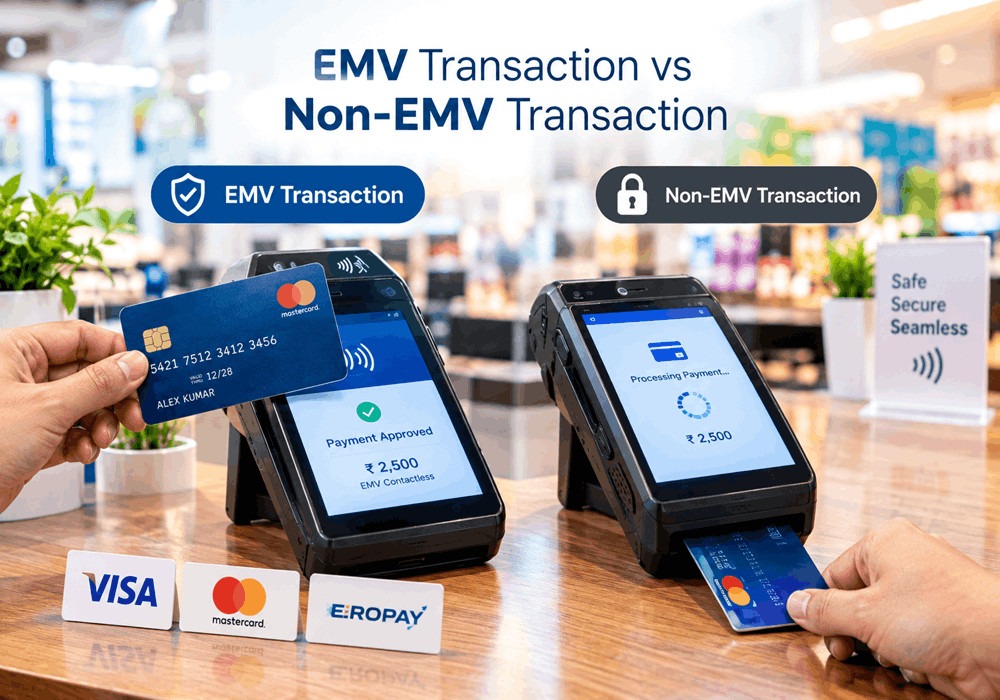
EMV in transit payments refers to the use of EMV payment technology to accept eligible contactless payment credentials in transportation environments.
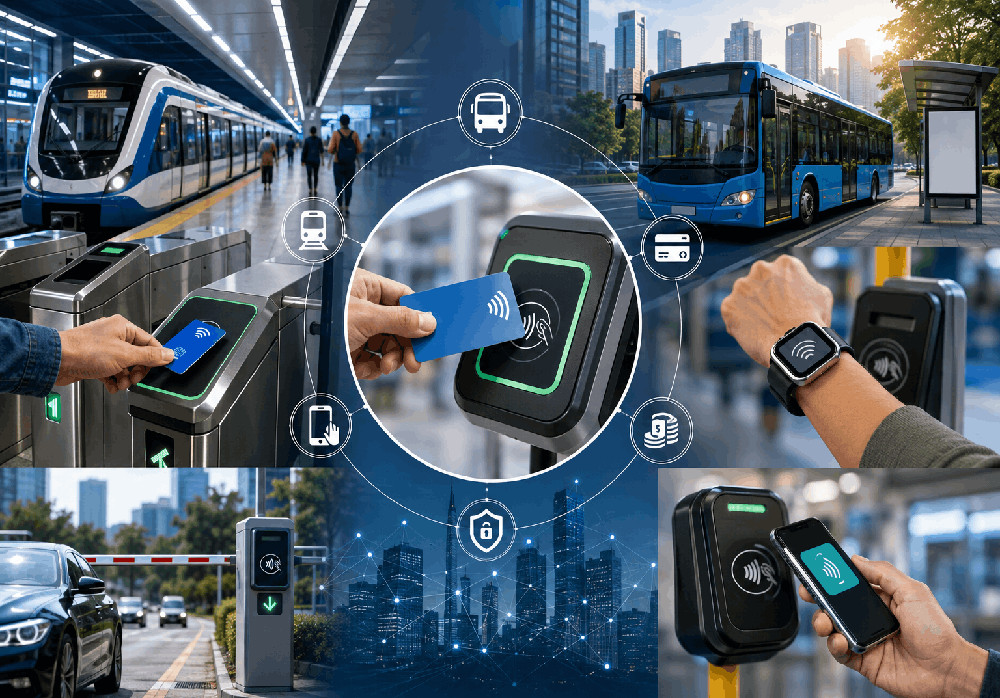
A passenger can tap a contactless card, smartphone, smartwatch, or other supported payment device on a transit validator. The validator uses payment software and an EMV contactless kernel to process the payment interaction and communicate with the wider payment and transit infrastructure.
EMVCo describes a contactless kernel as software that enables payment acceptance devices to process contactless transactions. EMVCo has also introduced its EMV Contactless Kernel Specification to support more consistent contactless acceptance.
A simplified transit payment architecture can be represented as:
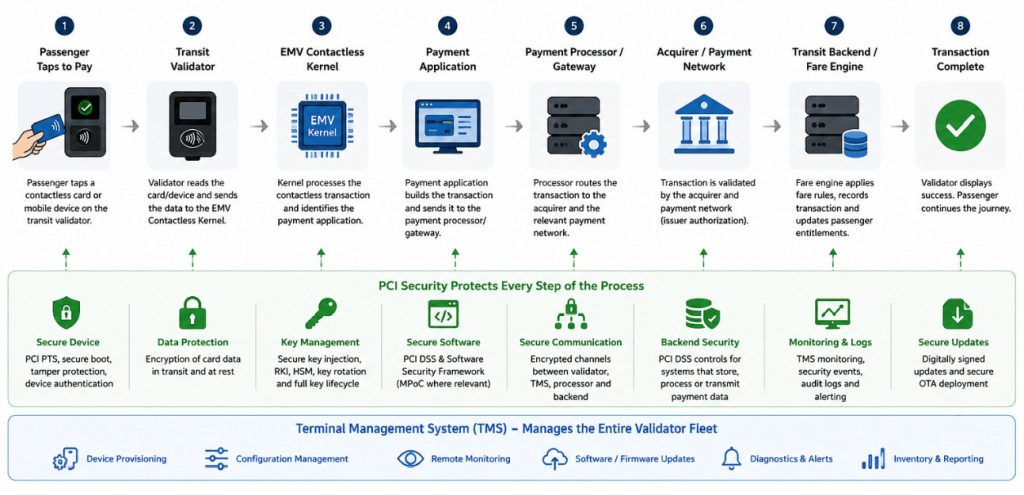
Passenger → Transit Validator → EMV Contactless Kernel → Payment Application → Payment Gateway/Processor → Acquirer/Payment Network → Transit Backend/Fare Engine → Transaction Result
The exact architecture varies according to the transit model, payment schemes, fare structure, acquiring environment, connectivity, security requirements, and country.
Why Do Transit Operators Need EMV?
Traditional transit payment systems often depend on dedicated transit cards, tickets, mobile applications, or other proprietary credentials.
EMV acceptance can provide another payment option and help create a more familiar passenger experience.
For operators, an appropriately designed EMV transit payment system can support:
- Faster passenger processing
- Contactless payment acceptance
- Convenient visitor and tourist payments
- Reduced payment friction
- Support for modern mobile payment credentials
- Integration with existing payment infrastructure
- Scalable validator deployments
- Future mobility and multimodal payment initiatives
However, EMV acceptance is not simply a hardware decision.
The kernel, payment application, validator, backend, certification, security architecture, and payment processing infrastructure must work together.
Understanding the EMV Contactless Kernel
The EMV contactless kernel is one of the most important software components inside a contactless payment acceptance device.
It provides functions required by the payment application to process contactless transactions and interact with the payment credential.
Depending on the market and project requirements, an acceptance solution may need to support payment schemes such as:
- Visa
- Mastercard
- American Express
- Discover
- JCB
- UnionPay
- RuPay
Applicable domestic or regional payment applications
EMVCo’s specifications support the development of contactless payment acceptance technology, while individual payment systems maintain their own applicable specifications and requirements.
- For transit operators, kernel selection should therefore consider:
- Payment scheme requirements
- Contactless transaction performance
- Kernel integration
- Certification requirements
- Security architecture
- Hardware compatibility
- Software lifecycle management
- Future payment requirements
- A properly integrated kernel can become the foundation for reliable contactless acceptance across a transit validator fleet.
EMV Certification in Transit Payments
Certification is a critical consideration when developing a transit payment solution.
Depending on the architecture, organizations may need to address different testing and approval requirements, including:
- EMV Certification (EMV L1, L2, L3)
- Payment scheme certification
- Acquirer testing
- Processor integration
- Application testing
- End-to-end transaction testing
The exact requirements depend on the payment device, kernel, application, payment scheme, processor, acquirer, and deployment model.
Therefore, certification should be considered before development begins, not after the product is finished.
Early certification planning can help identify architectural issues, integration gaps, and testing requirements before they become expensive deployment problems.
EMV vs PCI in Transit Payments: What Is the Difference?
One of the most important questions for transit operators is:
Is EMV the same as PCI?
EMV and PCI address different aspects of the payment ecosystem.
Aspect | EMV in Transit | PCI in Transit |
Primary Purpose | Defines how payment credentials and acceptance devices interact and how EMV transactions are processed | Defines security requirements for protecting payment data, applications, devices, keys, and payment environments |
Main Focus | Payment transaction processing and interoperability | Payment security and risk protection |
Applies To | EMV cards/devices, contactless kernels, payment applications, and compatible acceptance terminals | Payment environments, payment applications, applicable devices, infrastructure, data, and cryptographic processes |
Transit Validator | Supports EMV contactless transaction processing | Helps address applicable security requirements for the payment device and environment |
EMV Contactless Kernel | Core component for processing supported contactless payment applications | Kernel and payment software may need to operate within applicable security requirements |
Certification / Validation | May involve EMV L1, L2, L3 and payment scheme certification/testing | May involve applicable PCI standards, assessments, or device/software certifications |
Payment Schemes | Supports applicable schemes such as Visa, Mastercard, RuPay, UnionPay, JCB, Amex, etc. | Protects the payment environment supporting applicable payment transactions |
Cryptographic Keys | Uses cryptographic functions required for EMV transaction processing | Addresses applicable requirements for secure key management, protection, injection, and lifecycle |
Device Security | Defines relevant payment transaction behavior and technical requirements | Addresses applicable device security requirements, including PCI PTS where relevant |
Payment Application | Enables EMV transaction processing and integration with the kernel | Requires applicable security controls for protecting payment applications |
Data Protection | Supports secure payment transaction processing according to applicable specifications | Focuses on protecting applicable payment account data and payment environments |
SoftPOS / Android | EMV contactless technology can be integrated into supported software-based payment acceptance | PCI Software Security Frameworks, including MPoC where applicable, may be relevant |
Key Technologies | EMV Kernel, contactless interface, payment application, terminal | Encryption, HSM, key management, secure boot, secure updates, authentication, monitoring |
Transit Backend | Supports transaction processing and interaction with payment/fare infrastructure | Requires appropriate security controls for applicable systems and connections |
Offline Transactions | EMV defines applicable transaction processing mechanisms | PCI addresses security controls applicable to the implementation and data environment |
Overall Role | Enables interoperable EMV payment acceptance | Helps secure the payment ecosystem |
Simple Explanation | How the payment transaction works | How the payment environment is protected |
EMV helps define how the payment works.
PCI helps define how applicable payment environments are protected.
They are complementary, not competing technologies.
An EMV-certified implementation does not automatically mean that the complete payment environment satisfies every applicable PCI requirement.
Similarly, meeting applicable PCI requirements does not replace EMV or payment scheme certification.
PCI Security in Transit Payments
Transit payment systems can contain thousands of distributed validators, payment applications, backend systems, and communication channels.
Security therefore needs to be designed across the entire ecosystem.
Depending on the architecture and scope, transit payment projects may need to consider PCI standards and programs such as:
PCI DSS
PCI DSS provides security requirements for applicable environments that store, process, or transmit payment account data.
PCI DSS v4.0.1 is currently listed by PCI SSC as the active version in its document library.
PCI PTS
PCI PTS provides security requirements for applicable payment transaction devices.
PCI SSC currently lists the PTS POI Modular Security Requirements v7.0 in its document library.
For transit validators, operators should determine whether the specific payment acceptance device falls within the applicable PCI PTS scope.
PCI MPoC
Software-based payment acceptance introduces another layer of security considerations.
PCI MPoC (Mobile Payments on COTS) addresses applicable payment acceptance solutions using commercial off-the-shelf mobile devices. PCI SSC describes MPoC as supporting flexible mobile payment acceptance architectures and combining aspects of contactless and PIN acceptance security.
This can become particularly relevant when evaluating SoftPOS or Android-based payment acceptance for mobility use cases.
EMV and PCI Key Management in Transit
Cryptographic key management is another important component of payment security.
A large transit operator may have thousands of validators deployed across stations, buses, railway networks, or multiple cities.
A secure key-management strategy can involve:
- Secure key generation
- Secure key injection
- Remote Key Injection (RKI)
- Hardware Security Modules (HSMs)
- Key rotation
- Key replacement
- Key revocation
- Key destruction
- Secure communication
- Cryptographic lifecycle management
The objective is to protect sensitive cryptographic material throughout its lifecycle.
Transit operators should also understand how keys are managed between validators, payment systems, TMS platforms, gateways, and backend infrastructure.
How to Secure a Transit Validator
Transit validators operate in distributed environments and may be physically accessible.
A secure validator architecture should therefore consider both software and hardware security.
Important capabilities can include:
- Secure Boot: Ensures that only trusted software is loaded when the validator starts.
- Application Integrity: Helps protect payment and transit applications from unauthorized modification.
- Device Authentication: Allows backend systems to identify and authorize legitimate validators.
- Tamper Protection: Provides protection against unauthorized physical or logical access where applicable.
- Secure OTA Updates: Ensures that software and firmware updates are authenticated and protected against unauthorized modification.
- Remote Monitoring: A centralized TMS can monitor validator health, configuration, software versions, security events, and operational status.
EMV Transit Payment Process: From Tap to Transaction
Understanding the transaction flow makes the relationship between EMV and PCI easier to understand.
Step 1: Passenger Taps
The passenger presents a supported contactless card or mobile device to the transit validator.
Step 2: Validator Detects the Credential
The validator establishes communication with the payment credential.
Step 3: EMV Kernel Processes the Contactless Interaction
The EMV contactless kernel performs the relevant transaction processing functions.
Step 4: Payment Application Manages the Transaction
The payment application applies the required transaction logic and communicates with the payment infrastructure.
Step 5: Payment Gateway or Processor Receives the Transaction
The transaction is routed through the appropriate payment infrastructure.
Step 6: Acquirer and Payment Network Process the Transaction
The relevant payment participants handle authorization and processing according to the applicable architecture.
Step 7: Transit Backend Applies Fare Logic
The transit backend or fare engine applies the relevant fare rules, journey information, caps, transfers, or other business rules.
Step 8: Transaction Result
The validator receives the appropriate response and provides the passenger with the relevant transaction or travel outcome.
At the same time, security controls operate across the ecosystem, including authentication, encryption, key management, device security, application protection, monitoring, and applicable PCI controls.
Transit Validator Performance Is Critical
A transit validator is not simply a conventional retail POS terminal placed at a station.
Passengers expect transactions to happen within seconds.
A transit validator should therefore be evaluated for:
- Fast contactless processing
- High transaction throughput
- Reliable card/device detection
- High availability
- Connectivity resilience
- Applicable offline transaction capability
- Secure software
- Remote diagnostics
- OTA management
- Long-term operational reliability
Performance becomes particularly important at high-volume metro stations, railway platforms, bus boarding points, and other locations where passenger throughput directly affects operational efficiency.
SoftPOS and Android in Transit Payments
The evolution of Android-based payment devices and SoftPOS is creating new opportunities for mobility payment applications.
Depending on the use case, software-based acceptance may be considered for:
- Mobile validators
- Portable inspection devices
- Transport staff devices
- Ticketing applications
- Temporary payment acceptance
- Flexible mobility services
However, SoftPOS introduces additional security considerations.
- Organizations should evaluate:
- Device security
- Operating system security
- Application integrity
- Secure communication
- Payment data protection
- Device authentication
- Secure updates
- Remote device management
- Applicable PCI requirements
Where the implementation falls within the applicable scope, PCI MPoC may need to be considered. PCI SSC continues to evolve its MPoC program for mobile payment acceptance solutions.
TMS for Transit Payment Infrastructure
Managing one validator is different from managing thousands.
A Terminal Management System (TMS) can provide centralized control over a distributed payment device fleet.
Typical TMS capabilities include:
- Device provisioning
- Device activation
- Configuration management
- Application deployment
- Firmware updates
- OTA updates
- Remote commands
- Device monitoring
- Diagnostics
- Security monitoring
- Inventory management
- Reporting
For large transit networks, TMS integration can improve operational visibility and simplify device lifecycle management.
Designing for India and Global Transit Markets
Transit payment requirements vary by geography.
In India, projects may involve local payment and transit ecosystems such as RuPay and NCMC, depending on the specific implementation.
International deployments across the UAE, Southeast Asia, Africa, Europe, and other markets can involve different payment schemes, acquiring environments, certification requirements, security expectations, and transit architectures.
Therefore, a transit payment solution should be designed around the target market from the beginning.
For example, an operator planning an NCMC deployment in India may have different requirements from an operator implementing an EMV open-loop transit system in the UAE or Southeast Asia.
A technology partner with experience across payment ecosystems can help organizations plan for these regional differences.
What Should Transit Operators Look for in an EMV & PCI Technology Partner?
Before selecting a technology provider, transit operators should evaluate more than hardware specifications.
Ask potential technology partners:
Do you provide EMV contactless kernel development?
Which payment schemes can your solution support?
- Can you support EMV certification?
- Can you integrate the kernel with existing validators?
- What PCI security requirements apply to the proposed architecture?
- How are cryptographic keys managed?
- Do you support RKI and HSM integration?
- How is validator security implemented?
- Does the solution support secure OTA updates?
- Can it integrate with the existing fare engine?
Does it support TMS?
- Can it scale across thousands of validators?
- Can it support Android or SoftPOS use cases?
- Can it support NCMC/RuPay requirements where applicable?
- Do you provide integration and certification support?
The answers can help distinguish between a basic payment hardware provider and a complete payment technology partner.
How EazyPay Tech Supports EMV & PCI Transit Payment Solutions
At EazyPay Tech, we help organizations build and integrate payment technologies for modern transit and mobility environments.
Our expertise covers multiple layers of the payment ecosystem, including:
- EMV Contactless Kernel Development
- EMV Certification ( Level 1, Level 2 & Level 3 ) Support
- EMV Kernel Integration
- Transit Validator Software
- NCMC & RuPay Kernel Solutions
- Payment Application Development
- Payment Gateway and Backend Integration
- Android POS & SoftPOS Solutions
- Terminal Management Systems
- Payment Security Integration
- Testing and Certification Support
We work with transit operators, OEMs, terminal manufacturers, banks, acquirers, payment service providers, fintech companies, mobility technology providers, and system integrators.
Our approach is focused on helping organizations move from payment architecture and technology selection through development, integration, testing, certification, and deployment.
Whether you are building a new transit validator, integrating an EMV kernel, preparing for certification, implementing NCMC/RuPay, or evaluating Android and SoftPOS-based payment acceptance, EazyPay Tech can support your technology requirements.
The Future of EMV & PCI in Transit Payments
The future of transit payments will not be defined by a single technology.
Instead, successful mobility ecosystems will combine:
EMV + PCI Security + Secure Devices + Payment Applications + Transit Validators + Fare Engines + TMS + Backend Integration + Data Security
- EMV provides the foundation for interoperable payment transaction processing.
- PCI provides an important framework for applicable payment security requirements.
- TMS provides operational control.
- The transit backend manages fare and journey logic.
- And the validator connects the passenger experience to the payment ecosystem.
For operators, the real challenge is bringing all these components together without compromising speed, security, passenger experience, scalability, or certification readiness.
Build Your Secure EMV Transit Payment Infrastructure with EazyPay Tech
Are you developing a new EMV transit validator, upgrading an existing payment system, integrating an EMV contactless kernel, implementing NCMC/RuPay, evaluating SoftPOS, or preparing for payment certification?
EazyPay Tech can help you evaluate the technology architecture and build the payment components required for your project.
Talk to Our EMV & Transit Payment Experts
Get support for:
EMV Kernel | EMV Certification | PCI Security | Transit Validator | NCMC/RuPay | SoftPOS | Payment Application | TMS | Payment Integration
→ Contact EazyPay Tech to discuss your EMV & PCI transit payment requirements.