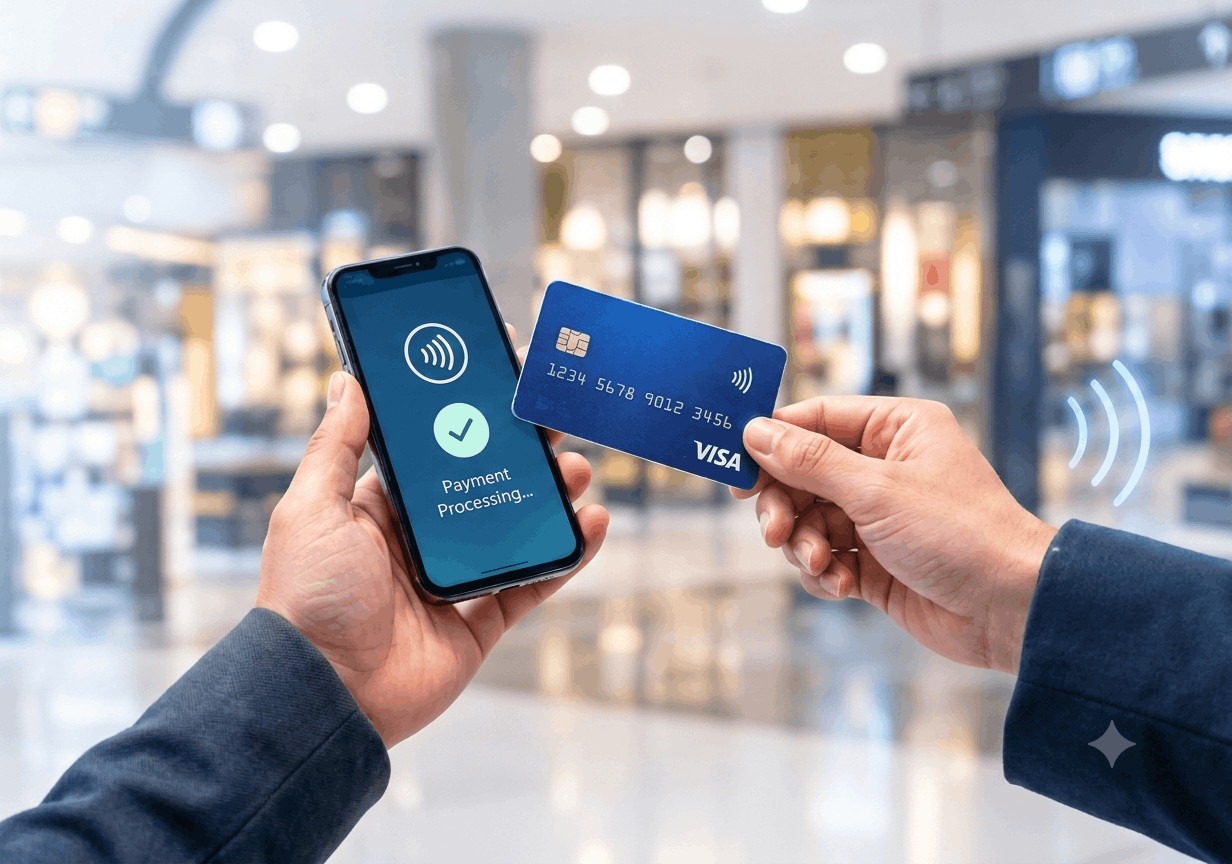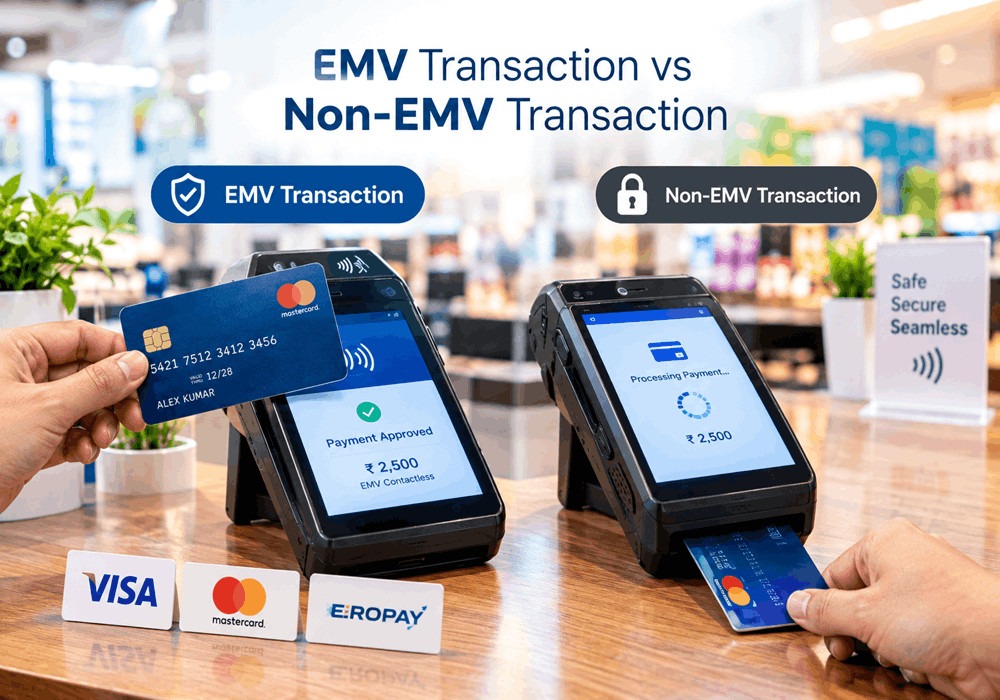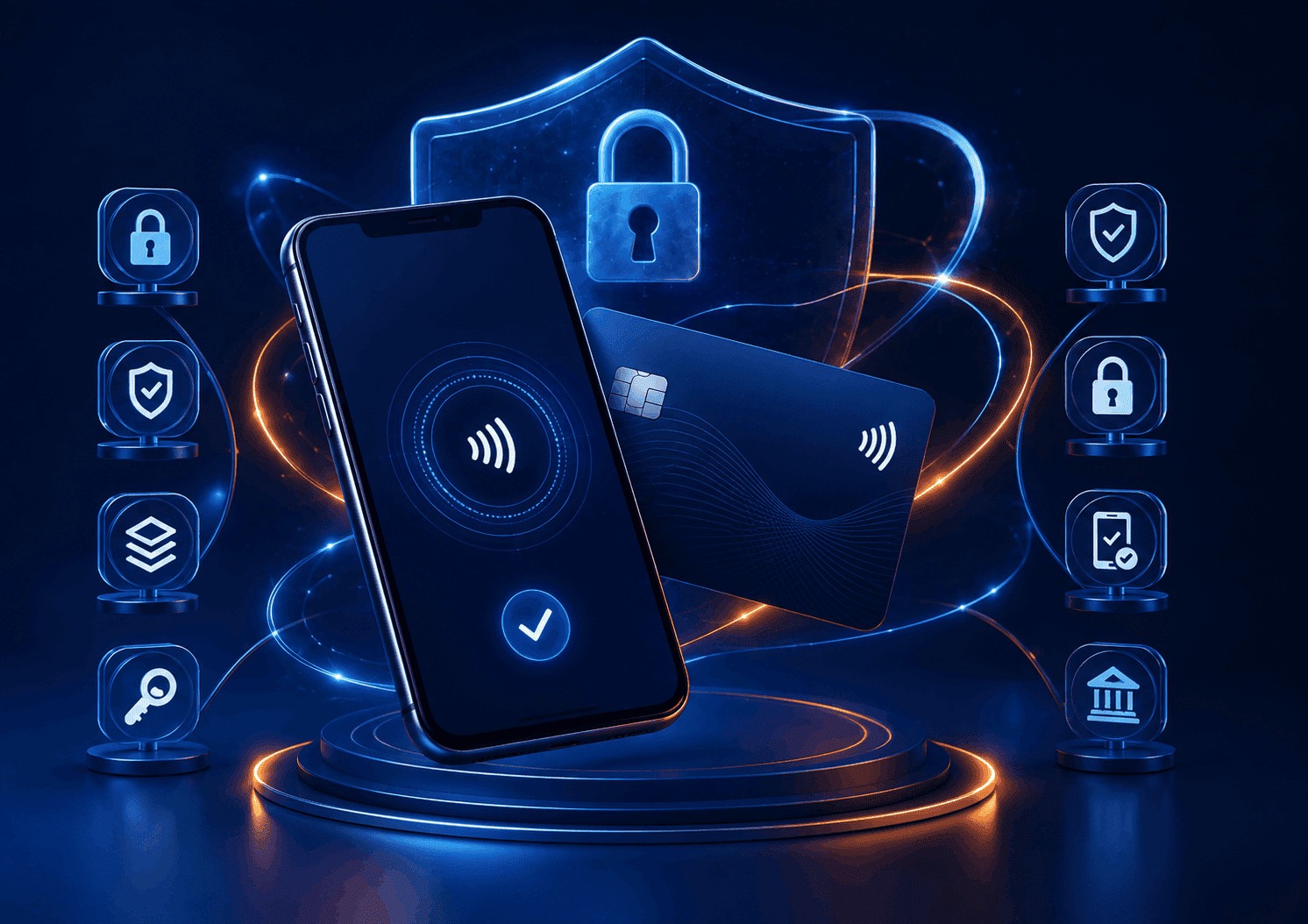
SoftPOS, short for Software Point of Sale, is transforming the way businesses accept contactless payments. Instead of depending on a dedicated POS terminal, SoftPOS technology allows an NFC-enabled smartphone or tablet to function as a contactless payment acceptance device.
For banks, fintech companies, payment service providers, acquirers, and merchants, this model can reduce hardware dependency, simplify deployment, support faster merchant onboarding, and make payment acceptance available through existing mobile devices.
However, SoftPOS also changes the security model of payment acceptance.
A traditional POS terminal is specifically designed for payment processing and normally operates within a controlled hardware and software environment. A smartphone is a general-purpose device that can run multiple applications, connect to public networks, receive operating-system updates, and potentially be exposed to malware, rooting, debugging, or unauthorized modification.
Therefore, SoftPOS security cannot be limited to protecting the mobile application.
A secure SoftPOS solution must protect the complete payment ecosystem:
Mobile Device → SoftPOS Application → NFC → EMV Kernel → Cryptography → API → Backend → Acquirer/Processor
This is why banks and fintechs need a structured SoftPOS security checklist before developing, integrating, certifying, or deploying a mobile payment acceptance solution.
What Is SoftPOS Security?
SoftPOS security is the combination of technologies, security controls, compliance requirements, and operational processes used to protect payment transactions when a commercially available mobile device is used as a payment acceptance terminal.
A typical SoftPOS ecosystem can contain:
- NFC-enabled Android smartphone or tablet
- SoftPOS application
- SoftPOS SDK
- EMV contactless kernel
- Payment processing components
- Cryptographic keys
- Backend APIs
- Payment gateway or processor
- Acquirer infrastructure
- Merchant management system
- Terminal Management System (TMS)
- Security monitoring platform
Each component introduces potential security risks.
For example, a compromised mobile device can affect application integrity, while an insecure API can expose backend services. Weak key management can expose cryptographic material, and poor device lifecycle management can leave outdated or compromised applications running in production.
A strong SoftPOS architecture therefore follows a defense-in-depth security model.
Instead of relying on one security mechanism, multiple independent controls work together to protect the payment environment.
Why Is SoftPOS Security Different From Traditional POS Security?
The most important difference between traditional POS and SoftPOS is the underlying device environment.
Traditional payment terminals are purpose-built devices. SoftPOS operates on Commercial Off-The-Shelf (COTS) mobile devices.
Security Area | Traditional POS | SoftPOS |
Hardware | Dedicated payment terminal | Commercial smartphone/tablet |
Operating System | Controlled environment | General-purpose mobile OS |
Applications | Limited | Multiple applications |
Connectivity | Controlled terminal environment | Wi-Fi/mobile/public networks |
Updates | Controlled terminal updates | OS + application updates |
Device Management | Physical/centralized | Primarily remote |
Attack Surface | Relatively controlled | Broader mobile attack surface |
Security Model | Hardware-centric | Device + application + cloud-centric |
SoftPOS is not automatically insecure because it uses a smartphone. Instead, it requires a security architecture designed specifically for the risks associated with mobile payment acceptance.
SoftPOS Security Checklist for Banks and Fintechs
Evaluate PCI MPoC Requirements
One of the first areas organizations should evaluate is the PCI Mobile Payments on COTS (MPoC) security framework.
PCI MPoC is relevant to payment acceptance solutions that operate on commercially available mobile devices.
Banks and fintechs should determine the applicable security and validation requirements for their specific SoftPOS architecture.
The assessment should consider:
- COTS device security
- Payment application security
- Account data protection
- Software integrity
- Cryptographic controls
- Application monitoring
- Backend infrastructure
- Device management
- Operational security
- Certification requirements
Why should PCI MPoC be considered early?
A common mistake is to build the complete SoftPOS product first and think about compliance later.
Security and compliance requirements can influence application architecture, data flows, cryptographic design, device controls, and operational processes.
Therefore, PCI and security requirements should be considered during the planning and architecture phase, not only before certification.
Secure the Mobile Device
The mobile device is one of the most important components of a SoftPOS environment.
If an attacker gains privileged access to the smartphone, application-level security may be weakened.
Banks and fintechs should establish a device security policy covering:
- Root detection
- Jailbreak detection where applicable
- Secure boot verification
- Bootloader status
- Debugging detection
- Emulator detection
- OS version validation
- Device integrity
- Hardware capability
- Security patch level
A SoftPOS application should be able to determine whether the device meets the organization’s security policy before allowing payment acceptance.
For example, if the device is rooted or running an unsupported operating-system configuration, the application may need to restrict or suspend payment functionality depending on the defined risk model.
Protect the SoftPOS Application
The SoftPOS application is a critical security boundary because it handles payment-related processes.
Attackers may attempt to reverse engineer the application, modify its code, hook runtime functions, extract credentials, or bypass security mechanisms.
A secure SoftPOS application should consider multiple layers of protection, including:
- Code obfuscation
- Anti-tampering
- Anti-debugging
- Runtime protection
- Application integrity verification
- Secure storage
- Certificate validation
- Strong authentication
- Secure error handling
- Controlled logging
The objective is to make unauthorized modification or manipulation significantly more difficult and to detect potentially compromised application environments.
Application security should also be reviewed whenever major application versions or third-party dependencies are introduced.
Secure NFC Contactless Payment Processing
NFC is the communication technology that allows a contactless card or payment device to interact with the SoftPOS device.
The NFC layer therefore becomes an important part of the payment security architecture.
Organizations should consider:
- Secure NFC transaction handling
- Controlled access to payment data
- EMV transaction processing
- Transaction integrity
- Contactless transaction validation
- Protection against unauthorized transaction manipulation
- Secure transaction lifecycle management
The SoftPOS application should process contactless transactions through a properly designed payment architecture rather than treating NFC simply as a generic communication interface.
Use a Secure EMV Contactless Kernel
A SoftPOS solution is much more than an application that reads NFC information.
The EMV contactless kernel performs important transaction-processing functions required for contactless card payments.
Depending on the implementation, the payment kernel may handle processes related to:
- Application selection
- Processing restrictions
- Cardholder verification
- Terminal risk management
- Card and application authentication
- Cryptographic processing
- Transaction decision logic
Banks and fintechs should therefore carefully evaluate the EMV kernel before selecting a SoftPOS technology provider.
They should also establish the applicable EMV Level 2, Level 3, payment-network, and acquirer certification requirements for the project.
A mature EMV kernel and experienced certification partner can help reduce integration problems and accelerate the path toward production.
Implement Strong Encryption and Cryptography
Cryptography is fundamental to payment security.
Sensitive payment information should be protected throughout its lifecycle, from processing through secure transmission and, where applicable, storage.
Organizations should define clear policies for:
- Encryption algorithms
- Cryptographic key generation
- Key storage
- Key provisioning
- Key rotation
- Key revocation
- Certificate management
- Key destruction
- Secure random number generation
A key principle is to avoid unnecessary exposure of sensitive cryptographic information.
Cryptographic material should be protected using appropriate secure storage and platform security capabilities.
Strengthen Payment Key Management
Payment encryption keys require specialized lifecycle management.
Banks and fintechs should clearly answer:
- Who generates the keys?
- How are keys provisioned?
- Where are keys stored?
- Who can access them?
- When are keys rotated?
- How are compromised keys revoked?
- How are expired keys destroyed?
For large-scale SoftPOS deployments, automated and secure key-management processes can reduce manual operations and minimize the possibility of key exposure.
Remote key provisioning and centralized lifecycle management can become particularly important when an organization operates thousands or millions of devices.
Secure SoftPOS APIs and Communication
SoftPOS applications normally communicate with backend services for authentication, provisioning, merchant configuration, transaction processing, device management, and risk controls.
This communication must be secured.
Recommended controls include:
- TLS
- Strong certificate validation
- API authentication
- API authorization
- Token security
- Request validation
- Replay protection
- Rate limiting
- API gateway controls
- Server-side transaction validation
It is important to remember that HTTPS alone does not make an API secure.
Transport encryption protects communication, but the backend must still verify the identity, authorization, integrity, and validity of every request.
Secure the SoftPOS Backend
The backend is responsible for critical services and should be treated as a major security boundary.
Potential threats include:
- Unauthorized API access
- Credential theft
- Privilege escalation
- Injection attacks
- Data leakage
- Cloud misconfiguration
- Insecure secrets
- API abuse
- Denial-of-service attacks
A secure backend architecture should include:
- Identity and access management
- Least-privilege access
- Secure database configuration
- Secrets management
- API security
- Network security
- Vulnerability management
- Penetration testing
- Security logging
- Continuous monitoring
The backend and mobile application should be designed as one security ecosystem rather than as separate products.
Implement Strong Authentication and Authorization
A SoftPOS environment can contain multiple identities:
- Merchant
- Employee
- Device
- Application
- Administrator
- API client
- Backend service
Each identity should have clearly defined privileges.
Authentication answers:
“Who are you?”
Authorization answers:
“What are you allowed to do?”
Organizations should implement:
- Strong authentication
- Role-based access control
- Least-privilege permissions
- Session management
- Multi-factor authentication for privileged accounts
- Token expiration
- Credential rotation
This reduces the risk of unauthorized access to payment and device-management functions.
Use a Secure Terminal Management System
A bank or fintech may eventually manage thousands of SoftPOS devices.
Manually managing these devices is inefficient and increases operational risk.
A Terminal Management System (TMS) provides centralized control over the SoftPOS lifecycle.
A secure TMS can support:
- Device registration
- Device activation
- Merchant-device mapping
- Application provisioning
- Configuration management
- Application version management
- Secure OTA updates
- Device health monitoring
- Remote commands
- Security-policy enforcement
- Device suspension
A TMS is particularly valuable when an organization needs to quickly respond to security vulnerabilities or deploy updates across a large device population.
Secure OTA Software Updates
SoftPOS applications require regular updates for:
- Security patches
- Bug fixes
- New payment features
- EMV changes
- Payment-network updates
- OS compatibility
- Compliance requirements
However, the software-update mechanism itself must be secured.
A secure OTA architecture should use:
- Digitally signed software packages
- Package integrity verification
- Secure download channels
- Version validation
- Rollback protection
- Controlled deployment
- Update audit trails
Only authorized software should be allowed to execute in the production payment environment.
Minimize Sensitive Payment Data Exposure
One of the most effective security principles is:
Collect less. Store less. Expose less.
Banks and fintechs should identify exactly what payment and customer information is collected and determine whether each data element is necessary.
Security teams should understand:
- What data is processed
- What data is stored
- Where it is stored
- Who can access it
- How long it is retained
- When it is deleted
- Whether tokenization can reduce exposure
Sensitive information should not unnecessarily appear in:
- Application logs
- Debug files
- Crash reports
- Analytics platforms
- Screenshots
- Error messages
Data minimization reduces both security exposure and operational complexity.
Implement Secure Logging and Audit Trails
Security monitoring depends on reliable logs.
A SoftPOS platform should consider logging important security and lifecycle events such as:
- Device registration
- Device activation
- Device suspension
- Authentication failures
- Application integrity failures
- Root detection
- Configuration changes
- OTA updates
- Key-management events
- API failures
- Suspicious transaction activity
Logs should be protected against unauthorized modification.
At the same time, organizations must ensure that logs do not unnecessarily contain sensitive payment information.
Monitor SoftPOS Security in Real Time
Security does not end after a device is successfully deployed.
Continuous monitoring should correlate information across:
Device + Application + Merchant + Transaction + API + Backend
Security teams can monitor for indicators such as:
- Repeated authentication failures
- Unexpected device changes
- Abnormal transaction behavior
- Application integrity failures
- Outdated application versions
- Unusual API requests
- Suspicious device activity
Depending on the organization’s risk architecture, these events can trigger automated actions such as additional verification, alert generation, device suspension, or security investigation.
Secure the Merchant Environment
The merchant is another important component of the SoftPOS security model.
A SoftPOS device may be used by multiple employees or may be physically accessible to customers and other individuals.
Banks and fintechs should define:
- Merchant authentication
- Device assignment
- Employee roles
- Session timeout
- Access control
- Lost-device procedures
- Device replacement procedures
- Merchant suspension
- Employee offboarding
If a device is lost or stolen, payment acceptance should be capable of being suspended remotely according to the organization’s operational and security policy.
Secure the Software Development Lifecycle
Security should be built into the product development lifecycle.
A secure SoftPOS SDLC should include:
Planning
Identify payment security requirements and conduct threat modeling.
Architecture
Define trust boundaries, data flows, cryptographic requirements, and security controls.
Development
Use secure coding practices and carefully manage third-party dependencies.
Testing
Perform application security testing, vulnerability assessments, penetration testing, and payment transaction testing.
Certification
Complete applicable EMV, payment-network, PCI, and acquirer certification activities.
Deployment
Use controlled release processes and approved production configurations.
Operations
Monitor vulnerabilities, security events, devices, applications, and infrastructure continuously.
This approach ensures security remains part of the product lifecycle instead of becoming a final-stage checklist.
Assess Third-Party SDKs and Dependencies
Many SoftPOS solutions depend on third-party libraries, SDKs, cloud services, and payment components.
These dependencies should be assessed before integration.
Organizations should review:
- Known vulnerabilities
- Security update history
- Maintenance status
- Permissions
- Data access
- Software integrity
- Dependency versions
- Licensing requirements
Software Composition Analysis can help identify vulnerable third-party components before they become production risks.
Conduct Regular Security Testing
Security testing should occur before deployment and continue throughout the SoftPOS lifecycle.
Mobile application testing
Test for:
- Reverse engineering
- Tampering
- Runtime manipulation
- Authentication bypass
- Insecure storage
API testing
Evaluate:
- Authentication
- Authorization
- Token handling
- Input validation
- Rate limiting
- Replay protection
Backend testing
Review:
- Vulnerability exposure
- Access controls
- Cloud configuration
- Database security
- Secrets management
Device testing
Evaluate:
- Root detection
- Debugging
- Emulator detection
- OS compatibility
- Device integrity
Payment testing
Validate:
- EMV transaction processing
- Contactless transaction behavior
- Cryptographic processing
- Payment-network requirements
- Certification requirements
Establish Incident Response and Remote Device Revocation
No security architecture should assume that incidents will never occur.
A SoftPOS incident-response plan should define how the organization will:
- Detect suspicious activity
- Identify affected devices
- Isolate compromised devices
- Revoke credentials
- Rotate or revoke cryptographic keys
- Investigate transactions
- Deploy security patches
- Restore services
- Document the incident
- Conduct post-incident analysis
Remote device suspension and centralized device management are especially important when the SoftPOS platform is deployed at scale.
Maintain Continuous Compliance After Certification
One of the most important SoftPOS security principles is:
Certification is not the end of security.
A production SoftPOS environment changes continuously.
For example, an organization may update:
- Android versions
- Mobile device models
- SoftPOS applications
- EMV kernels
- Cryptographic libraries
- APIs
- Cloud infrastructure
- Backend services
Any significant change can introduce new security or compliance considerations.
Therefore, organizations should establish a continuous compliance and security-monitoring program after deployment.
Complete SoftPOS Security Checklist
Use this checklist when evaluating a SoftPOS solution.
Device Security
- Root detection implemented
- Jailbreak detection considered where applicable
- Secure boot status evaluated
- Bootloader integrity evaluated
- Debugging detection implemented
- Emulator detection implemented
- Supported OS versions defined
- Security patch levels monitored
- Device integrity continuously evaluated
Application Security
- Code obfuscation implemented
- Anti-tampering controls implemented
- Anti-debugging controls implemented
- Runtime protection implemented
- Application integrity validated
- Secure storage implemented
- Sensitive data exposure minimized
- Third-party dependencies assessed
EMV and Payment Security
- EMV contactless kernel selected
- NFC processing secured
- EMV certification scope identified
- Payment-network requirements identified
- Acquirer requirements identified
- Transaction integrity controls implemented
- Payment testing completed
Cryptography and Key Management
- Encryption requirements defined
- Keys securely generated
- Keys securely provisioned
- Keys securely stored
- Key rotation process established
- Key revocation process established
- Key destruction process established
- Certificate lifecycle managed
API and Backend Security
- TLS enabled
- Certificate validation implemented
- API authentication implemented
- API authorization implemented
- Replay protection implemented
- Rate limiting implemented
- Backend access controls implemented
- Secrets securely managed
- Database security reviewed
- Cloud configuration reviewed
TMS and Device Lifecycle
- Secure device registration
- Device activation
- Merchant-device mapping
- Secure OTA updates
- Signed software packages
- Application version control
- Remote device suspension
- Device health monitoring
- Security-policy enforcement
Monitoring and Compliance
- Security event monitoring
- Device monitoring
- Authentication monitoring
- API monitoring
- Transaction-risk monitoring
- Audit logging
- Incident-response plan
- Applicable PCI requirements assessed
- EMV certification roadmap established
- Continuous compliance program implemented
SoftPOS Security Architecture: A Layered Approach
A secure SoftPOS architecture can be understood as multiple security layers working together.
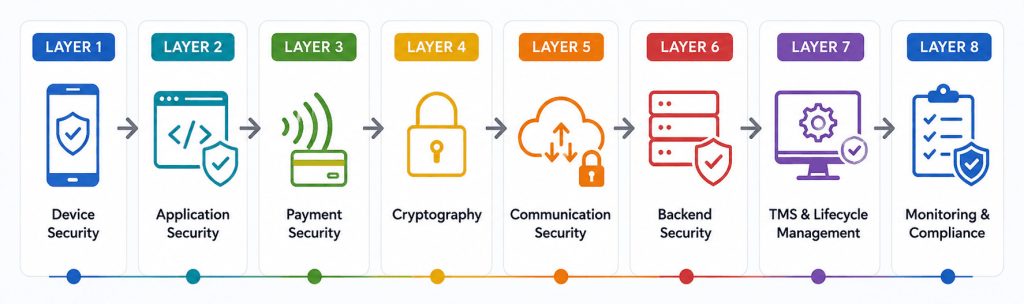
- Layer 1: Device Security: The device layer verifies the integrity of the smartphone, operating system, boot environment, and security configuration.
- Layer 2: Application Security: The application layer protects the SoftPOS software against reverse engineering, tampering, debugging, and unauthorized modification.
- Layer 3: Payment Security: The payment layer manages NFC communication, EMV contactless processing, transaction logic, and payment-specific security controls.
- Layer 4: Cryptography: The cryptographic layer protects payment information and manages sensitive encryption keys.
- Layer 5: Communication Security: The communication layer protects APIs and data exchanged between the mobile application and backend infrastructure.
- Layer 6: Backend Security: The backend layer protects payment processing systems, databases, APIs, cloud infrastructure, and administrative services.
- Layer 7: TMS and Lifecycle Management: The TMS layer manages device provisioning, application versions, configuration, OTA updates, health monitoring, and remote suspension.
- Layer 8: Monitoring and Compliance: The final layer provides continuous security monitoring, audit trails, incident response, certification management, and compliance oversight.
- This defense-in-depth model helps ensure that the compromise of one security layer does not automatically compromise the entire payment ecosystem.
Common SoftPOS Security Mistakes
- Mistake 1: Treating SoftPOS Like a Normal Mobile Application- A SoftPOS application operates in a payment environment and therefore requires specialized security controls beyond typical mobile application security.
- Considering Compliance Only at the End- Certification requirements can influence architecture. Delaying compliance analysis can result in costly redesigns.
- Ignoring Device Integrity- A compromised smartphone can undermine application security.
- Using Weak Key Management- Payment encryption keys require dedicated lifecycle controls and protection.
- Securing the Mobile App but Ignoring the Backend- The mobile application, APIs, backend, and device-management infrastructure must be secured together.
- Relying on Manual Device Management- Large deployments require centralized provisioning, monitoring, updates, and remote suspension.
- Stopping Security Monitoring After Certification- Threats continue to evolve after certification. Security must therefore be continuously monitored.
How Should Banks and Fintechs Evaluate a SoftPOS Provider?
Before selecting a SoftPOS SDK, platform, or technology partner, decision-makers should evaluate the following areas.
Security Architecture
Ask:
- How is device integrity checked?
- How is application tampering detected?
- How are sensitive keys protected?
- How is secure storage implemented?
EMV and Payment Support
Ask:
- Which EMV contactless kernels are supported?
- Which payment schemes are supported?
- What EMV certification support is available?
- Can the provider support EMV L2 and L3 integration?
Compliance
Ask:
- How does the solution address applicable PCI MPoC requirements?
- What security documentation is available?
- What testing has already been performed?
- What certification support is provided?
Device Management
Ask:
- Is a TMS available?
- Can devices be remotely activated and suspended?
- How are OTA updates secured?
- Can device health be monitored centrally?
Integration
Ask:
- Is a SoftPOS SDK available?
- What APIs and integration options are provided?
- Can the SDK integrate with an existing banking or fintech application?
- What technical and certification support is available?
Why Banks and Fintechs Need Specialized SoftPOS Expertise
SoftPOS combines several highly specialized technologies:
Android + NFC + EMV + Cryptography + PCI + Payment Networks + APIs + Cloud + TMS + Security + Certification
This makes SoftPOS considerably more complex than developing a conventional Android application.
An experienced payment technology partner can help organizations address the technical and certification requirements earlier in the product lifecycle.
The right expertise can help reduce:
- Development complexity
- Integration challenges
- Certification risks
- Security gaps
- Time-to-market
- Operational issues
SoftPOS represents an important evolution in payment acceptance, but turning a smartphone into a payment terminal requires much more than NFC functionality.
A secure SoftPOS ecosystem must protect every stage of the payment lifecycle:
Device → Application → NFC → EMV Kernel → Cryptography → Key Management → API → Backend → TMS → Monitoring → Compliance
For banks and fintechs, the strongest approach is to treat security as a continuous lifecycle rather than a one-time certification activity.
Before launching a SoftPOS program, organizations should validate the device security model, application architecture, EMV kernel, cryptographic design, key-management processes, backend infrastructure, TMS, monitoring capabilities, certification roadmap, and incident-response procedures.
The result should not simply be a smartphone that accepts contactless payments.
It should be a secure, scalable, manageable, certifiable, and production-ready payment acceptance ecosystem.
Build Your Secure SoftPOS Solution With EazyPayTech
Whether you are a bank, fintech, PSP, acquirer, OEM, payment processor, or technology provider, EazyPayTech can support your SoftPOS journey across technology, integration, EMV, and certification.
From SoftPOS SDK and Android Tap to Pay to EMV Contactless Kernel, EMV L1/L2/L3 certification, payment applications, TMS, NFC acceptance, and NCMC transit solutions, EazyPay Tech provides payment technology expertise for next-generation digital acceptance.
Planning a SoftPOS project?
Connect with EazyPay Tech to discuss your SoftPOS architecture, SDK integration, EMV certification, payment security, and deployment requirements.
EazyPay Tech Building Secure Payment Technology for the Next Generation of Digital Acceptance.