
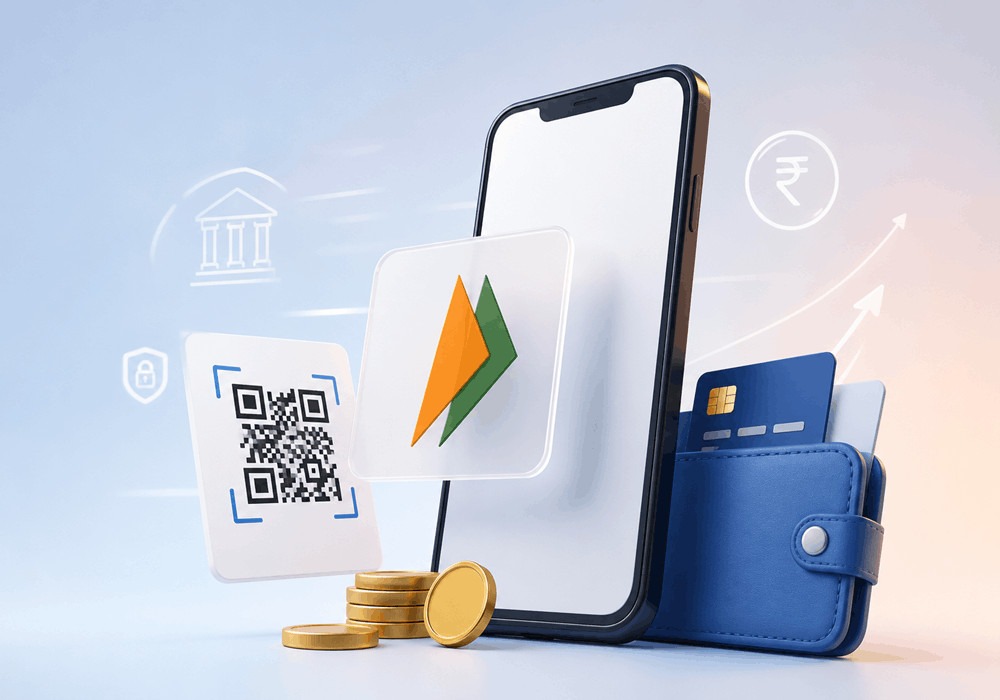
India’s digital payment ecosystem has transformed dramatically over the last decade, and Unified Payments Interface (UPI) has become one of its most important payment rails.
At the consumer level, people often associate UPI with mobile payment applications. However, UPI is much more than an app. It is an interoperable payment infrastructure that enables customers to transfer money directly between bank accounts using mobile devices.
BHIM (Bharat Interface for Money) is one of the applications built to enable users to make payments through the UPI ecosystem. Understanding the relationship between UPI and BHIM is important for banks, fintech companies, merchants, payment service providers, and businesses building digital payment solutions.
For merchants, UPI also connects directly with technologies such as UPI QR codes, QR-based payment acceptance, payment notification systems, and payment soundboxes.
This article explains UPI and BHIM from a fintech perspective, including how they work, their differences, security considerations, and their importance for India’s evolving payment infrastructure.
What Is UPI?
Unified Payments Interface (UPI) is an instant payment system that enables users to transfer money between participating bank accounts through a mobile device.
Instead of requiring customers to enter complete bank account details for every transaction, UPI allows payments using identifiers such as:
- UPI ID
- Mobile number
- UPI QR code
- Account-linked payment credentials
- Other supported payment identifiers
The underlying concept is interoperability.
A customer can use one UPI-enabled application to make a payment to a merchant or another user using a compatible UPI address, even when the sender and receiver use different participating banks or applications.
Why Is UPI Important?
Traditional electronic bank transfers often require users to know account numbers, IFSC codes, or other banking information. UPI simplifies the payment experience by combining:
Bank Account + Mobile Interface + Payment Address + Instant Transaction
This has made digital payments easier for consumers and businesses.
For merchants, UPI provides a relatively simple way to accept digital payments without requiring customers to carry cash or use physical cards.
What Is BHIM?
BHIM, or Bharat Interface for Money, is a UPI-based mobile payment application introduced to facilitate digital payments directly through bank accounts.
BHIM allows users to:
- Send money
- Receive money
- Scan and pay using QR codes
- Make UPI transactions
- Use UPI identifiers for payments
- Check transaction-related information
One of the important distinctions is that BHIM is an application, while UPI is the underlying payment infrastructure.
This distinction is critical when discussing India’s payment ecosystem.
Think of it this way:
UPI = Payment infrastructure
BHIM = UPI-enabled payment application
Other UPI applications can also connect to the UPI ecosystem, depending on their participation and integration arrangements.
UPI vs BHIM: What Is the Difference?
A common question is:
Is UPI and BHIM the same?
No.
UPI and BHIM are related but not the same.
| Feature | UPI | BHIM |
| Type | Payment infrastructure | Mobile payment application |
| Full Form | Unified Payments Interface | Bharat Interface for Money |
| Purpose | Enables interoperable bank-account payments | Provides a user interface for UPI payments |
| QR Payments | Supports QR-based payments | Supports QR-based payments |
| Bank Account Based | Yes | Yes |
| Developed/Introduced | NPCI payment ecosystem | NPCI |
| Can work with other UPI apps? | Yes | BHIM is one UPI application |
The easiest way to understand the relationship is:
UPI provides the rails; applications such as BHIM provide the user interface.
How Does a UPI Payment Work?
Although a UPI transaction may appear simple to the customer, multiple components can participate in the transaction flow.
A simplified payment journey looks like this:
Customer → UPI App → PSP/Bank Infrastructure → UPI Network → Beneficiary Bank → Merchant/Receiver
For example, consider a customer purchasing a product from a retail store.
Step 1: Merchant Displays a UPI QR Code
The merchant displays a QR code at the checkout counter.
The QR may contain information required to initiate a UPI payment.
Step 2: Customer Scans the QR
The customer opens a UPI-enabled application and scans the merchant’s QR code.
Step 3: Payment Details Are Displayed
The customer enters or confirms the payment amount and verifies the recipient.
Step 4: Customer Authorizes the Transaction
The customer authenticates the transaction using the appropriate UPI authorization mechanism.
Step 5: Transaction Is Processed
The payment request travels through the participating payment infrastructure and banking systems.
Step 6: Merchant Receives Confirmation
Once the transaction is successfully processed, the merchant receives confirmation.
This final step is where merchant technologies such as payment soundboxes can improve the operational experience.
What Is a UPI QR Code?
A UPI QR code is a machine-readable code that allows customers to initiate a UPI payment by scanning it with a compatible payment application.
For a merchant, the QR code can become a simple digital acceptance point.
Instead of asking customers for bank details, the merchant can display a QR code at:
- Retail stores
- Restaurants
- Hotels
- Parking facilities
- Transportation counters
- Clinics
- Educational institutions
- Small businesses
- E-commerce pickup points
- Service businesses
QR-based acceptance is particularly useful for businesses where speed and convenience are important.
Static vs Dynamic UPI QR Codes
From a merchant technology perspective, UPI QR implementations can broadly be discussed as static and dynamic QR codes.
Static QR
A static QR generally represents a fixed merchant payment identity. The customer typically scans the QR and enters the transaction amount. This is common in small retail environments.
Dynamic QR
A dynamic QR can be generated for a particular transaction and may include transaction-specific information such as the amount. Dynamic QR implementations can be useful where merchants need better transaction-level reconciliation.
For fintechs and payment providers, the choice between static and dynamic QR acceptance depends on the business model, transaction workflow, reconciliation requirements, and integration architecture.
UPI QR Code Generator for Businesses
Businesses that need to create customized UPI QR codes can use a UPI QR code generator to simplify QR creation and merchant acceptance.
A QR code generator can be designed to generate QR codes based on merchant payment information and can potentially support additional business requirements such as:
- Merchant information
- Store identification
- Custom branding
- Payment identifiers
- Multiple outlets
- QR download and printing
- Digital QR display
- Merchant onboarding
For fintech companies, payment providers, and merchant solution providers, QR generation can become part of a broader merchant acceptance platform.
A well-designed QR solution should focus not only on generating a QR image but also on merchant onboarding, transaction mapping, reconciliation, security, and lifecycle management.
What Is a UPI Payment Soundbox?
A UPI payment soundbox is a merchant-facing device that provides an audible confirmation when a digital payment is successfully received.
For a traditional merchant, one challenge with QR payments is confirming whether the payment has actually been received.
A payment soundbox can address this operational challenge by providing an audio notification.
A simplified workflow is:
Customer scans QR → UPI payment initiated → Transaction processed → Payment status received → Soundbox announces payment
For example:
“Payment received: ₹500.”
This can be particularly useful for merchants handling multiple customers simultaneously.
Why Payment Soundbox Matters for UPI Merchants
As QR payments become more common, merchants need more than just payment acceptance. They also need payment visibility and confirmation.
A soundbox can provide several operational benefits:
- Faster Payment Confirmation
Merchants can hear a payment confirmation without constantly checking a mobile phone.
- Reduced Manual Verification
Audio notifications can reduce the need to repeatedly verify transaction screens.
- Better Checkout Experience
Faster confirmation can help improve customer flow at busy counters.
- Multi-Language Support
Depending on the solution, soundboxes can support multiple languages and voice prompts.
- Remote Device Management
Enterprise-grade payment soundbox platforms can incorporate a Terminal Management System (TMS) for remote configuration, software updates, monitoring, and device management.
For fintechs and payment providers, this turns a basic speaker into part of a larger merchant acceptance ecosystem.
UPI, QR and Soundbox: How the Technologies Connect
UPI, QR codes and payment soundboxes solve different parts of the payment journey.
UPI provides the payment infrastructure.
QR code provides a convenient payment initiation mechanism.
Payment soundbox provides merchant-side payment confirmation.
Together, they can create a simple merchant payment experience:
Customer
↓
Scan UPI QR
↓
UPI Payment
↓
Banking & Payment Infrastructure
↓
Transaction Confirmation
↓
Payment Soundbox Announcement
This combination demonstrates how India’s digital payment ecosystem is evolving from simple payment initiation toward complete merchant acceptance solutions.
Is BHIM Required to Make a UPI Payment?
No.
A customer does not necessarily need the BHIM application to make a UPI payment.
UPI is an interoperable payment infrastructure, and multiple participating applications can provide UPI payment functionality.
A customer can therefore use a compatible UPI application to scan a merchant QR code and initiate a payment.
BHIM is one of the applications that enables UPI payments.
Is UPI Safe?
UPI transactions incorporate multiple security mechanisms and require customer authorization for payments.
However, users should understand that payment security is not only about the underlying payment infrastructure.
Fraud often occurs through social engineering, phishing, fake payment requests, malicious links, screen-sharing scams, or users sharing confidential credentials.
Users should therefore:
- Never share their UPI PIN
- Verify the recipient before approving a payment
- Avoid unknown payment links
- Never approve unexpected collect/payment requests
- Verify merchant details before completing a transaction
- Use official payment applications
- Report suspicious transactions quickly
An important principle is:
A UPI PIN is generally used to authorize sending money, not to receive money.
Businesses should also implement appropriate controls around QR generation, merchant onboarding, transaction reconciliation, device security, and payment notification systems.
UPI for Fintechs and Payment Providers
For fintech companies, UPI should not be viewed simply as a consumer payment method.
It represents an ecosystem of interconnected services covering:
- Merchant onboarding
- Payment acceptance
- QR management
- Transaction processing
- Reconciliation
- Payment notifications
- Risk management
- Customer support
- Device management
- Analytics
- Banking integration
This creates opportunities for fintech companies to build specialized products around UPI acceptance.
For example, a merchant technology platform can combine:
UPI QR + Merchant Application + Payment Soundbox + TMS + Analytics
Such an architecture can provide merchants with both payment acceptance and operational visibility.
UPI and the Future of Merchant Payments
The next phase of UPI adoption is likely to focus increasingly on the merchant experience.
Payment acceptance is becoming more integrated with:
- Smart QR
- Payment Soundbox devices
- POS terminals
- Android payment devices
- SoftPOS
- Digital banking
- Embedded payments
- Merchant management platforms
- Automated reconciliation
- Payment analytics
This evolution is important because merchants don’t simply need a way to receive money.
They need to know:
Who paid?
How much was paid?
Was the transaction successful?
Can the transaction be reconciled?
Can the payment device be remotely managed?
Can the business scale across thousands of merchants?
This is where fintech engineering and payment infrastructure become increasingly important.
UPI and BHIM represent two different but connected layers of India’s digital payment ecosystem.
UPI provides the interoperable infrastructure that enables bank-account-based digital payments, while BHIM provides an application interface for accessing UPI payment functionality.
For merchants, the ecosystem extends beyond the payment transaction itself.
UPI + QR Code + Payment Confirmation + Merchant Technology can create a more complete digital acceptance experience.
As businesses increasingly adopt QR-based payments, technologies such as UPI QR code generators, payment soundboxes, merchant applications, TMS platforms, and digital payment infrastructure will play an important role in improving payment acceptance and merchant operations.
For fintechs, banks, PSPs, and payment solution providers, the opportunity is no longer simply to enable a transaction—it is to build a secure, scalable, and intelligent merchant payment ecosystem.
Build Smarter UPI Payment Solutions with EazyPay Tech
EazyPayTech helps businesses and fintech companies build payment technology solutions across the digital acceptance ecosystem, including UPI payment solutions, UPI QR code generation, payment soundbox solutions, POS technologies, SoftPOS, EMV solutions, and payment infrastructure.
Whether you are developing a merchant QR solution, deploying a UPI payment soundbox, or building a complete merchant acceptance platform, the right technology architecture can help you scale securely and efficiently.
Looking to build or integrate a UPI QR or payment soundbox solution?
Talk to EazyPayTech and explore your payment technology requirements.
CTA: Get in Touch with EazyPayTech →