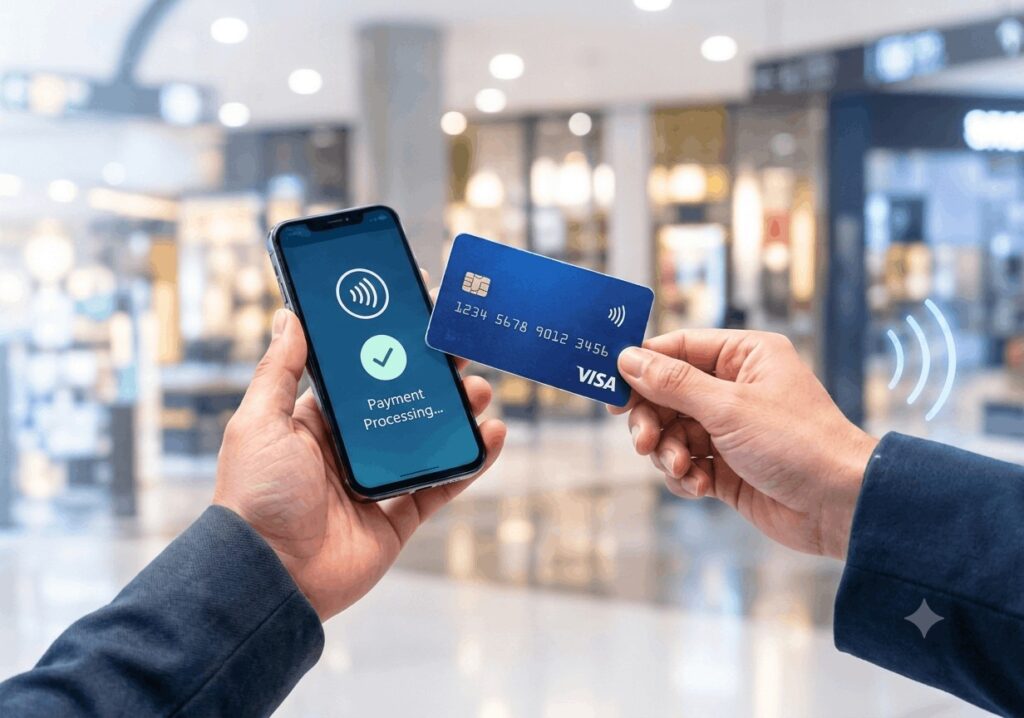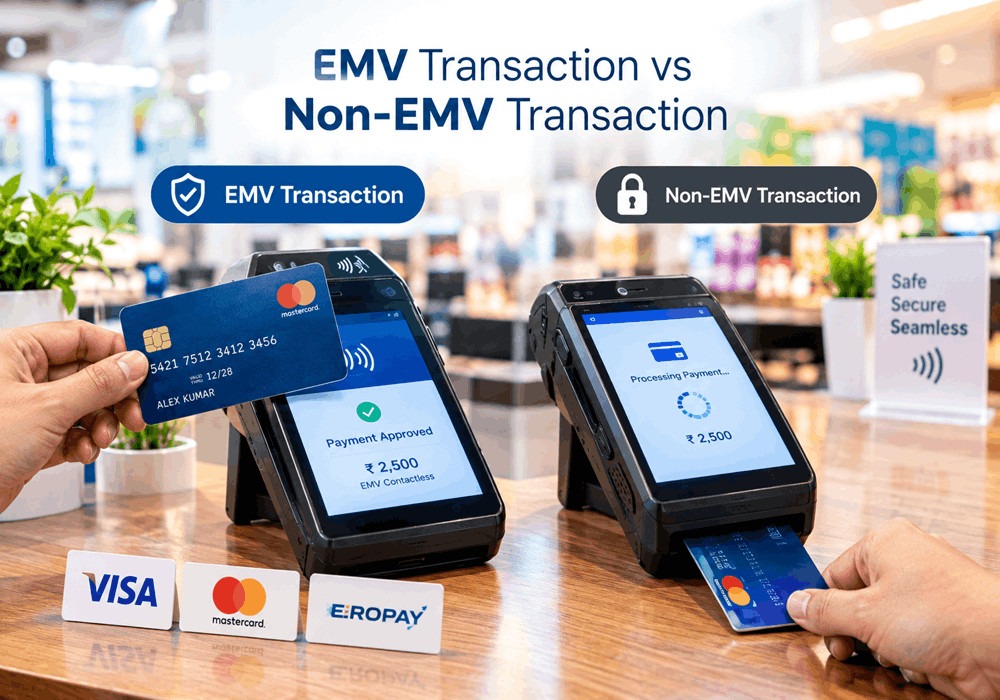

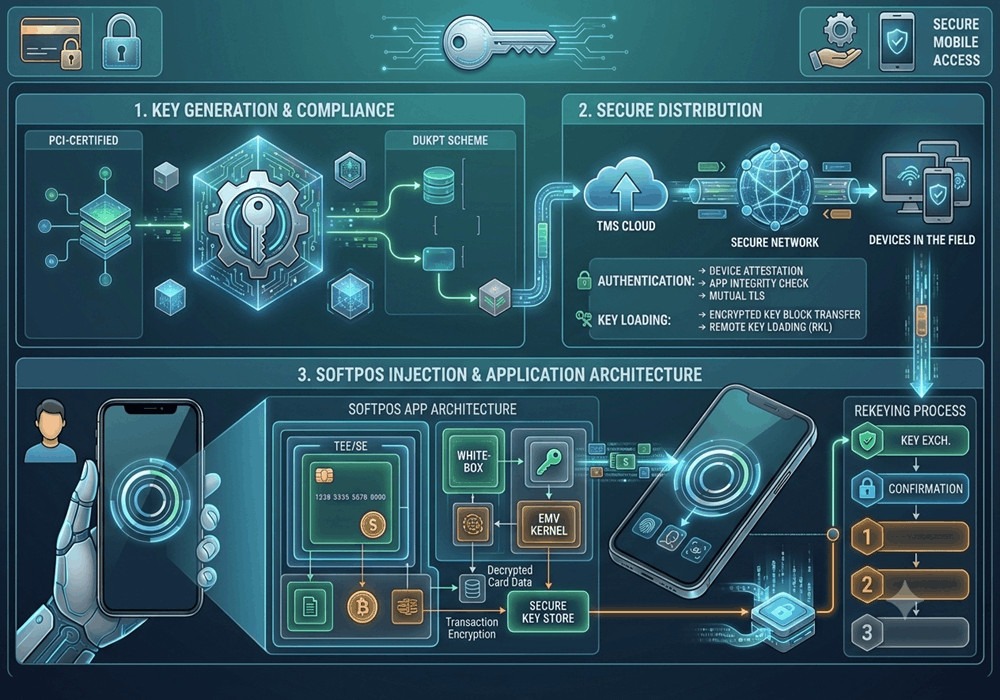
The rapid adoption of SoftPOS (Software Point of Sale) has transformed smartphones and Android devices into secure payment acceptance terminals. Instead of relying on traditional POS hardware, merchants can now accept contactless card payments directly on NFC-enabled mobile devices.
However, one critical question arises:
How are sensitive payment encryption keys securely delivered to thousands or even millions of SoftPOS devices without physically touching each device?
The answer lies in Remote Key Injection (RKI).
Remote Key Injection enables payment providers to securely inject, update, rotate, and revoke cryptographic keys over secure communication channels. It eliminates manual key loading while maintaining the highest levels of payment security and compliance.
For banks, fintech companies, PSPs, and payment terminal providers, RKI has become one of the most important components of modern payment infrastructure.
What is Remote Key Injection (RKI)?
Remote Key Injection is a secure process that allows cryptographic keys to be remotely installed onto payment devices through encrypted communication channels instead of manual loading in a secure facility.
Unlike traditional key injection, which requires physical access to every payment terminal, RKI performs key provisioning remotely while ensuring confidentiality, integrity, and authentication.
Simply Put Instead of:
- Shipping devices to a secure key injection center
- Loading encryption keys manually
- Returning devices to merchants
Organizations can:
- Provision devices remotely
- Authenticate devices automatically
- Deliver encrypted keys securely
- Activate payment services instantly
This significantly accelerates SoftPOS deployment while maintaining strong security.
Why SoftPOS Needs Remote Key Injection
SoftPOS deployments often involve thousands or millions of Android devices distributed across different cities and countries.
Manual key injection becomes impractical because:
- Devices are geographically distributed.
- Merchants expect instant activation.
- Physical handling increases operational costs.
- Device replacements happen frequently.
- Key rotation must occur regularly.
RKI solves these challenges by enabling:
- Secure remote provisioning
- Faster merchant onboarding
- Automated key lifecycle management
- Reduced logistics costs
- Enhanced operational efficiency
Understanding Cryptographic Keys in Payment Systems
Payment systems rely on cryptographic keys to secure transactions and protect cardholder data.
These keys perform several essential security functions.
Encryption: Encryption ensures payment information remains unreadable during transmission.
Authentication: Authentication verifies the identities of devices, servers, and payment applications.
Message Integrity: Integrity mechanisms ensure transaction data has not been altered.
Digital Signatures: Digital signatures validate transaction authenticity.
Secure Session Creation: Temporary session keys establish encrypted communication channels.
Without secure cryptographic keys, payment systems become vulnerable to fraud, interception, and unauthorized access.
How Remote Key Injection Works
A modern RKI workflow follows multiple security layers.
Step 1: Device Registration
The SoftPOS application registers with the backend server. Information collected includes:
- Device ID
- Hardware fingerprint
- Trusted Execution Environment status
- Application certificate
- Device attestation information
Step 2: Device Authentication The backend verifies:
- Device identity
- Software integrity
- OS version
- Security patch level
- Application authenticity
Only trusted devices continue.
Step 3: Secure Channel Creation An encrypted communication channel is established using:
- TLS
- Mutual authentication
- Certificate validation
- Hardware-backed security
Step 4: Key Generation The backend creates:
- Transaction keys
- Session keys
- Terminal keys
- Encryption keys
Keys are generated inside Hardware Security Modules (HSMs).
Step 5: Secure Key Wrapping Keys are encrypted using secure wrapping techniques before transmission.
This ensures:
- Confidentiality
- Integrity
- Tamper resistance
Step 6: Remote Key Delivery Wrapped keys are securely transmitted to the SoftPOS application.
The application never receives plaintext keys outside the secure execution environment.
Step 7: Secure Storage Keys are stored inside secure hardware such as:
- Trusted Execution Environment (TEE)
- Secure Element
- Hardware-backed Keystore
Step 8: Activation Once validation completes:
- Keys become active.
- Payment processing starts.
- Transactions are securely encrypted.
RKI Architecture for SoftPOS
A typical Remote Key Injection architecture consists of several interconnected components.
Device Layer
- Android smartphone
- SoftPOS application
- NFC interface
- Secure storage
Security Layer
- Device attestation
- Trusted Execution Environment
- Hardware-backed Keystore
- Certificate validation
Communication Layer
- TLS encryption
- Mutual authentication
- Secure APIs
Backend Layer
- Key Management Server
- HSM
- Authentication Server
- Certificate Authority
Monitoring Layer
- Audit logs
- Security monitoring
- Key lifecycle tracking
- Compliance reporting
Types of Cryptographic Keys Used in SoftPOS
Different keys perform different security functions.
Master Keys: Used to protect other encryption keys.
Session Keys: Generated temporarily for individual secure sessions.
Data Encryption Keys: Encrypt transaction information.
MAC Keys: Generate Message Authentication Codes to verify integrity.
PIN Encryption Keys: Protect PIN data where applicable.
Certificate Keys: Support authentication between systems.
Remote Key Injection vs Traditional Key Injection
|
Feature |
Traditional Key Injection |
Remote Key Injection |
|
Physical Access |
Required |
Not Required |
|
Deployment Speed |
Slow |
Fast |
|
Scalability |
Limited |
Very High |
|
Logistics Cost |
High |
Low |
|
Key Rotation |
Manual |
Automated |
|
Merchant Activation |
Delayed |
Instant |
|
Remote Updates |
No |
Yes |
|
Enterprise Management |
Difficult |
Easy |
Benefits of Remote Key Injection
Faster Device Deployment: Organizations can activate payment devices within minutes instead of waiting for physical provisioning.
Reduced Operational Costs: Remote provisioning eliminates transportation, warehousing, and manual handling costs.
Improved Security: Keys remain protected throughout their lifecycle using encrypted transmission and secure storage.
Automated Key Rotation: Organizations can regularly replace cryptographic keys without recalling devices.
Regulatory Compliance: RKI supports compliance with payment industry security standards.
Business Scalability: Payment providers can onboard thousands of merchants efficiently across multiple locations.
Security Mechanisms Behind RKI
Remote Key Injection relies on multiple layers of defense.
End-to-End Encryption: Protects data during transmission.
Mutual TLS Authentication: Ensures both client and server verify each other’s identity.
Hardware Security Modules (HSMs): Generate, store, and manage cryptographic keys securely.
Trusted Execution Environment (TEE): Protects sensitive operations from the Android operating system.
Device Attestation: Verifies device integrity before provisioning keys.
Certificate-Based Authentication: Confirms the authenticity of devices and backend services.
Secure Audit Logging: Maintains detailed records of key management operations for compliance and forensic analysis.
Device Authentication and Trust Establishment
Before any key is injected, the platform establishes device trust.
Key verification checks include:
- Device identity validation
- Application signature verification
- Boot integrity
- Root detection
- Emulator detection
- Malware detection
- Security patch verification
- Hardware-backed key support
Only devices that pass all security checks are authorized to receive cryptographic keys.
Integration with EMV Kernel
An EMV Kernel is responsible for processing EMV contact and contactless payment transactions by implementing card scheme rules, cryptographic checks, card authentication, and transaction processing logic. In a SoftPOS environment, the EMV Kernel works closely with secure key management to ensure that sensitive payment operations are executed correctly and securely.
Remote Key Injection complements the EMV Kernel by securely provisioning the cryptographic keys required for transaction encryption, authentication, and validation. Together, these technologies help maintain secure payment processing while simplifying large-scale deployment of SoftPOS solutions, making them an important area for internal linking within payment technology content.
EMV Certification and RKI Compliance
Deploying Remote Key Injection alone does not guarantee a compliant payment solution. Payment applications must also satisfy the technical and security requirements defined by card schemes and industry standards through EMV Certification.
EMV Certification validates that payment software, kernels, and transaction flows operate according to EMV specifications and interoperability requirements. When combined with secure Remote Key Injection, certified payment solutions provide stronger assurance that cryptographic keys, transaction processing, and payment acceptance comply with recognized industry standards, creating a natural connection between security, compliance, and operational reliability.
PCI MPoC Requirements for RKI
Modern SoftPOS implementations typically align with PCI Mobile Payments on COTS (MPoC) requirements.
Key RKI-related expectations include:
- Secure remote provisioning of keys
- Strong device authentication
- Hardware-backed key storage
- Encrypted communication channels
- Tamper detection
- Continuous device integrity verification
- Security event logging
- Secure software updates
Meeting these requirements helps protect payment credentials throughout the device lifecycle.
Remote Key Lifecycle Management
Effective RKI is not limited to initial key delivery. Organizations should manage keys throughout their lifecycle.
Key Generation: Keys should be generated within certified HSMs using approved cryptographic algorithms.
Key Distribution: Keys must be securely wrapped and transmitted over encrypted channels.
Key Activation: Keys become operational only after successful device authentication and validation.
Key Rotation: Periodic replacement of keys minimizes the impact of potential key compromise.
Key Suspension: Keys may be temporarily disabled when suspicious activity is detected.
Key Revocation: Compromised or expired keys should be permanently revoked and replaced.
Key Destruction: Retired keys should be securely erased from devices and backend systems to prevent unauthorized recovery.
OTA Key Rotation and Updates
Over-the-Air (OTA) updates simplify ongoing key management.
Benefits include:
- Scheduled key replacement
- Emergency key revocation
- Security patch deployment
- Cryptographic algorithm upgrades
- Reduced maintenance effort
- Improved compliance
OTA capabilities allow organizations to maintain security without interrupting merchant operations.
Business Benefits for Banks and PSPs
Remote Key Injection delivers measurable operational and business value.
For Banks
- Faster merchant onboarding
- Lower infrastructure costs
- Simplified compliance management
- Centralized control over payment devices
For Payment Service Providers
- Rapid SoftPOS deployment
- Reduced operational complexity
- Improved service availability
- Faster incident response
For Enterprise Merchants
- Quick device activation
- Minimal downtime
- Secure payment acceptance
- Remote support capabilities
Challenges in Implementing RKI
Despite its advantages, organizations should address several implementation challenges.
Device Diversity: Different Android manufacturers implement hardware security differently, requiring careful compatibility testing.
Network Reliability: Secure key provisioning depends on stable and encrypted network connectivity.
Certificate Management: Large-scale deployments require efficient management of digital certificates and trust chains.
Key Rotation Scheduling: Organizations need policies that balance operational continuity with security requirements.
Regulatory Compliance: Maintaining alignment with evolving PCI and EMV requirements requires continuous monitoring and updates.
Best Practices for Remote Key Injection
Implementing the following practices helps strengthen SoftPOS security:
- Generate keys only within certified HSMs.
- Use mutual TLS for all communication.
- Enable hardware-backed secure key storage.
- Perform device attestation before key provisioning.
- Rotate cryptographic keys regularly.
- Maintain comprehensive audit logs.
- Monitor device health continuously.
- Revoke compromised keys immediately.
- Automate compliance reporting where possible.
- Conduct regular penetration testing and security assessments.
Future of Remote Key Injection
The evolution of digital payments will continue to enhance RKI capabilities.
Emerging trends include:
- AI-driven anomaly detection for key management
- Cloud-native key management platforms
- Zero Trust security architectures
- Confidential computing environments
- Post-quantum cryptographic readiness
- Automated compliance validation
- Advanced device risk scoring
- Integration with decentralized identity frameworks
These advancements are expected to improve both security and scalability for global SoftPOS deployments.
Remote Key Injection has become a foundational technology for secure and scalable SoftPOS deployments. By enabling encrypted remote provisioning, automated key lifecycle management, and centralized security controls, RKI eliminates the operational limitations of traditional key injection while supporting modern payment ecosystems.
When combined with robust device authentication, hardware-backed security, secure communication protocols, EMV-compliant transaction processing, and industry certifications, Remote Key Injection helps banks, payment service providers, fintech companies, and enterprises deliver secure digital payment experiences at scale.
As SoftPOS adoption continues to grow globally, implementing a well-designed RKI strategy will remain essential for maintaining payment security, regulatory compliance, operational efficiency, and customer trust.
Looking to build a secure, compliant, and scalable SoftPOS or digital payment solution?
EazyPay Tech provides comprehensive payment technology solutions, including:
- EMV Kernel development for contact and contactless payment applications
- EMV Certification support, including Level 1, Level 2, and Level 3 certification assistance
- SoftPOS and Tap-to-Pay solutions
- Remote Key Injection (RKI) and secure key management integration
- Terminal Management System (TMS) solutions
- Android POS software development
- Payment gateway and banking integrations
- Payment security consulting and compliance services
Contact EazyPay Tech today to discuss your payment infrastructure requirements and discover how our EMV Kernel, EMV Certification, SoftPOS, and payment security solutions can help you accelerate secure payment deployments while meeting industry compliance standards.