
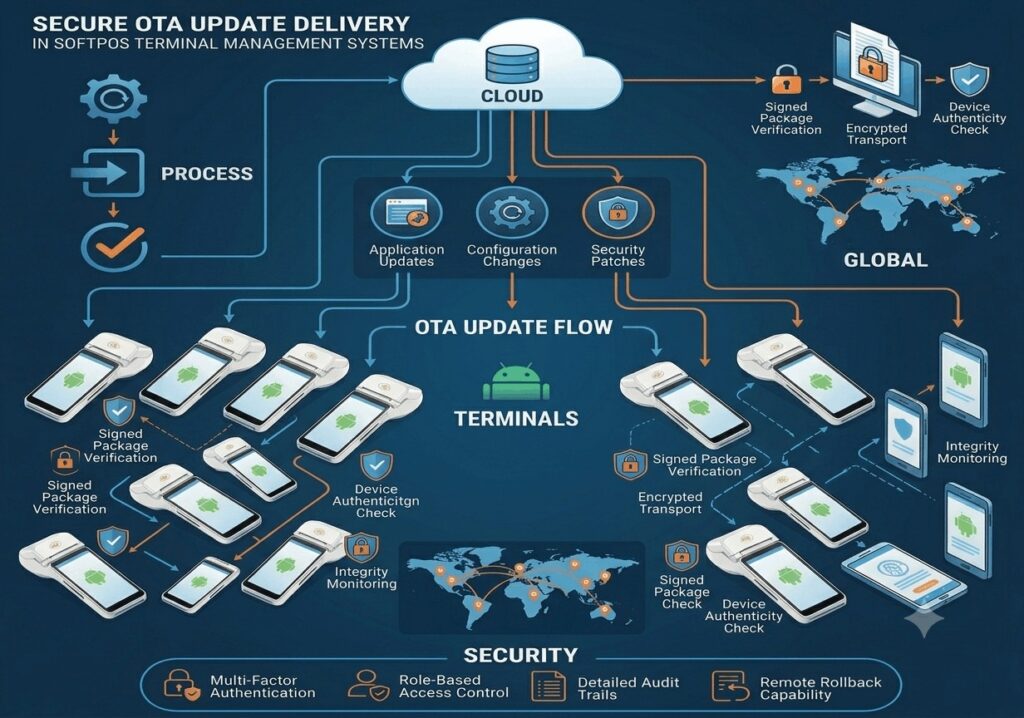
The payment industry is evolving rapidly, requiring payment applications to continuously adapt to new security requirements, regulatory standards, EMV specifications, and customer expectations. Businesses deploying SoftPOS solutions must regularly update payment applications, security certificates, configuration files, and operating system components without disrupting merchant operations.
Manually updating hundreds or thousands of Android payment devices is both time consuming and expensive. It also increases the risk of inconsistent software versions, delayed security patches, and compliance issues.
This is where Over-the-Air (OTA) Updates play a critical role within a SoftPOS Terminal Management System (TMS). OTA technology enables organizations to remotely deploy software updates, application enhancements, security patches, configuration changes, and policy updates directly to SoftPOS-enabled Android devices through a secure cloud platform.
For banks, Payment Service Providers (PSPs), fintech companies, OEMs, and enterprise merchants, OTA updates simplify device lifecycle management while ensuring every payment device remains secure, compliant, and up to date. Combined with centralized device management, OTA updates reduce operational costs, improve deployment speed, and strengthen the overall payment infrastructure.
What Are OTA Updates in SoftPOS TMS?
Over-the-Air (OTA) Updates refer to the remote delivery of software packages, configuration files, security certificates, and application updates to SoftPOS enabled Android devices through a centralized Terminal Management System.
Instead of requiring technicians to physically access devices, administrators can deploy updates from a single management console.
OTA updates typically include:
- Payment application updates
- Security patches
- Configuration changes
- Merchant settings
- Encryption key rotation
- Digital certificates
- Bug fixes
- Feature enhancements
- Compliance updates
The entire update process is encrypted, authenticated, monitored, and centrally managed.
Why OTA Updates Matter for SoftPOS
SoftPOS devices process sensitive payment transactions and operate in highly regulated environments. Running outdated software increases security vulnerabilities, transaction failures, and compliance risks.
OTA updates help organizations:
- Maintain software consistency
- Reduce security vulnerabilities
- Deliver new payment features
- Meet compliance requirements
- Improve merchant experience
- Minimize operational downtime
- Eliminate manual software installation
- Support large-scale deployments
For organizations managing thousands of payment devices, OTA updates are essential for maintaining operational efficiency and business continuity.
How OTA Updates Work
A modern SoftPOS Terminal Management System automates the entire update lifecycle.
Update Preparation: Administrators/ Developers upload approved software packages, configuration files, or security updates to the OTA server. Each package is digitally signed and validated before deployment.
Device Eligibility: The TMS determines which devices should receive the update based on:
- Device model
- Android version
- Merchant profile
- Software version
- Geographic region
- Device group
- Payment application version
This ensures only compatible devices receive the update.
Secure Distribution: Update packages are securely delivered using encrypted communication channels such as HTTPS or MQTT protected by TLS encryption.
Each device verifies:
- Digital signature
- Package integrity
- Version compatibility
- Authentication credentials
before installation begins.
Installation: Updates may be installed immediately or scheduled during non-business hours to avoid interrupting merchant transactions.
Organizations often deploy updates in phases to reduce operational risk.
Verification: After installation, devices report:
- Installation status
- Software version
- Device health
- Update success
- Error logs
Administrators receive real-time visibility into deployment progress.
Types of OTA Updates in SoftPOS
A centralized TMS supports multiple update categories.
Payment Application Updates: Payment applications regularly receive:
- New payment methods
- UI improvements
- Performance enhancements
- Bug fixes
- Transaction optimizations
OTA deployment ensures all merchants operate on the latest approved application version.
OTA updates simplify:
- Contactless optimization
- Transaction rule changes
- Security improvements
- Version consistency
This reduces deployment complexity while maintaining reliable payment acceptance.
Security Updates: Security patches address emerging threats before they affect merchants.
Typical updates include:
- Android security patches
- Encryption improvements
- Certificate renewal
- Root detection updates
- Authentication enhancements
- Vulnerability fixes
Configuration Updates: Organizations frequently modify operational settings without changing the application itself.
Examples include:
- Merchant branding
- Transaction limits
- Payment methods
- Regional settings
- Language preferences
- Network configuration
- Risk parameters
Compliance Updates: Payment regulations continue evolving. OTA deployment enables organizations to remotely implement:
- PCI MPoC requirements
- EMV compliance updates
- Regulatory policy changes
- Scheme-specific enhancements
- Security standards
Key Features of OTA Management
Centralized Deployment: Administrators manage every software release from a single dashboard.
Scheduled Rollouts: Updates can be planned during off-peak hours to minimize merchant disruption.
Staged Deployment: Organizations commonly deploy updates in phases:
- Internal testing
- Pilot merchants
- Regional rollout
- Nationwide deployment
This reduces operational risk.
Version Control: The TMS maintains complete visibility into software versions running across every device.
Administrators can quickly identify outdated devices requiring updates.
Rollback Capability: If an issue is detected after deployment, organizations can remotely revert devices to the previous stable version.
Rollback significantly reduces downtime.
Update Analytics: Real-time dashboards provide insights including:
- Successful installations
- Failed deployments
- Pending updates
- Device compatibility
- Regional adoption
- Software distribution
Security Considerations: Security is fundamental throughout the OTA process. Best practices include:
- End-to-end encryption
- TLS 1.2+
- Digital signatures
- Package validation
- Certificate authentication
- Secure APIs
- Hash verification
- Integrity checks
Only authenticated devices should receive approved update packages.
Benefits of OTA Updates
- Reduced Operational Costs: Remote deployment eliminates expensive field technician visits.
- Faster Feature Delivery: Organizations can introduce payment innovations within hours instead of weeks.
- Improved Security: Rapid deployment of security patches reduces exposure to cyber threats.
- Better Compliance: Keeping every device on approved software versions simplifies regulatory audits and certification.
- Consistent User Experience: Merchants receive the same application features and payment capabilities regardless of location.
- Greater Scalability: Thousands of SoftPoS devices can be updated simultaneously without increasing operational complexity.
OTA Updates and EMV Certification
Payment applications evolve continuously, making EMV Certification an ongoing process rather than a one-time activity.
Whenever certified payment software components are updated, organizations must ensure new versions remain compliant with applicable card scheme requirements.
A centralized TMS helps organizations:
- Deploy only approved software
- Verify certified versions
- Track deployment history
- Simplify audit preparation
- Maintain software consistency
Business Use Cases of SoftPoS TMS
- Banks: Deploy new payment features across nationwide merchant networks without replacing devices.
- Payment Service Providers: Maintain consistent payment software across thousands of merchants.
- Fintech Companies: Release new digital payment capabilities rapidly through phased OTA rollouts.
- Enterprise Retailers: Keep payment applications standardized across every retail location.
- Android POS Providers: Manage both Android POS terminals and SoftPOS smartphones from a centralized platform.
- QR Payment SoundBox Deployments: Organizations operating QR Payment SoundBox devices alongside SoftPOS can distribute firmware, voice packs, configuration updates, and application enhancements through the same centralized TMS.
Best Practices
Successful OTA management includes:
- Digitally sign every update package.
- Test releases in staging environments.
- Use phased deployments.
- Schedule updates outside business hours.
- Monitor installation success in real time.
- Maintain rollback capabilities.
- Automate compliance verification.
- Keep detailed audit logs.
- Validate device compatibility before deployment.
- Monitor update performance using centralized dashboards.
Future Trends
OTA technology continues evolving with modern payment ecosystems. Emerging innovations include:
- AI-driven update scheduling
- Predictive deployment analytics
- Zero-touch software provisioning
- Cloud-native OTA infrastructure
- Automated certificate rotation
- Differential updates
- Self-healing deployments
- Unified management for SoftPOS, Android POS, kiosks, and QR Payment SoundBox devices
These advancements will further reduce operational effort while improving payment security and reliability.
Over-the-Air (OTA) updates have become an essential capability for organizations deploying SoftPOS solutions at scale. Rather than relying on manual software installation, businesses can remotely deliver application updates, security patches, configuration changes and compliance improvements through a centralized Terminal Management System (TMS).
By automating software distribution, OTA updates reduce maintenance costs, improve security, accelerate feature delivery, and ensure consistent payment experiences across every merchant device. Features such as encrypted deployment, staged rollouts, rollback support, version control, and real-time monitoring help organizations maintain a secure and reliable payment infrastructure.
Whether you are a bank, Payment Service Provider (PSP), fintech company, OEM or enterprise retailer, implementing secure OTA updates within your SoftPOS ecosystem is critical for supporting long-term scalability and regulatory compliance. When combined with SoftPOS, Android POS TMS, EMV Certification, EMV Kernel and QR Payment SoundBox management, OTA technology provides a future-ready foundation for efficient, centralized payment device lifecycle management.