The payment industry is rapidly moving toward contactless, mobile-first, and software-driven payment experiences. Businesses are increasingly adopting SoftPOS (Software Point of Sale) technology to transform NFC-enabled smartphones and tablets into secure payment acceptance devices without relying on traditional POS hardware.
SoftPOS allows merchants to accept payments through contactless cards, mobile wallets, smartwatches, and wearable devices using existing Android devices. This reduces hardware dependency, lowers deployment costs, and enables faster payment acceptance for businesses of all sizes.
However, behind every successful SoftPOS transaction, multiple systems work together within seconds, including payment gateways, acquiring banks, card networks, fraud management platforms, settlement engines, and merchant management systems.
The communication between these systems is powered by API integration, which acts as the foundation of the SoftPOS ecosystem. APIs enable secure, real-time data exchange, transaction processing, authentication, authorization, and settlement while ensuring scalability, reliability, and compliance with global payment standards.
Why API Integration Is the Foundation of SoftPOS
How API Integration Enables Secure SoftPOS Transaction Processing
Although merchants interact only with the SoftPOS application, the actual payment process involves a complex backend ecosystem.
APIs create a secure communication layer between SoftPOS applications and financial systems, allowing seamless interaction with:
- Payment gateways
- Acquiring banks
- Card networks
- Issuing banks
- Fraud detection platforms
- Merchant management systems
- Settlement and reconciliation platforms
When a customer taps a contactless card, smartphone, smartwatch, or wearable device on a SoftPOS-enabled Android device, APIs coordinate every step of the transaction journey.
A strong SoftPOS API ecosystem enables:
- Real-time payment authorization
- Secure transmission of payment data
- Merchant authentication and device validation
- Fraud detection and risk analysis
- Transaction routing
- Refund and reversal processing
- Settlement automation
- Digital receipts and notifications
- Payment analytics and reporting
- Integration with open banking and embedded finance platforms
By connecting different components of the payment ecosystem, APIs help financial institutions, fintech companies, and merchants deliver faster and more secure payment experiences.
End-to-End SoftPOS Transaction Flow Through Banking Systems
A SoftPOS transaction passes through multiple stages, starting from merchant authentication and ending with settlement. Each stage relies on secure API communication to ensure accurate and reliable payment processing.
Step 1: Merchant Authentication and Device Enrollment
Before accepting payments, the SoftPOS application must verify the merchant and register the payment device.
The activation and enrollment process connects the smartphone or tablet with a specific merchant profile through secure APIs.
Key functions include:
- Merchant identity verification
- Device registration
- Activation code validation
- Application authentication
- Security policy compliance checks
- Terminal configuration download
This ensures that only authorized merchants and trusted devices can process payment transactions.
Step 2: Transaction Initiation Through SoftPOS API
When a merchant enters the transaction amount, the SoftPOS application creates a secure transaction request.
The Transaction API sends required parameters to backend payment systems, including:
- Transaction amount
- Currency
- Merchant identification
- Transaction reference ID
- Payment instrument details
- Transaction type
The API validates transaction information, checks limits, and establishes secure communication with payment processing systems.
A typical transaction request may include:
{
  "api_key": "YOUR_SECURE_API_KEY",
  "transaction_type": "SALE",
  "amount": 25.50,
  "currency": "USD",
  "merchant_order_id": "ORD-2026-9912",
  "callback_url": "https://yourbackend.com"
}
This request is securely transmitted through APIs for further processing and authorization.
Step 3: Customer Contactless Payment Processing
The customer completes the payment by tapping a supported NFC payment instrument, such as:
- Contactless debit or credit card
- Smartphone wallet
- Smartwatch
- NFC-enabled wearable device
The SoftPOS application securely captures payment information through NFC communication while maintaining required security controls.
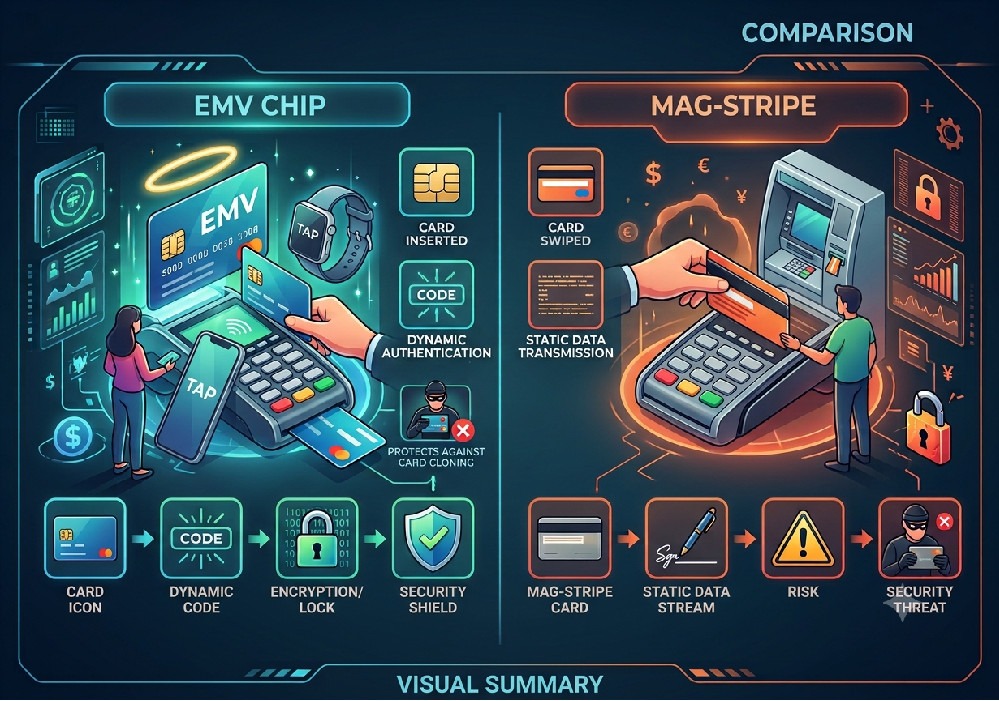
Step 4: EMV Transaction Processing Through EMV Kernel
Before transaction data reaches banking systems, the payment information is processed through an EMV Kernel.
The EMV Kernel performs critical operations based on EMVCo specifications, including:
- Application selection
- Card authentication
- Cryptographic processing
- Terminal risk management
- Processing restriction checks
- Cardholder Verification Method (CVM) evaluation
An EMV-certified kernel ensures secure communication between payment cards and SoftPOS applications.
For production deployment, organizations require EMV Certification, including:
- EMV Level 1 Certification for hardware and communication validation
- EMV Level 2 Certification for payment kernel compliance
- EMV Level 3 Certification for end-to-end payment acceptance testing
These certifications ensure interoperability, security, and compliance across global payment networks.
Step 5: API Gateway Processing
After EMV processing, encrypted transaction information moves through the API Gateway.
The API Gateway acts as a secure bridge between SoftPOS applications and backend payment infrastructure.
It manages:
- API authentication
- Data validation
- Request routing
- Security enforcement
- Transaction monitoring
- Logging and auditing
A secure API Gateway improves reliability while protecting sensitive payment information.
Step 6: Payment Gateway and Acquiring Bank Processing
The Payment Gateway receives the transaction request and performs additional validation before forwarding it to the acquiring bank.
Payment Gateway APIs manage:
- Transaction encryption
- Merchant verification
- Payment routing
- Error handling
- Retry mechanisms
- Multi-bank connectivity
The acquiring bank validates the request and forwards it to the appropriate payment network.
Step 7: Card Network and Issuer Authorization
Payment networks such as Visa, Mastercard, RuPay, American Express, JCB, and UnionPay securely route transactions to the customer’s issuing bank.
The issuing bank evaluates:
- Card validity
- Available balance
- Transaction limits
- Fraud indicators
- Customer account status
Based on these checks, the transaction is approved or declined.
Step 8: Authorization Response, Settlement, and Reconciliation
After authorization, the response travels back through the secure API communication path:
Issuer Bank → Card Network → Acquiring Bank → Payment Gateway → SoftPOS Application
The merchant receives transaction confirmation within seconds.
Settlement and reconciliation APIs then manage:
- Merchant payouts
- Transaction matching
- Refund processing
- Fee calculations
- Dispute management
- Financial reporting
These APIs ensure accurate financial records and efficient payment operations.
Core APIs Powering the SoftPOS Ecosystem
Payment Authorization APIs
Payment Authorization APIs enable real-time communication between SoftPOS applications, payment gateways, acquiring banks, and card networks.
They handle:
- Transaction validation
- Merchant verification
- Authorization requests
- Payment routing decisions
Merchant Onboarding APIs
Merchant onboarding APIs simplify digital registration by automating:
- KYC verification
- Merchant profile creation
- Account setup
- Terminal activation
These APIs help banks and fintech providers onboard merchants faster.
Fraud Detection APIs
Fraud Detection APIs analyze transactions using:
- Artificial intelligence
- Machine learning models
- Device fingerprinting
- Behavioral analytics
- Risk scoring
They identify suspicious activities and reduce fraud losses.
Tokenization APIs
Tokenization APIs replace sensitive card details with secure digital tokens.
Benefits include:
- Reduced card data exposure
- Improved payment security
- PCI DSS compliance support
- Safer digital transactions
Settlement and Reconciliation APIs
Settlement APIs automate post-transaction operations, including:
- Batch processing
- Merchant settlements
- Refund management
- Transaction reconciliation
- Financial reporting
Future of SoftPOS API Integration
As digital payments continue expanding, API-driven architectures will become essential for building scalable payment ecosystems.
By combining SoftPOS, EMV Kernel, EMV Certification, secure APIs, tokenization, fraud prevention, and cloud-based Terminal Management Systems (TMS), businesses can deliver secure, flexible, and future-ready payment acceptance solutions.
API integration is not just a technical connection between systems; it is the foundation that enables faster transactions, stronger security, and seamless payment experiences.
Build Your Secure SoftPOS Payment Solution with EazyPay Tech
EazyPay Tech helps banks, fintech companies, payment service providers, and OEMs develop advanced payment solutions with:
- SoftPOS SDK Integration
- EMV Kernel Solutions
- EMV Certification Support
- Payment API Integration
- Terminal Management System (TMS)
- Secure Payment Software Development
Partner with EazyPay Tech to build a scalable, compliant, and next-generation SoftPOS payment ecosystem. Contact our payment technology experts today and accelerate your digital payment transformation.