
Integrating a contactless payment kernel into a POS terminal involves more than implementing EMV transaction logic. The kernel must work seamlessly with the terminal’s NFC reader, hardware platform, payment application, operating system, security components and payment processing infrastructure.
For terminal manufacturers and payment solution providers exploring EMV C-8, understanding how these components interact is essential before beginning implementation, integration testing and certification activities.
EMV Contactless Kernel C-8 is associated with the EMV contactless framework and the relevant payment scheme requirements. Implementing a C-8-based contactless solution requires careful consideration of hardware interfaces, application architecture, NFC communication, transaction processing and terminal configuration.
In this guide, we explore how EMV C-8 kernel integration works with POS hardware, NFC readers and payment applications, the interfaces involved, common implementation challenges and the key considerations for a successful integration project.
1. What Is EMV C-8 Kernel Integration?
EMV C-8 kernel integration refers to the process of incorporating the applicable EMV Contactless Kernel C-8 functionality into a payment terminal platform and connecting it with the device’s NFC interface, payment application and transaction-processing environment.
The kernel manages defined portions of the EMV contactless transaction flow, including communication and processing of payment-related data according to its specification and configured transaction requirements.
The kernel does not operate in isolation. It depends on the POS terminal’s hardware and software environment to initiate contactless transactions, exchange data with the card or mobile payment device, process transaction information and provide the required results to the payment application.
A typical C-8 integration project may involve:
- NFC reader and antenna integration.
- Contactless card and mobile device communication.
- Kernel interface implementation.
- Payment application integration.
- Terminal configuration and parameter management.
- Transaction data exchange.
- Error handling and recovery.
- Testing, validation and certification preparation.
Why integration matters
Even when the kernel implementation is available, incompatibilities between hardware, NFC communication, application interfaces and terminal configuration can affect transaction performance, interoperability and compliance.
2. Understanding POS Hardware Architecture
A modern POS terminal consists of multiple hardware and software components that work together to process card-present payments.
The contactless payment environment typically includes a processor or system-on-chip (SoC), NFC controller, antenna, operating system, payment application, EMV kernel and security-related components.
Key hardware components
| Hardware Component | Role in Contactless Payment |
|---|---|
| Processor / SoC | Executes the terminal operating system, payment application and integration components. |
| NFC Controller | Facilitates contactless communication between the terminal and the card or mobile device. |
| NFC Antenna | Provides the RF interface used to communicate with contactless payment devices. |
| Memory | Stores application components, configuration data and other required system resources. |
| Secure Element (where applicable) | Supports specific secure functions depending on the device architecture and use case. |
| Display | Presents transaction prompts and status information to the user. |
| Keypad / Touchscreen | Enables transaction input, confirmation and other terminal interactions. |
| Communication Module | Supports connectivity with the payment host through Wi-Fi, cellular, Ethernet or other supported interfaces. |
Not every POS device uses the same architecture. Android POS devices, traditional Linux-based terminals and embedded payment platforms may have different NFC interfaces, system frameworks, hardware abstraction layers and application deployment models.
Suggested WordPress visual: Create a technical architecture illustration showing the SoC, operating system, NFC controller, antenna, payment application, EMV kernel and communication module connected within a POS terminal.
3. Role of the NFC Reader in EMV C-8 Integration
The NFC reader is one of the most important components in a contactless payment terminal. It enables the POS device to establish RF communication with a contactless card or compatible mobile payment device.
During a contactless transaction, the terminal’s NFC subsystem performs communication-related operations required for the contactless exchange. The kernel interacts with the reader environment through the integration interface and the underlying communication framework.
NFC reader responsibilities
- Establishing and maintaining contactless communication.
- Detecting contactless cards or compatible payment devices.
- Supporting required RF communication operations.
- Facilitating the exchange of APDU commands and responses.
- Managing communication status and reader-related events.
- Reporting communication failures and reader conditions to the appropriate software components.
NFC controller and kernel interaction
The NFC controller and EMV kernel perform different functions.
NFC controller
The NFC controller manages the physical and communication-related aspects of contactless interaction, according to the controller’s capabilities and the terminal’s software architecture.
EMV contactless kernel
The kernel manages the applicable EMV contactless transaction processing logic and data exchange according to the relevant specification and configuration.
Payment application
The payment application coordinates the overall transaction, including initiating the transaction, handling terminal-side requirements, communicating with the kernel and processing the result within the payment application environment.
The separation between these components helps developers build modular payment terminal architectures and simplifies integration, testing and maintenance.
4. How EMV C-8 Integrates with the POS Payment Application
The payment application acts as the primary transaction coordinator within the terminal software environment. It connects user interaction, transaction information, kernel processing and payment host communication.
Kernel integration requires the payment application to provide the required transaction inputs and consume the relevant kernel outputs through the applicable interface.
The exact interface, command structure, data exchange and processing responsibilities depend on the kernel implementation, platform architecture and applicable EMV and payment scheme requirements.
Typical payment application responsibilities
- Initiating the payment transaction.
- Collecting transaction amount and transaction context.
- Managing terminal-side transaction flow.
- Invoking kernel processing.
- Handling kernel callbacks, events or results as applicable.
- Preparing transaction data for host processing.
- Managing transaction completion and user feedback.
- Handling timeouts, cancellations and transaction exceptions.
Kernel integration interface
The kernel integration interface establishes how the payment application communicates with the kernel.
Depending on the implementation, the interface may include:
- Transaction initialization.
- Transaction parameter configuration.
- Contactless processing initiation.
- Event and callback handling.
- Data exchange and retrieval.
- Kernel outcome processing.
- Transaction termination and cleanup.
Developers should use the applicable kernel implementation documentation and interface specifications to define the exact interaction model rather than assuming that every kernel exposes the same APIs or callbacks.
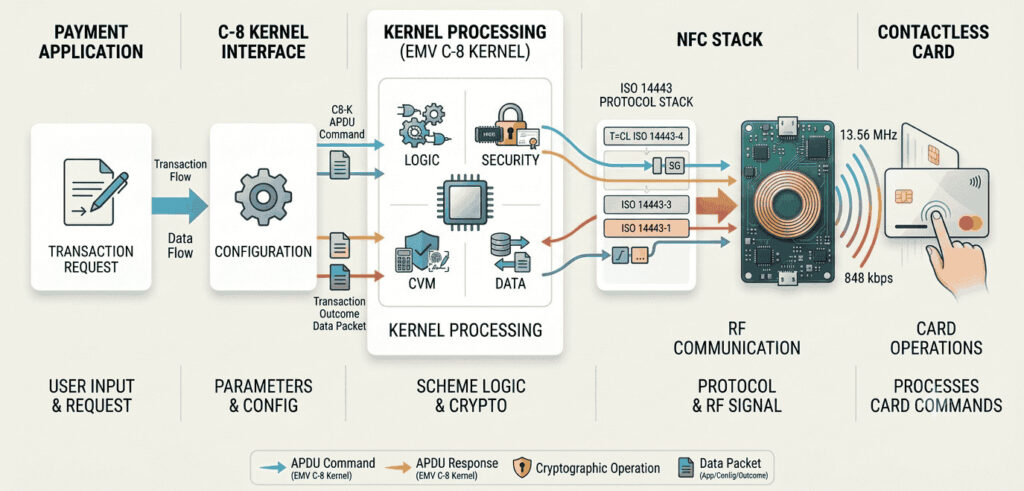
5. EMV C-8 Integration Architecture
A modular architecture can help terminal manufacturers separate transaction orchestration, kernel processing and hardware communication.
The architecture should be designed according to the target POS hardware, operating system, kernel implementation, scheme requirements and certification scope.
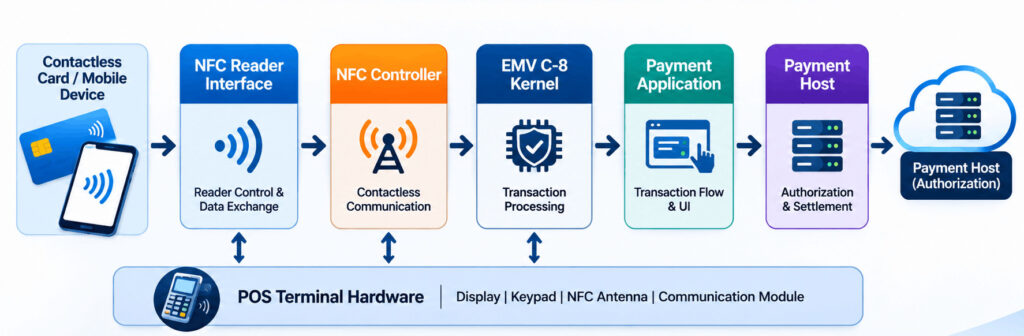
Integration layers
| Layer | Integration Responsibility |
|---|---|
| Payment Application | Transaction orchestration, terminal interaction and transaction result management. |
| Kernel Interface | Communication between payment application and kernel. |
| Kernel Processing | Contactless EMV processing according to applicable specifications and configuration. |
| NFC / Reader Interface | Communication with the NFC reader subsystem. |
| NFC Controller | RF communication management and controller-specific operations. |
| Card / Mobile Device | Contactless payment interaction with the terminal. |
6. Contactless Transaction Flow Between NFC Reader, Kernel and Payment Application
Understanding the transaction flow is essential when integrating EMV C-8 into a POS terminal.
A contactless transaction involves multiple components exchanging information throughout the payment process. The exact flow depends on the kernel implementation, terminal configuration, transaction type and applicable payment scheme requirements.
Step-by-step transaction flow
Step 1: Transaction initiation
The payment application initiates a payment transaction after the merchant enters the transaction amount and other required information.
Step 2: Contactless interface activation
The terminal activates the contactless interface and prepares the NFC reader to detect a compatible card or mobile payment device.
Step 3: Card or mobile device detection
The NFC reader detects the contactless device and establishes the required communication.
Step 4: Data exchange
The terminal and contactless device exchange relevant payment data through the NFC communication interface.
Step 5: Kernel processing
The EMV kernel processes the transaction data according to its defined logic, configuration and applicable requirements.
Step 6: Kernel outcome
The kernel provides the relevant outcome, data or events to the payment application through the applicable interface.
Step 7: Host processing
Where required, the payment application prepares the transaction information and sends it to the payment host or acquiring system for authorization.
Step 8: Transaction completion
The payment application manages the transaction result, displays the appropriate status and completes the terminal-side transaction flow.
7. Key Hardware and Software Dependencies
One of the most common challenges in EMV kernel integration is identifying the dependencies between the hardware, software and payment processing components early in the project.
The kernel implementation must be evaluated against the capabilities and limitations of the target platform.
Hardware dependencies
- NFC controller compatibility.
- NFC antenna design and RF performance.
- Reader firmware and configuration.
- Processor and memory capacity.
- Operating system compatibility.
- Secure hardware and security architecture, where applicable.
Software dependencies
Payment application architecture.
- Kernel APIs and integration interfaces.
- NFC framework and reader drivers.
- Operating system and hardware abstraction layer.
- Terminal configuration and parameter management.
- Payment host communication.
- Logging and diagnostic framework.
Integration dependency matrix
| Component | Integration Requirement | Potential Risk |
|---|---|---|
| NFC Controller | Compatible reader interface and communication capabilities | Reader incompatibility or communication failures |
| NFC Antenna | Appropriate RF performance and device design | Detection or transaction reliability issues |
| Kernel | Correct implementation and interface integration | Incorrect processing or integration defects |
| Payment Application | Correct input, output and transaction orchestration | Transaction flow errors |
| OS / HAL | Compatible access to NFC and hardware resources | API or driver incompatibility |
| Terminal Configuration | Correct parameters and configuration management | Unexpected transaction behaviour |
| Host Interface | Appropriate transaction data and communication flow | Authorization or transaction processing issues |
8. Common EMV C-8 Integration Challenges
Kernel integration is rarely limited to connecting a software component to an NFC reader. The development team must address hardware compatibility, transaction flow, application interfaces, configuration, testing and platform-specific constraints.
8.1 NFC reader compatibility
Different POS hardware platforms may use different NFC controllers, firmware versions, reader interfaces and communication frameworks.
Challenge: The kernel integration may require changes to the NFC reader interface or software layer to support the target hardware.
Solution approach: Evaluate the reader interface, hardware documentation, NFC communication capabilities and kernel integration requirements before development begins.
8.2 Payment application and kernel interface mismatches
The payment application and kernel must exchange the required information through the applicable integration interface.
Challenge: Incorrect data mapping, event handling, transaction initialization or result processing may lead to integration defects.
Solution approach: Define the interface contract, data exchange requirements, event model, lifecycle management and error handling before implementing the integration.
8.3 Contactless transaction timing
Contactless transactions require coordinated communication between the terminal, kernel and contactless device.
Challenge: Delays, incorrect timeout handling, reader interruptions or inefficient application processing can affect transaction performance.
Solution approach: Evaluate transaction timing, reader communication, processing delays and interruption handling across the complete terminal architecture.
8.4 Terminal configuration management
Terminal parameters, contactless settings and transaction configuration must be appropriately managed.
Challenge: Incorrect or inconsistent configuration can affect transaction processing and test outcomes.
Solution approach: Maintain configuration control, parameter validation, version tracking and deployment procedures.
8.5 Error handling and recovery
A terminal must handle unexpected situations during contactless transaction processing.
Examples include:
- NFC communication failure.
- Card removal during transaction processing.
- Reader timeout.
- Kernel processing error.
- Application interruption.
- Transaction cancellation.
- Unexpected kernel outcome.
- Terminal resource or interface failure.
Solution approach: Develop consistent error handling, transaction recovery, cancellation, cleanup and user-prompt logic across the application, kernel and reader layers.
9. Testing and Validation Before Certification
Testing is a critical stage of EMV C-8 kernel integration. The development team must verify that the kernel, POS hardware, NFC reader, payment application and terminal configuration work together as expected.
Testing should be planned according to the relevant kernel documentation, applicable EMV specifications, payment scheme requirements, target device architecture and certification scope.
Integration testing checklist
| Testing Area | What to Validate |
|---|---|
| NFC Reader Testing | Reader activation, communication, card detection and supported reader behaviour |
| Kernel Interface Testing | Application-to-kernel interaction, data exchange, events and outcome processing |
| Transaction Flow Testing | Initiation, processing, completion, cancellation and transaction lifecycle |
| Configuration Testing | Terminal parameters, configuration consistency and supported transaction settings |
| Error Handling | Reader errors, timeouts, interruptions, cancellation and recovery |
| Host Integration | Transaction data mapping, communication and authorization flow |
| Device Compatibility | Behaviour across target hardware and software configurations |
| Regression Testing | Existing payment functionality after kernel integration changes |
| Scheme-Specific Testing | Applicable payment scheme requirements and test scenarios |
| Certification Preparation | Documentation, configuration, test evidence and readiness for applicable certification activities |
Integration testing versus certification
Integration testing
Integration testing validates whether the kernel works correctly with the POS hardware, NFC reader, payment application and other terminal components.
Certification testing
Certification testing evaluates the terminal or applicable components against defined requirements and test procedures for the relevant payment scheme, certification scope or approval process.
Successful integration testing does not automatically guarantee certification approval.
10. How EazyPay Tech Supports EMV Kernel and POS Integration
Integrating an EMV contactless kernel into a POS terminal requires coordination between hardware, payment software, NFC communication, terminal configuration and payment application architecture.
EazyPay Tech supports payment technology companies, POS manufacturers, fintech’s and terminal developers with EMV kernel development, payment application integration, terminal software development and EMV certification-related engineering services.
Our integration capabilities can support projects involving:
- EMV Kernel Development and Integration: Kernel integration support for payment terminal platforms and payment application environments.
- POS Hardware Integration: Integration of payment software with POS hardware platforms, NFC readers and terminal interfaces.
- Payment Application Development: Payment application architecture, transaction processing and terminal-side integration.
- Contactless Payment Integration: Engineering support for contactless payment functionality and reader integration.
- EMV Testing and Certification Support: Technical support for testing, validation, debugging and certification preparation.
- Android POS Development: Payment application and software integration for Android-based payment terminal platforms.
Whether you are developing a new payment terminal, integrating a contactless kernel into an existing device or upgrading a payment application architecture, a structured integration approach can help reduce development complexity and improve integration readiness.
Planning an EMV C-8 integration project?
Talk to EazyPay Tech about your POS hardware, NFC reader, kernel interface and payment application integration requirements.
Contact EazyPay Tech to discuss your POS terminal and EMV kernel integration requirements.
Frequently Asked Questions (FAQs)
1. What is EMV C-8 kernel integration?
EMV C-8 kernel integration involves incorporating the applicable EMV Contactless Kernel C-8 functionality into a POS terminal and integrating it with the NFC reader, payment application and terminal software environment.
2. Does EMV C-8 require a specific NFC controller?
The NFC controller must support the capabilities and communication requirements needed by the target kernel implementation and terminal architecture. Compatibility should be evaluated using the applicable implementation documentation and hardware specifications.
3. What is the role of the NFC reader in EMV kernel integration?
The NFC reader enables contactless communication between the POS terminal and a payment card or compatible mobile payment device. It facilitates the exchange of data required for the contactless transaction.
4. How does the payment application communicate with the EMV kernel?
The payment application communicates with the kernel through the applicable integration interface. This may involve transaction initialization, parameter handling, event processing, data exchange and kernel outcome management.
5. Can EMV C-8 be integrated into Android POS terminals?
Integration may be possible on supported Android POS platforms, subject to hardware capabilities, software architecture, kernel implementation requirements, NFC interface compatibility and applicable payment scheme requirements.
6. What testing is required after EMV C-8 integration?
Testing may include NFC reader validation, kernel interface testing, transaction flow testing, error handling, configuration testing, host integration, regression testing and applicable scheme-specific certification testing.
7. Does kernel integration alone complete EMV certification?
No. Kernel integration is one part of a broader terminal development and validation process. Certification requirements depend on the applicable payment scheme, terminal architecture, certification scope and other relevant requirements.