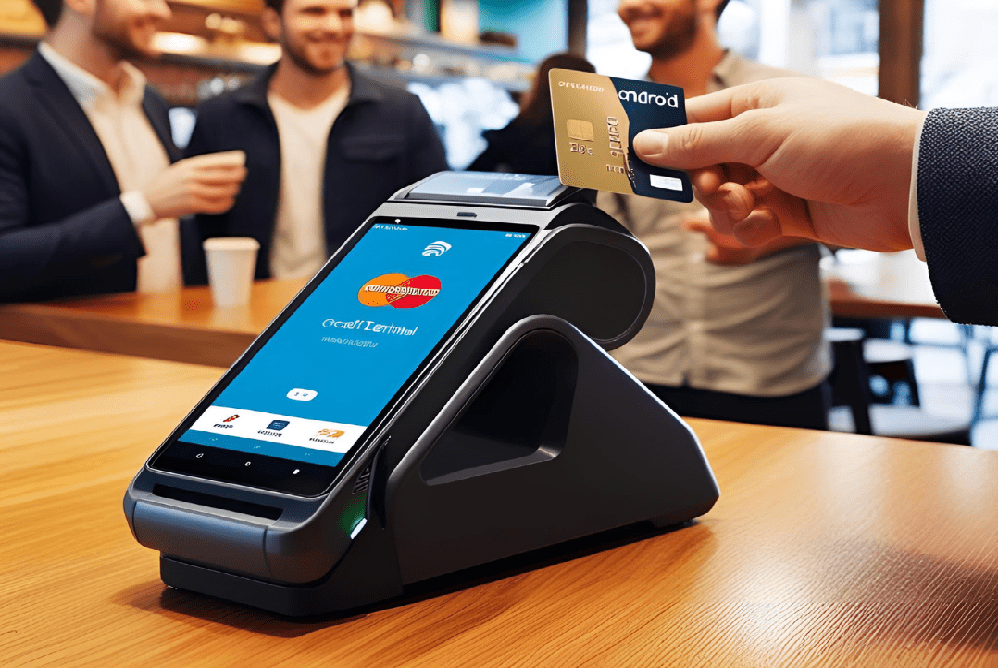


Contactless payment acceptance is becoming an essential requirement for modern payment devices. Banks, fintech companies, payment service providers and POS manufacturers are continuously upgrading their payment infrastructure to support faster and more secure contactless transactions.
However, implementing contactless payment functionality in a POS Terminal involves more than integrating an NFC reader or payment application. It requires coordination between the contactless reader, Entry Point, EMV kernel, terminal software, security components and payment processing environment.
One important development in this area is EMV Contactless Kernel C-8, defined in EMVCo Book C-8. It introduces a common contactless kernel specification designed to support the evolution of contactless and mobile payments.
For POS OEMs and terminal developers, implementing C-8 requires a structured engineering approach.
In this guide, we explain the complete implementation process, from initial technical planning and hardware evaluation to software integration, testing and approval preparation.
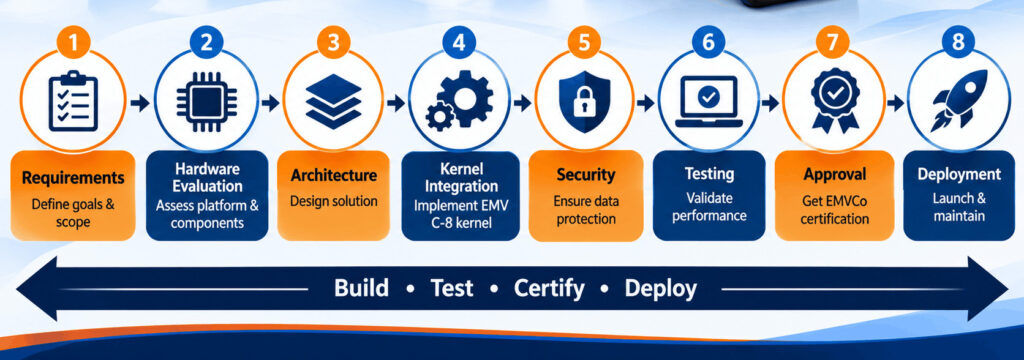
1. Understand EMV C-8 Implementation Requirements
Before starting development, the engineering team should understand what EMV C-8 does and how it fits into the overall contactless payment architecture.
EMV C-8 is a contactless kernel specification. A kernel is software that manages the interaction with a contactless payment instrument during the relevant transaction-processing stages.
Three important components work together:
| Component | Responsibility |
|---|---|
| Contactless Reader | Provides the physical communication interface with the contactless card or NFC-enabled device |
| Entry Point | Manages application selection and kernel activation according to applicable requirements |
| EMV C-8 Kernel | Performs contactless transaction processing defined by the Kernel 8 specification |
1.1 Identify the Target POS Terminal
First, define the device in which the kernel will be implemented.
The target platform may include:
- Android POS terminal
- Linux-based payment terminal
- Integrated countertop POS device
- Portable or handheld payment terminal
- Contactless reader connected to a separate payment application
The selected platform affects software architecture, hardware interfaces, memory requirements and integration methods.
1.2 Define the Implementation Scope
The development team should establish whether it is implementing:
- A standalone EMV C-8 kernel
- C-8 as part of a complete contactless product
- C-8 within an existing multi-kernel terminal architecture
- C-8 as part of a new POS terminal development project
This distinction is important because product configuration, testing scope and approval requirements can differ.
1.3 Review the Applicable EMV Specifications
Before implementation, review the relevant EMVCo documentation and supporting materials.
Important documents include:
- EMV Contactless Specifications – Book A
- Book B – Entry Point Specification
- Book C-8 – Kernel 8 Specification
- Applicable security and key-management documentation
- C-8 testing environment requirements
- Relevant test cases and specification updates
Always use the applicable published versions for the intended product submission.
[VISUAL 2: EMV SPECIFICATION DOCUMENTATION – Insert a technical illustration showing Book A, Book B and Book C-8 as three connected specification layers.]
2. Evaluate POS Terminal Hardware Compatibility
Once the requirements are understood, evaluate whether the target POS terminal hardware can support the intended contactless implementation.
The kernel operates within a wider hardware and software environment. Hardware compatibility should therefore be checked before software integration begins.
2.1 NFC Controller and Contactless Reader
The NFC controller and reader provide the communication interface between the payment device and contactless card or mobile device.
Evaluate:
- Supported NFC controller
- Antenna design and configuration
- RF performance
- Reader communication interfaces
- Supported contactless operating conditions
- Compatibility with the intended testing environment
2.2 Processor and Memory Resources
Evaluate the POS terminal processor and memory against the requirements of the complete payment software environment.
Consider:
- CPU processing capacity
- Available RAM
- Flash storage
- Operating system resource usage
- Kernel software requirements
- Transaction processing performance
Insufficient hardware resources can affect software stability and transaction performance.
2.3 Operating System and Hardware Interfaces
The target platform may use Android, Linux or another supported operating environment.
Identify how the NFC reader, kernel and payment application will communicate through the operating system and available software interfaces.
For Android POS terminals, this may involve coordination between the NFC hardware interface, native services, application components and device-specific software layers.
2.4 Secure Hardware and Storage
Evaluate the terminal’s security architecture, including relevant secure storage and cryptographic capabilities.
Security and key-management requirements should be considered during the initial design rather than added after kernel integration.
[VISUAL 3: POS TERMINAL HARDWARE COMPONENTS – Insert a horizontal labelled diagram showing NFC controller, antenna, processor, memory, operating system and secure storage.]
3. Design the EMV C-8 Software Architecture
After hardware evaluation, define the software architecture for the POS terminal.
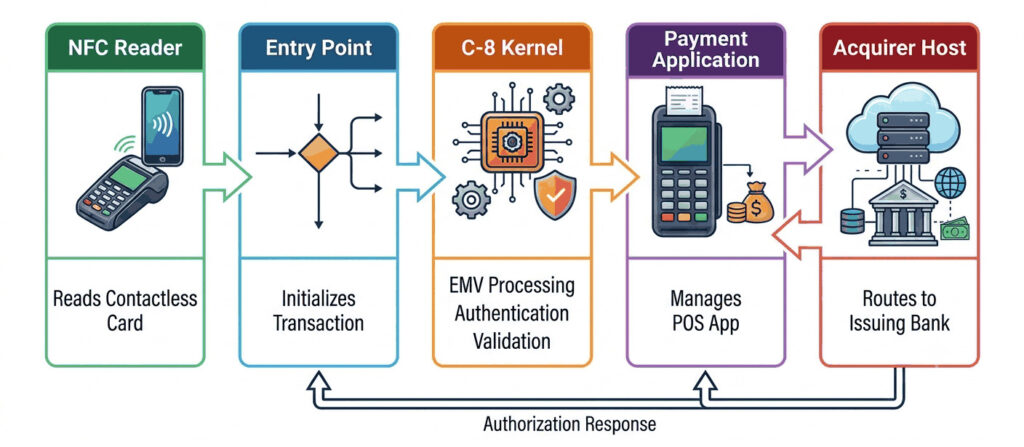
A modular architecture can help separate the responsibilities of the reader, Entry Point, contactless kernel and payment application.
Typical EMV C-8 Software Architecture
Contactless Card / NFC Mobile Device
↓
NFC Reader and Contactless Interface
↓
EMV Entry Point – Application Selection and Kernel Activation
↓
EMV C-8 Kernel – Contactless Transaction Processing
↓
POS Payment Application – Transaction Management
↓
Acquirer Host and Payment Processing Infrastructure
The exact interfaces and responsibilities must follow the applicable EMV specifications and product design.
3.1 Integrate the Contactless Reader Interface
The reader interface should provide the required communication between the NFC hardware and contactless software environment.
The integration should address:
- Reader initialisation
- Card or device detection
- Contactless communication
- Command and response handling
- Communication error management
- Reader configuration
3.2 Integrate the Entry Point
The Entry Point manages the selection and activation of the applicable contactless kernel.
For a multi-kernel terminal, the implementation must correctly manage supported application and kernel combinations.
Validate the interfaces between the reader, Entry Point and kernel according to the applicable requirements.
3.3 Integrate the EMV C-8 Kernel
The C-8 kernel must be integrated into the intended software environment.
The implementation should account for:
- Kernel initialisation
- Configuration and supported options
- Input data and transaction parameters
- Card communication
- Required EMV data exchanges
- Processing outcomes
- Error and exception handling
3.4 Connect the POS Payment Application
The payment application coordinates the overall transaction environment.
It typically manages:
- Transaction amount and currency
- Merchant and terminal configuration
- Transaction initiation
- Kernel invocation through the appropriate architecture
- Online authorisation communication
- Transaction response handling
- Receipt and transaction records
4. Implement the EMV C-8 Kernel Software
With the architecture defined, the engineering team can proceed with kernel implementation and integration.
This stage requires attention to the applicable C-8 specification, implementation options, configuration and software interfaces.
4.1 Review Kernel Interface Requirements
Study the required kernel interfaces and the data exchanged between the kernel and the surrounding terminal environment.
Identify:
- Required input parameters
- Kernel configuration data
- Card communication requirements
- Processing commands and responses
- Output data and transaction outcomes
- Error and exception conditions
4.2 Configure Supported Features and Options
Identify the features and options supported by the selected kernel implementation.
The team must distinguish between mandatory specification requirements, optional implementation features and configuration-dependent behaviour.
Document the selected configuration so that software implementation, test environment and approval submission remain aligned.
4.3 Implement Transaction Data Handling
The kernel and surrounding terminal software must correctly handle the data required by the applicable specification.
The development team should validate:
- Input data
- Data formats and lengths
- Required data exchanges
- Data availability
- Processing conditions
- Output and status information
Incorrect data handling can lead to transaction failures or unexpected processing behaviour.
4.4 Implement Error and Exception Handling
A production-ready POS terminal must handle unexpected conditions consistently.
Examples include:
- Contactless communication interruption
- Card removal during processing
- Unsupported application or configuration
- Invalid or unavailable data
- Reader communication errors
- Kernel processing errors
- Transaction timeout conditions
The terminal should handle each condition according to the applicable specification and product requirements.
4.5 Validate Kernel and Application Interfaces
After integration, verify that the payment application correctly communicates with the kernel environment.
Check that the application:
- Provides the required transaction information
- Invokes the correct processing path
- Receives the expected kernel outcome
- Handles transaction continuation or termination
- Records the appropriate transaction status
5. Integrate Security and Key Management Requirements
Security must be considered throughout the EMV C-8 implementation lifecycle.
EMV C-8 includes security-related capabilities such as Secure Channel and Elliptic Curve Cryptography (ECC) for card authentication. The implementation must follow the applicable specification requirements and supported features.
5.1 Secure Communication
Review the communication security requirements relevant to the implementation.
Understand how the applicable security mechanisms protect sensitive information and address communication threats.
5.2 Cryptographic Processing
Evaluate the cryptographic functions required by the implementation.
This includes understanding:
- Supported cryptographic algorithms
- Authentication requirements
- Key-related operations
- Secure processing responsibilities
- Platform compatibility
5.3 Key Management
Key management should be designed according to the applicable EMV security requirements and the product’s security architecture.
Document the responsibilities of the kernel, terminal platform and other relevant components.
5.4 Protect Sensitive Payment Data
Review how sensitive information is handled across the reader, kernel, payment application and terminal platform.
Access control, secure storage, data handling and applicable security controls should be incorporated into the complete payment device design.
[VISUAL 5: PAYMENT SECURITY LAYERS – Insert an infographic showing secure communication, cryptographic processing, key management and sensitive data protection.]
6. Integrate the Kernel with Different POS Terminal Platforms
The implementation approach can vary depending on the target POS terminal platform.
6.1 Android POS Terminal Integration
Android POS terminals generally combine an Android operating system, NFC reader, payment application and device-specific software components.
Evaluate:
- Android platform compatibility
- NFC hardware integration
- Native software interfaces
- Kernel integration method
- Application communication
- Device resource management
- Software update and maintenance requirements
Validate the kernel integration on the actual target hardware rather than relying only on a development environment.
6.2 Linux POS Terminal Integration
Linux-based payment terminals may use a modular architecture with separate reader, kernel, application and communication services.
The development team should validate:
- Hardware driver compatibility
- Software library integration
- Process and memory management
- Inter-process communication
- Kernel and application interfaces
- Platform-specific build and deployment requirements
6.3 Existing Multi-Kernel POS Terminal
Some manufacturers already have terminals that support multiple contactless kernels.
In these environments, C-8 integration requires careful consideration of the existing Entry Point, kernel selection mechanism and supported application combinations.
Validate the complete configuration and ensure that the new implementation does not unintentionally affect existing supported payment applications or kernels.
6.4 Mobile and SoftPOS Considerations
Mobile payment acceptance introduces additional device and security considerations.
A SoftPOS solution uses compatible NFC-enabled mobile devices to accept contactless payments.
However, integrating an EMV kernel alone does not make a smartphone-based payment solution compliant. The complete solution must meet the applicable device, software, security and payment acceptance requirements.
[VISUAL 6: POS PLATFORM COMPARISON – Insert three side-by-side illustrations showing Android POS, Linux POS and SoftPOS.]
7. Perform Functional and Integration Testing
Testing should begin during development rather than being postponed until the kernel is fully integrated.
A structured testing approach helps identify issues early and improves product readiness.
7.1 Kernel-Level Functional Testing
Test the kernel implementation against the relevant functional requirements.
Check:
- Kernel initialisation
- Supported configuration
- Input and output data
- Processing behaviour
- Error handling
- Expected transaction outcomes
7.2 Reader and Kernel Integration Testing
Verify communication between the contactless reader and kernel.
Testing should cover reader initialisation, contactless communication, data exchange and relevant failure conditions.
7.3 Entry Point and Kernel Testing
Validate the interaction between the Entry Point and C-8 kernel.
Check application selection, kernel activation and transaction processing coordination against the applicable requirements.
7.4 Payment Application Integration Testing
Verify that the payment application correctly handles kernel outcomes and continues the transaction through the appropriate processing path.
Test the interaction with the acquiring host where online authorisation is required.
7.5 Platform and Regression Testing
Run testing on the actual target POS terminal.
Evaluate:
- Device stability
- Memory and CPU utilisation
- Transaction performance
- Reader communication reliability
- Software compatibility
- Existing payment application behaviour
- Regression after software changes
[VISUAL 7: EMV C-8 TESTING WORKFLOW – Insert a horizontal flow diagram: Kernel Testing → Reader Integration → Entry Point Testing → Application Testing → Platform Testing → Regression Testing.]
8. Prepare for EMVCo C-8 Testing and Approval
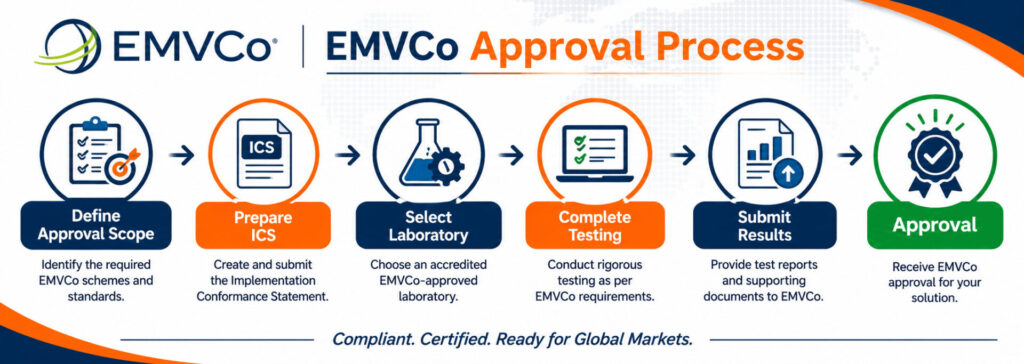
After implementation and internal validation, the product provider must prepare for the applicable EMVCo testing and approval process.
The approval route depends on whether the submission is for a standalone C-8 kernel or a complete contactless product.
8.1 Identify the Approval Scope
First, determine what is being submitted.
The relevant scope may be:
- Standalone Contactless Kernel C-8
- A complete contactless product containing C-8
- A product with multiple contactless kernels
- An updated or derivative product configuration
Approval of a standalone kernel does not automatically cover the complete POS terminal or contactless product.
8.2 Prepare the Implementation Conformance Statement (ICS)
The ICS documents the product implementation and supported features.
For a C-8 standalone submission, the applicable Contactless Kernel 8 ICS must be prepared. For a complete contactless product, the relevant product and kernel ICS documents must be considered.
The documentation should accurately reflect the implementation being tested.
8.3 Select an EMVCo-Recognised Laboratory
The product provider selects the appropriate laboratory for the relevant contactless product testing process.
Coordinate the submission requirements, testing environment, product configuration and required documentation with the selected laboratory.
8.4 Complete the Applicable Testing
The laboratory performs testing against the applicable requirements.
Relevant testing resources may include:
- Book C-8 test cases
- Book C-8 testing environment requirements
- Book C-8 reader configurations
- Applicable Entry Point test cases, where relevant
The exact testing scope depends on the product and approval route.
8.5 Submit the Product for Approval
After receiving the laboratory test report, the product provider can proceed with the applicable EMVCo approval submission.
For conforming products, EMVCo evaluates the reports and issues the relevant Letter of Approval (LOA), subject to the applicable process and requirements.
Important: EMVCo distinguishes between standalone C-8 kernel approval and complete contactless product approval. A standalone kernel approval does not automatically approve the reader, Entry Point, complete terminal or payment application.
9. Deploy and Maintain the EMV C-8 POS Terminal Implementation
Implementation does not end when development and testing are complete.
Manufacturers should plan for deployment, software maintenance and product configuration management.
9.1 Maintain Approved Product Configuration
Maintain records of the tested and approved product configuration, including relevant software versions, kernel implementation and supported hardware environment.
9.2 Manage Software Updates
Any software or hardware changes should be assessed against applicable approval and product change requirements.
A change to the kernel, Entry Point, reader or other relevant product component may affect the approval status or require additional evaluation.
9.3 Monitor Device Performance
After deployment, monitor relevant operational indicators, including:
- Contactless transaction success and failure patterns
- Reader communication issues
- Application stability
- Software compatibility
- Device performance
- Transaction processing exceptions
9.4 Plan Long-Term Maintenance
Maintain technical documentation, version records, configuration details and issue-resolution processes.
This helps manufacturers manage product updates and support deployed POS terminal environments.
10. Common Challenges in EMV C-8 Kernel Implementation
Even with a defined implementation plan, POS terminal manufacturers may face several technical challenges.
| Implementation Challenge | Possible Impact | Recommended Approach |
|---|---|---|
| NFC reader compatibility | Contactless communication issues | Evaluate reader and hardware configuration early |
| Entry Point integration | Incorrect application or kernel selection | Validate applicable Entry Point requirements |
| Kernel interface mismatch | Transaction processing errors | Define and test software interfaces |
| Incorrect data handling | Failed or unexpected transaction outcomes | Validate data requirements against Book C-8 |
| Security integration gaps | Implementation and compliance risks | Include security in architecture planning |
| Platform differences | Inconsistent behaviour across devices | Test on actual target hardware |
| Incomplete test preparation | Delays during laboratory evaluation | Prepare ICS and testing configuration early |
| Uncontrolled software changes | Product approval and maintenance issues | Maintain configuration and change records |
Addressing these challenges early can help reduce integration risks and improve development efficiency.
11. EMV C-8 Implementation Checklist for POS OEMs
Before moving a POS terminal implementation towards formal testing, engineering teams should review the following checklist.
| Development Stage | Key Activities |
|---|---|
| Requirements | Review applicable EMV C-8 specifications |
| Product Planning | Define standalone kernel or complete product scope |
| Hardware | Evaluate NFC reader, antenna and processor |
| Architecture | Define reader, Entry Point, kernel and application interfaces |
| Kernel Integration | Implement and configure C-8 |
| Payment Application | Integrate transaction management and host communication |
| Security | Review cryptographic and key-management requirements |
| Functional Testing | Validate kernel processing and error handling |
| Integration Testing | Test reader, Entry Point and payment application |
| Documentation | Prepare applicable ICS documents |
| Laboratory Testing | Complete the relevant test process |
| Approval | Submit the applicable product for EMVCo approval |
| Deployment | Maintain approved configuration and software versions |
Planning these activities early can help manufacturers identify integration risks and improve development readiness.
12. How EazyPay Tech Supports EMV Kernel Implementation for POS Terminals
Implementing a contactless payment solution requires expertise across EMV specifications, payment software, terminal integration, security and certification preparation.
EazyPay Tech supports banks, fintech companies, payment service providers, OEMs and POS terminal manufacturers with payment technology engineering services.
12.1 EMV Kernel Development and Integration
We support EMV kernel development and integration requirements for contact and contactless payment acceptance environments.
12.2 POS Terminal Software Development
We support payment application software development and integration for Android POS terminals and other payment acceptance platforms.
12.3 EMV L2 and L3 Certification Support
We support terminal manufacturers and payment solution providers with EMV Level 2 kernel and Level 3 terminal integration and certification requirements.
12.4 Contactless Payment Integration
We support contactless payment implementation requirements involving terminal software, reader interfaces and payment application integration.
12.5 SoftPOS Development
We support mobile payment acceptance requirements through SoftPOS application development, SDK integration and related payment technology capabilities.
12.6 Payment Security and Compliance
We support payment technology organizations with relevant PCI compliance, payment security and certification-related requirements.
Whether you are developing a new POS terminal, integrating an EMV C-8 kernel into an existing device or preparing a contactless product for testing, selecting the right implementation approach is an important first step.
Implementing an EMV C-8 kernel in a POS terminal requires a structured approach covering specification review, hardware evaluation, software architecture, kernel integration, security, testing and approval preparation.
For POS OEMs and engineering teams, the key is to plan the complete contactless acceptance environment rather than treating the kernel as an isolated software component.
A well-planned implementation can help manufacturers build reliable contactless payment devices, manage integration complexity and prepare their products for the applicable EMVCo evaluation process.
Planning EMV C-8 Kernel Implementation for Your POS Device?
EazyPay Tech supports POS manufacturers, OEMs, banks and fintech companies with EMV kernel development, POS terminal software integration and certification-related requirements.
Discuss your EMV kernel implementation requirements with EazyPay Tech.