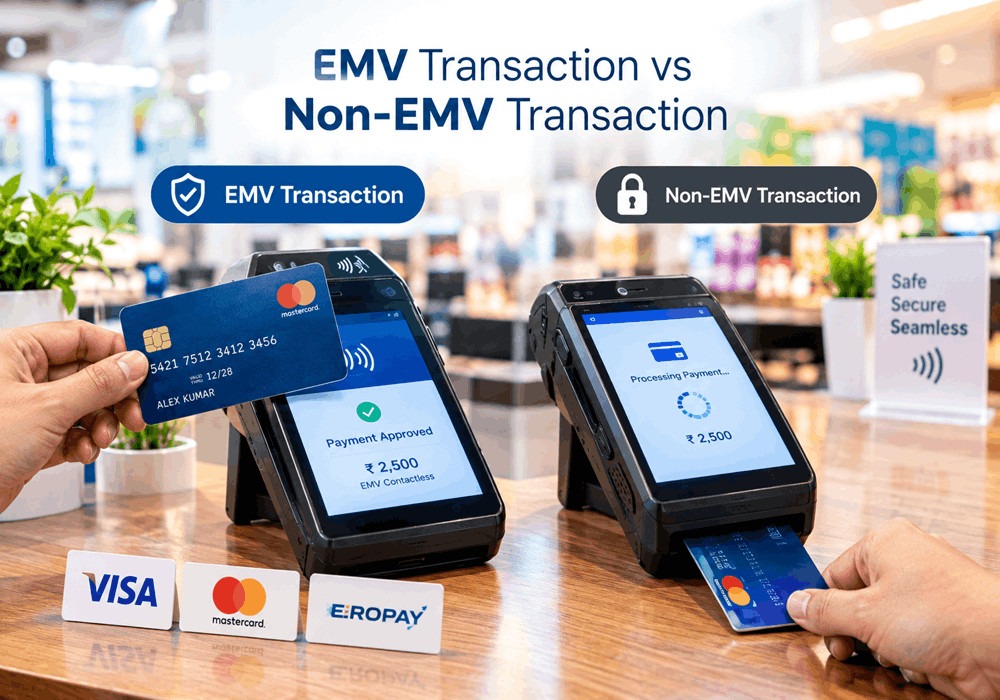
In today’s global payment ecosystem, security, interoperability, and compliance are not optional; they are fundamental requirements for the acceptance of electronic transactions. EMV certification sits at the very center of this landscape. Named after its original creators EuroPay, Mastercard, and Visa EMV has become the global standard for secure payment card transactions using chip technology. Over time, the framework has been adopted and extended by card networks and regulatory bodies around the world, ensuring that payment devices, terminals, and software applications interact securely with chip-enabled cards across different markets.
However, while the EMVCo specifications establish the common ground for all players in the industry, each major payment scheme Visa, Mastercard, RuPay, UnionPay, and historically EuroPay introduces its own unique requirements, additional test cases, and certification paths. These variations create complexity for device manufacturers, financial institutions, and fintech companies aiming to achieve compliance and market readiness across multiple regions. Understanding these differences is critical for any business looking to launch or expand payment solutions in global markets.
This blog provides a comprehensive, detailed, and technical comparison of EMV certification requirements across the world’s leading payment schemes. It examines what remains consistent under the EMVCo framework, where schemes diverge with brand-specific rules, and how organizations like EazyPay Tech help manufacturers and financial institutions navigate this complex landscape.
EMV Certification
EMV, which stands for EuroPay, Mastercard, and Visa, was introduced in the 1990s to combat fraud associated with magnetic stripe cards. Chip cards, unlike magstripe cards, contain microprocessors capable of performing secure cryptographic operations, making it significantly harder for fraudsters to clone or misuse them.
To ensure that every card interacts reliably with every terminal or ATM worldwide, EMV introduced a certification process. This process ensures that:
- Devices comply with hardware communication requirements (Level 1).
- Kernels the software implementing EMV transaction logic comply with EMVCo specifications (Level 2).
- Full transaction flows between cards, terminals, and acquiring hosts operate correctly under real-world conditions (Level 3).
The ultimate objective of EMV certification is interoperability and trust. A certified terminal should accept a certified card anywhere in the world without errors or security risks.
The Common Ground – EMVCo Framework
The global foundation for certification comes from EMVCo, the consortium originally formed by EuroPay, Mastercard, and Visa, and now owned by six major payment networks (Visa, Mastercard, American Express, Discover, JCB, and UnionPay). EMVCo defines the baseline requirements:
- Level 1 (L1): Focuses on the physical and electrical characteristics of communication between the card and terminal. This ensures that the chip on the card can communicate with the reader through contact or contactless interfaces consistently.
- Level 2 (L2): Focuses on the kernel, which implements EMV transaction logic, cryptographic processing, and risk management. Each terminal typically includes multiple L2 kernels to support different schemes.
- Level 3 (L3): Focuses on the end-to-end transaction process, including host communication, acquirer integration, and scheme-specific business rules. This is where scheme-level differences become significant.
While EMVCo manages L1 and L2 approval processes centrally, Level 3 certification is delegated to each card scheme, which means Visa, Mastercard, RuPay, and UnionPay all have different approaches.
Visa EMV Certification
Visa is one of the largest and most widely recognized payment networks in the world, with acceptance in nearly every country. Visa certification is therefore one of the most critical requirements for OEMs and payment solution providers.
Key Features of Visa Certification
- Visa mandates support for Visa Smart Debit/Credit (VSDC) for contact cards.
- For contactless, Visa uses qVSDC (Quick Visa Smart Debit/Credit), a streamlined protocol optimized for faster NFC transactions.
- Visa certification covers not only POS terminals but also ATMs, SoftPOS solutions, and mobile payment applications.
Testing Tools and Process
- Visa provides its own test suites and scripts to validate end-to-end transaction flows.
- Visa Level 3 testing ensures correct interaction with the VisaNet system and host acquirers.
- Only Visa-accredited laboratories can perform Visa certification tests.
Unique Requirements
- Visa has stricter rules for contactless transaction speed, requiring transactions to complete in less than half a second in many markets.
- Visa places emphasis on risk parameters, such as floor limits, CVM (Cardholder Verification Method) hierarchies, and offline data authentication.
Certification Authority
- Final approval is issued by Visa in the form of a Letter of Approval (LoA), without which devices cannot be deployed.
Mastercard EMV Certification
Mastercard has its own certification process, which, while aligned with EMVCo at Levels 1 and 2, differs significantly at Level 3.
Key Features of Mastercard Certification
- Mastercard requires terminals to support PayPass for contactless payments.
- Certification ensures compliance with M-TIP (Mastercard Terminal Integration Process), which validates correct end-to-end behaviour.
Testing Tools and Process
- The M-TIP test suite is central to Mastercard certification.
- Testing verifies support for both Single Message System (SMS) and Dual Message System (DMS) flows, since Mastercard processes transactions differently depending on the region and acquirer.
Unique Requirements
- Additional test cases are required for terminals that will process Maestro transactions, Mastercard debit, and prepaid cards.
- Mastercard has very detailed fallback and error handling requirements, ensuring that terminals respond consistently to declined or interrupted transactions.
Certification Authority
- After successful completion, Mastercard lists the device on its Vendor Approval File (VAF), which is the reference database for all certified devices globally.
RuPay EMV Certification (NPCI – India)
RuPay, launched by the National Payments Corporation of India (NPCI), is India’s domestic card network. It has grown significantly under government initiatives and now processes billions of transactions annually.
Key Features of RuPay Certification
- Supports debit, credit, and prepaid cards across POS and ATM channels.
- Certification often includes India-specific requirements, such as Aadhaar-enabled authentication in certain environments.
- With the rise of UPI (Unified Payments Interface), hybrid devices that support both RuPay and UPI must undergo special testing.
Testing Tools and Process
- NPCI provides its own RuPay certification toolkit for Level 3 testing.
- Testing includes end-to-end host validation with NPCI’s domestic processing systems.
Unique Requirements
- RuPay mandates support for NCMC (National Common Mobility Card), which is India’s initiative to unify transit, retail, and banking payments under one card.
- Domestic regulations such as PIN-mandatory requirements on certain amounts are enforced.
- NPCI also requires interoperability with Aadhaar Payment Bridge (APB) in specific government projects.
Certification Authority
- NPCI issues a Letter of Approval (LoA) once testing is successfully completed. Terminals without this cannot process RuPay transactions in India.
UnionPay EMV Certification (China UnionPay)
China UnionPay (CUP) is the dominant card network in China and has expanded internationally under UnionPay International (UPI).
Key Features of UnionPay Certification
- UnionPay contactless technology is branded as QuickPass.
- Certification covers both domestic Chinese transaction flows and international acceptance through partner banks.
Testing Tools and Process
- UnionPay provides its own L3 test suites.
- Testing is typically more fragmented because it must account for both Chinese domestic host systems and global partner networks.
Unique Requirements
- UnionPay requires different testing for domestic-only terminals versus terminals intended for cross-border acceptance.
- UnionPay mandates acceptance of mobile wallets linked to UnionPay, such as Huawei Pay and Oppo Pay, in addition to physical cards.
- Cryptographic keys and transaction limits are often region-specific.
Certification Authority
- Certification is issued by UnionPay International, with separate approval processes for domestic and global deployments.
EuroPay: Historical Context
EuroPay was one of the three original partners in the creation of EMV standards. Today, however, EuroPay as a standalone brand no longer exists. Its legacy continues primarily through two European payment systems:
- V-Pay, operated by Visa.
- Maestro, operated by Mastercard.
For practical purposes, EuroPay certification requirements today align with either Visa or Mastercard depending on the card product.
Comparative Analysis
Although all schemes rely on EMVCo for L1 and L2, their L3 requirements diverge significantly. Below is a high-level comparison:
Aspect | Visa | Mastercard | RuPay (NPCI) | UnionPay | EuroPay (legacy) |
L1 Certification | EMVCo standard | EMVCo standard | EMVCo standard | EMVCo standard | EMVCo standard |
L2 Kernel Extensions | qVSDC | PayPass | RuPay kernel, NCMC support | QuickPass | Legacy via V-Pay/Maestro |
L3 Toolkit | Visa test scripts | M-TIP | NPCI test suite | CUP test suite | N/A |
Special Flows | VSDC/qVSDC | SMS/DMS flows | Aadhaar, UPI, NCMC | Domestic vs. international | Migrated to Visa/Mastercard |
Certification Body | Visa | Mastercard | NPCI | UnionPay International | Visa/Mastercard |
Challenges in Multi-Scheme EMV Certification
For manufacturers and fintech companies, the need to certify across multiple schemes presents significant challenges:
- Time and Cost: Each scheme requires separate testing, increasing project timelines and costs.
- Technical Complexity: Differences in EMV kernels, cryptographic requirements, and transaction flows require specialized expertise.
- Regional Regulations: Domestic rules (like PIN mandates in India or mobile wallet requirements in China) complicate global deployment.
- Evolving Standards: With the rise of SoftPOS, wearables, and cloud-based kernels, certification requirements are constantly evolving.
Future of EMV Certification Across Schemes
The payments industry is moving towards greater convergence. Some future trends include:
- Cloud-based certification processes that reduce testing cycles.
- Alignment of contactless standards as NFC adoption grows globally.
- Integration of digital wallets alongside traditional EMV cards.
- Influence of PCI MPoC standards on SoftPOS and mobile acceptance.
- Growing competition from domestic networks like RuPay and UnionPay, pushing Visa and Mastercard to innovate faster.
Role of EazyPay Tech in EMV Certification
For OEMs, banks, and fintechs, navigating these diverse certification landscapes is not easy. This is where EazyPay Tech plays a crucial role. With deep expertise in EMV kernel development/ EMV Software, EMV L1/L2 certification, and scheme-specific L3 testing, EazyPay Tech helps payment providers accelerate time-to-market while ensuring compliance with global and domestic requirements.
EazyPay Tech supports:
- POS terminals, ATMs, SoftPOS, Contact and contactless payment terminals.
- Multi-scheme kernel integration covering Visa, Mastercard, RuPay, and UnionPay.
- End-to-end certification consultancy from design to approval.
- Regional deployment strategies, ensuring OEMs can expand seamlessly into markets like India, China, Europe, and beyond.
EMV certification is both a unifying global standard and a fragmented process that varies across payment schemes. While EMVCo provides the foundation through L1 and L2 certification, Visa, Mastercard, RuPay, and UnionPay each impose their own requirements at Level 3. For manufacturers and financial institutions, this means navigating a complex landscape of testing tools, regional regulations, and certification authorities.
By partnering with a trusted expert like EazyPay Tech, organizations can streamline this process, reduce time to market, and ensure their devices and applications are fully compliant across all major schemes. As payments evolve towards mobile-first, contactless, and cloud-based environments, certification will remain a cornerstone of trust and interoperability in the financial ecosystem.