
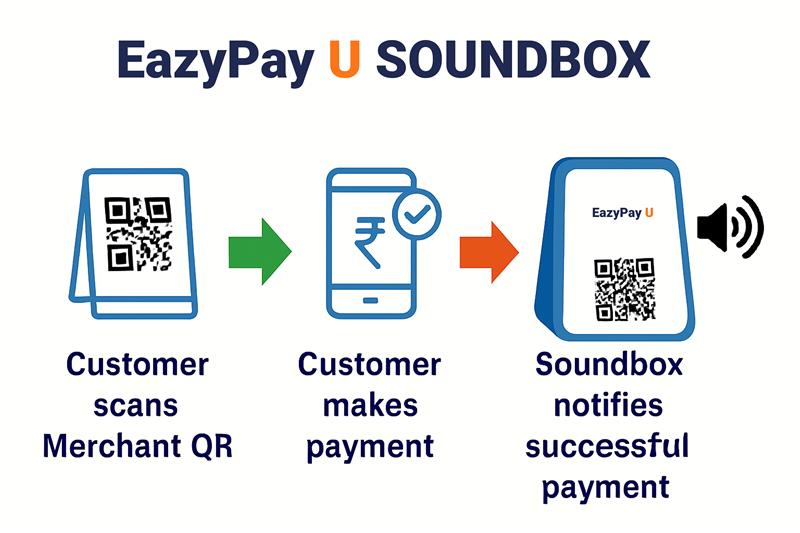
1. Provisioning and Activation
- Activation: The activation of a Payment Soundbox via TMS involves secure device provisioning, where the terminal sends its serial number and encrypted identifiers to the TMS, which authenticates the device, binds it to a merchant account, and responds with activation status and encrypted keys for secure operation. Certification ensures the soundbox meets compliance standards (EMV Certification, PCI, secure firmware), while TMS securely manages and delivers encryption/authentication keys—such as TMK, WK, keys using encrypted channels, enabling secure transaction processing, audio playback, and key lifecycle management.
- Dynamic QR Code Assignment to Devices: The TMS allows seamless allocation of merchant-specific QR codes to individual soundboxes, ensuring that each device is linked uniquely to a specific merchant ID for accurate payment routing.
- Communication Parameter Configuration: The TMS remotely configures essential settings such as the Access Point Name (APN) for SIM-based data connectivity, static or dynamic server IP addresses, and region-specific language preferences for voice alerts, ensuring localized usability.
2. Firmware Management
- OTA (Over-The-Air) Firmware and Software Updates: TMS can remotely deliver new firmware packages and application-level updates to the soundboxes without manual intervention, reducing on-site service costs and ensuring all devices stay current.
- Rollback and Fail-Safe Mechanisms: In case of failed updates or corrupted firmware, the TMS has rollback protocols to revert the device to the last known stable version, ensuring uninterrupted payment functionality.
3. Health Monitoring
- Real-Time Device Status (Online/Offline): The system continuously monitors the connectivity state of each soundbox, providing insights into whether the device is active, idle, or disconnected from the network.
- Vital Device Stats – Battery, Signal, Connectivity: Health dashboards track parameters like battery charge level, SIM signal strength, and data connectivity quality, enabling early detection of hardware or network issues that may disrupt transactions.
4. Remote Command Execution
- Reboot Devices from Cloud Panel: When issues arise, such as hanging or unresponsive devices, TMS enables support teams to remotely restart the soundbox, avoiding the need for physical service.
- Factory Reset Control: TMS can initiate a full reset, wiping merchant credentials, settings, and cached data, typically used during redeployment or in case of fraud suspicion.
5. Logs and Diagnostics
- Remote Log Retrieval: Device-generated logs (including system activity, transactions, errors) can be pulled from the field to the central TMS for analysis, greatly reducing manual debugging time.
- Payment Trend Analytics (Success/Failure): TMS analyses payment attempt patterns across devices, highlighting abnormal spikes in failures or delays that might indicate server/API issues or device-level faults.
- Root Cause Diagnostics via Logs: By studying device logs and transaction metadata, the system can isolate problems like QR scan errors, voice playback issues, or SIM failures, enabling precise remote troubleshooting.
6. Security Management
- Remote Enable/Disable of Devices: In case of device theft, tampering, or merchant account deactivation, the TMS can instantly disable soundbox functionality, locking out payment capabilities.
- Security Patch Management: Vulnerability fixes, SSL/TLS updates, and compliance-related patches can be securely pushed to the device fleet to meet PCI-DSS, RBI, or local fintech regulatory standards.
7. Reporting and Analytics
- Usage Pattern Insights: The TMS provides detailed usage reports showing transaction volume, voice playback frequency, QR code scans, and network availability, helping understand merchant activity.
- Merchant Activity Dashboard: Displays the top-performing merchants by transaction value or count, helping financial institutions identify valuable relationships or sales opportunities.
- Failure Heatmaps and Predictive Maintenance: TMS uses geospatial and time-based analytics to visualize where devices frequently fail or disconnect, allowing proactive servicing or network optimization in those high-failure zones.
Remote Commands in Payment Soundbox TMS
The Terminal Management System (TMS) enables powerful remote command execution features that empower backend administrators and technical support teams to control, update, and troubleshoot payment soundboxes deployed in the field all without requiring physical access to the devices. This real-time interaction ensures maximum uptime, improved merchant satisfaction, and significant reduction in service costs.
Common Remote Commands and Their Use Cases
1. Reboot Device (Soft Restart)
The TMS can remotely initiate a soft reboot of the soundbox, which restarts the operating environment without wiping data.
- Ideal for addressing temporary freezes, lag in voice playback, payment delay issues, or connectivity drops.
- This command is typically used as the first line of troubleshooting, helping restore normal function without waiting for the merchant to take action.
2. Factory Reset
- This command restores the device to its original factory settings, including default firmware, configuration files, and system language.
- Crucial for:
- Reassigning the soundbox to a new merchant.
- Wiping data after fraudulent activity or suspicious access.
- Ensuring a clean slate before issuing a replacement or sending the device for repair.
- TMS ensures secure resets with authentication checks to prevent misuse.
3. Change Language Remotely
- Allows administrators to switch the soundbox’s voice output language as per the merchant’s regional preference.
- Popular language options may include English, Hindi, Tamil, Telugu, Bengali, Marathi, or Gujarati, depending on the deployment region.
- Enhances merchant experience and inclusivity by supporting vernacular interfaces.
- Eliminates the need for customer support to physically access the device just to update language settings.
4. Adjust Speaker Volume
- Enables the technical team to remotely set or modify the speaker volume for payment confirmation announcements or voice alerts.
- Useful for:
- Reducing noise in small stores, quiet offices, or healthcare environments.
- Increasing volume in crowded or noisy retail spaces like malls, markets, or fuel stations.
- Helps maintain clear communication with merchants and customers without requiring manual adjustment.
5. Push Custom Voice Notifications
- TMS can broadcast custom audio messages directly to the soundbox speaker.
- Use Cases:
- Festive greetings to build merchant loyalty (e.g., “Happy Diwali from EazyPay Tech!”).
- Marketing messages for new features, partner promotions, or cashback campaigns.
- Compliance alerts, such as policy updates or transaction limits.
- Enables a direct and audible communication channel with every deployed soundbox.
6. Update QR Mapping
- Remotely change or update the merchant’s linked UPI QR code or backend PSP account, without physical scanning or resetting the device.
- Use Cases:
- Merchant account upgrades or switching payment service providers (PSPs).
- Correcting QR assignment errors post-deployment.
- Assigning new sub-merchant accounts under a parent distributor.
- Enhances flexibility, reduces downtime, and avoids any disruption in payment processing.
7. Network Switch Command
- Allows TMS to instruct the soundbox to switch its active network mode—for example, from GPRS to 4G LTE or to Wi-Fi, depending on the local connectivity conditions.
- Helps optimize device performance by:
- Resolving network instability or SIM signal drop issues.
- Enabling Wi-Fi connectivity in broadband-enabled stores to save SIM data costs.
- This command is particularly helpful in multi-network fallback enabled soundboxes.
8. Location Ping (Geo Tracking Support)
- If the soundbox supports GPS or cell tower triangulation, the TMS can trigger a location ping to fetch the approximate real-time geographic location of the device.
- Applications:
- Theft detection or loss recovery.
- Field audit support to verify deployment locations.
- Geo-anchoring promotions or QR assignments to specific service areas.
- Data privacy and access control measures are enforced to maintain compliance with regional data protection regulations.
Benefits of Remote Command Execution in TMS
- Minimized Downtime: Remote fixes ensure that merchants experience zero to minimal interruptions in receiving customer payments.
- Reduced Field Support Costs: Avoids the need to dispatch technicians for common issues like frozen devices or language changes.
- Real-Time Merchant Assistance: Enables quick resolution of technical complaints, improving merchant satisfaction and retention.
- Centralized Device Control: Makes large-scale deployments more manageable by allowing bulk actions and monitoring from a central cloud dashboard.
- Enhanced Operational Efficiency: Each remote command reduces response time, enabling teams to focus on growth rather than firefighting.