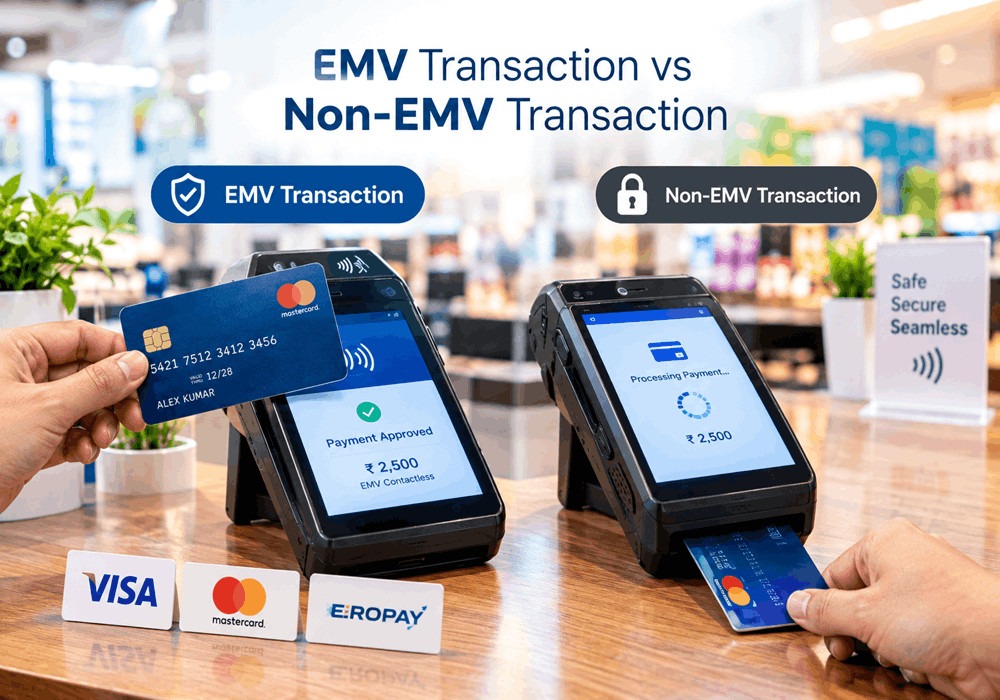


Every time a payment card is inserted, tapped, or waved at a POS terminal, a complex sequence of rules quietly determines whether the transaction is approved, declined, or sent online for authorization.
At the heart of this decision-making framework lies the Terminal Action Code (TAC) — a crucial element in EMV technology that governs how terminals respond to various risk conditions.
For terminal manufacturers, acquirers, and EMV kernel developers, understanding TAC is not optional. It defines the behavioral intelligence of a payment terminal, ensures compliance with global EMV standards, and directly impacts transaction security and customer trust.
At EazyPay Tech, we specialize in EMV kernel development, EMV Level 2 and EMV Level 3 certification, and terminal risk management testing helping OEMs and fintech’s configure, validate, and certify TAC logic for both contact and contactless payment environments.
What is a Terminal Action Code (TAC)?
A Terminal Action Code (TAC) is a five-byte configuration parameter embedded within an EMV enabled terminal. It defines how the terminal reacts when certain predefined risk conditions are detected during a transaction.
It operates in close association with:
- Issuer Action Code (IAC): Parameters programmed by the card issuer that determine how the card reacts to specific risk events.
- Terminal Verification Results (TVR): A five-byte record generated during the transaction that logs all detected exceptions or conditions such as card expiry, offline data authentication failure, or exceeded floor limit.
The TAC is compared with the IAC and the TVR to determine one of three possible outcomes:
- Approve offline
- Decline offline
- Request online authorization
Types of Terminal Action Codes
- TAC–Denial
Defines the conditions that immediately trigger an offline decline — without any attempt to reach the issuer.
Descriptive Highlights:
- Enforces strict denial logic when the card or transaction presents unacceptable risk factors.
- Typically used when the TVR indicates that critical security conditions have failed, such as card expired, offline PIN verification failed, or suspected counterfeit data.
- Helps ensure that potentially fraudulent transactions never reach the issuer for authorization, thus preventing unnecessary network traffic and liability exposure.
- Common in high-risk industries like fuel dispensing, transit, and unattended kiosks where online connectivity may be intermittent but risk tolerance is minimal.
- TAC–Online
Identifies the conditions under which the terminal must seek online authorization before approving the transaction.
Descriptive Highlights:
- Serves as a safety checkpoint, ensuring that the issuer has final authority over risky or high-value transactions.
- Typically includes risk parameters such as floor limit exceeded, offline data authentication not performed, or transaction amount unusually high.
- Ensures that all transaction approvals above a certain threshold are verified through issuer authorization, preventing offline approvals in gray areas.
- Enables real-time risk scoring, balance checks, and fraud monitoring when the terminal connects to the payment network.
- TAC–Default
Used when the terminal cannot establish a connection for online authorization yet detects risk conditions that normally require it.
Descriptive Highlights:
- Acts as a fail-safe measure to prevent risky offline approvals during network or system outages.
- If the terminal attempts to go online but fails, and any condition set in TAC–Default matches the TVR bits, the transaction must be declined.
- Protects both merchants and issuers from liability in cases of connectivity failure, system downtime, or temporary communication loss.
- Particularly relevant in mobile POS, SoftPOS, or semi-connected terminal environments where internet stability can fluctuate.
How Terminal Action Codes Work in EMV Transactions
The TAC mechanism is part of the EMV risk management framework that ensures every payment transaction follows a structured decision-making process.
Step 1: Transaction Initiation
- The customer presents a chip card or contactless card to the terminal.
- The terminal reads EMV chip data, identifies the card scheme, and starts the application processing.
- The EMV kernel retrieves transaction parameters like amount, terminal country code, and transaction type, then begins verification.
Step 2: Generation of Terminal Verification Results (TVR)
- The terminal checks various risk parameters and encodes the results in the 5-byte TVR.
- Each bit represents a specific condition (e.g., “Card expired”, “Offline PIN failed”, “Floor limit exceeded”).
- The TVR becomes the basis for evaluating whether the transaction is safe to process offline or requires online authorization.
Step 3: TAC and IAC Comparison
- The EMV kernel compares the TVR bits against TAC–Denial and IAC–Denial.
- If a match is found, the terminal immediately declines the transaction.
- If not, it checks TAC–Online and IAC–Online parameters.
- If a match occurs, the terminal initiates online authorization.
Step 4: Decision Execution
- If TAC–Denial triggered: Transaction is declined offline.
- If TAC–Online triggered: Terminal connects to issuer host for authorization.
- If TAC–Default triggered (and network is unavailable): Transaction is declined.
- If no match: The terminal may approve the transaction offline.
This layered structure ensures consistency, compliance, and traceability in every EMV transaction decision.
The Relationship Between TAC and Security
Terminal Action Codes form a critical component of terminal-side risk management. They act as a security filter that determines how deeply each transaction should be scrutinized.
Key Security Advantages:
- Fraud Mitigation: Prevents high-risk or counterfeit transactions from being approved offline.
- Issuer Control: Enforces online authorization for transactions that exceed the issuer-defined thresholds.
- Compliance Alignment: Ensures every transaction follows EMVCo, PCI, and scheme-specific security rules.
- Risk Segmentation: Allows different merchant categories to apply customized TAC logic based on transaction patterns.
- Liability Reduction: Shifts liability away from acquirers when TAC configurations prove that proper risk controls were in place.
Setting TAC Values in Terminals
Payment networks such as Visa, Mastercard, and RuPay provide standardized TAC recommendations. However, terminal vendors may customize these based on business type, regional rules, or network connectivity.
Example TAC Settings:
|
Type |
Sample Hex Value |
Function |
|
TAC–Denial |
00 10 00 00 00 |
Decline if expired card or authentication failure detected. |
|
TAC–Online |
58 40 04 F8 00 |
Trigger online authorization for high-risk or high-value transactions. |
|
TAC–Default |
58 40 00 A8 00 |
Decline when network connectivity is unavailable during risk-triggered transactions. |
EazyPay Tech’s EMV Certification services validate these configurations during L2 certification, ensuring that all TAC responses align with scheme mandates and regional security policies.
Factors Affecting TAC Configuration
The right TAC setup varies across industries, terminal types, and risk environments.
Key Influencing Factors:
- Business Category:
- Retail stores prioritize quick approvals and may adopt lenient TAC–Online parameters.
- Fuel stations or transport terminals adopt stricter TAC–Denial rules due to unattended operation.
- Transaction Frequency and Value:
- High-value or B2B environments enforce tighter TAC settings to reduce exposure.
- Risk Tolerance:
- Conservative merchants prefer stricter TAC rules to avoid chargebacks.
- Regulatory or Scheme Requirements:
- Certain regions (e.g., Europe, India) mandate specific TAC–Default values for compliance.
- Terminal Connectivity:
- Always-online terminals can rely more on TAC–Online, while offline or rural deployments depend heavily on TAC–Denial safeguards.
Why TAC Matters in Payment Processing
Configuring TAC correctly ensures transaction security, performance consistency, and global interoperability.
Strategic Importance:
- Enhances Fraud Control: Prevents approval of invalid cards and counterfeit transactions.
- Optimizes Network Usage: Reduces unnecessary online authorization requests, saving time and cost.
- Supports EMV Certification: EMV Level 2 testing validates correct TAC operation as part of kernel logic.
- Improves Merchant Confidence: Ensures terminals behave predictably under all transaction conditions.
- Protects the Ecosystem: Harmonizes terminal behavior with card issuer expectations and EMV standards.
Common Challenges in TAC Implementation
Even experienced developers can face challenges during TAC integration and testing.
Frequent Issues:
- Incorrect Configuration:
- Overly restrictive TAC parameters cause genuine transactions to fail.
- Loose TAC setups may allow fraudulent transactions to pass.
- Both scenarios result in certification delays and potential scheme rejections.
- Outdated TAC Settings:
- Payment schemes frequently update TAC and IAC guidelines.
- Failure to align with the latest parameters can trigger certification test case failures.
- Connectivity Dependence:
- Excessive reliance on online authorization increases transaction decline rates in low-network regions.
- A balanced configuration between TAC–Online and TAC–Denial ensures operational stability.
Best Practices for TAC Management and EMV Compliance
To maintain reliability and certification readiness, EazyPayTech recommends these structured TAC management practices:
- Regular Review and Updates:
- Reassess TAC configurations quarterly or after any scheme mandate update.
- Maintain documentation for audit and compliance traceability.
- Pre-Deployment Testing:
- Validate terminal responses under different simulated network conditions using EazyPayTech’s EMV L2 test suites.
- Ensure that every TAC and IAC bit functions according to EMV specifications.
- Merchant and Staff Training:
- Educate front-line staff on TAC-triggered declines to avoid customer confusion.
- Create clear POS messaging that explains transaction rejections without revealing sensitive logic.
- Data-Driven Optimization:
- Analyze transaction logs periodically to identify TAC-related declines and refine configurations accordingly.
The Future of Terminal Action Codes
As the payment landscape transitions toward contactless, NFC, SoftPOS, and AI-driven payment environments, the TAC logic is evolving too.
Future Trends:
- Adaptive TAC Configurations:
Terminals may soon use real-time analytics or AI to dynamically modify TAC settings based on transaction patterns. - Cloud-Synchronized Risk Models:
TAC updates could be managed remotely via Terminal Management Systems (TMS) for centralized risk policy enforcement. - Integration with Machine Learning Engines:
Advanced EMV kernels could use predictive scoring models to assess fraud likelihood before applying TAC decisions. - Expanded Role in SoftPOS Security:
As smartphone-based terminals proliferate, TAC will continue to serve as the backbone of PCI MPoC-certified SoftPOS logic.
Conclusion
The Terminal Action Code (TAC) is more than just a set of parameters — it’s the rulebook that governs how EMV terminals think and act during transactions.
When properly configured and tested, TAC ensures that every payment is processed securely, efficiently, and in compliance with EMVCo and payment scheme standards.
EazyPay Tech provides comprehensive EMV kernel development, risk parameter configuration, and certification support to help OEMs, acquirers, and fintechs achieve seamless interoperability and enhanced transaction security.
Our EMV specialists ensure that every TAC, IAC, and TVR interaction is validated through rigorous Level 2 and Level 3 certification processes, ensuring that your payment terminals operate securely across all global networks.