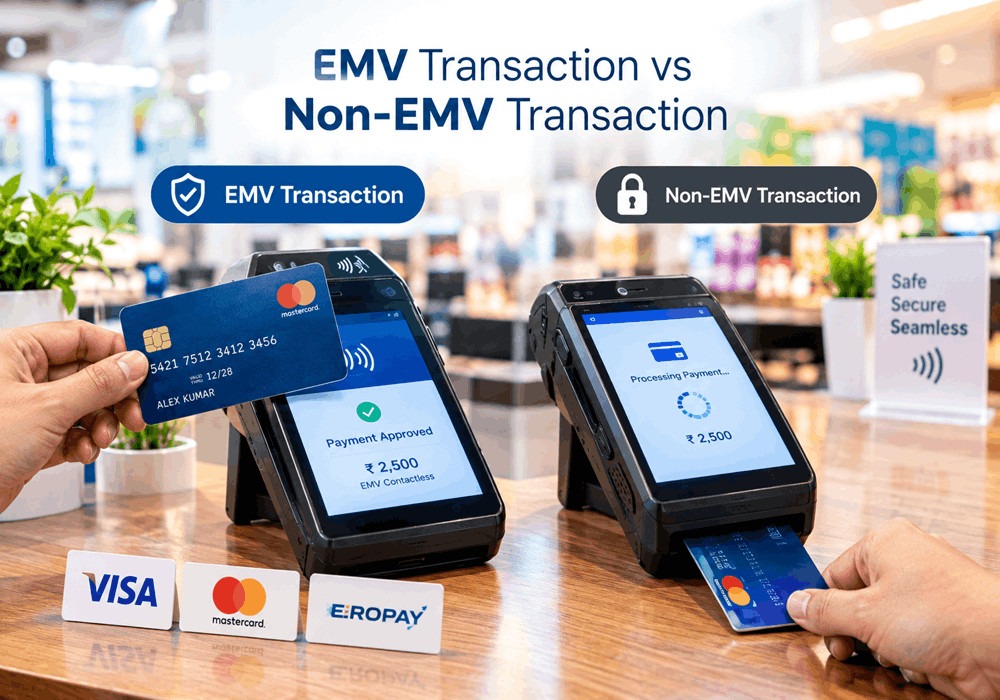
In the rapidly evolving and security-conscious digital payments landscape, meeting EMV (Europay, Mastercard, and Visa) compliance standards is essential for the successful deployment of payment terminals, SoftPOS applications, ATMs, and other card acceptance devices. EMV certification consists of several layers of validation, with EMV Level 2 and Level 3 being critical to the secure, compliant, and seamless operation of payment systems. To streamline the certification journey and eliminate avoidable issues, pretesting at both L2 and L3 stages becomes a vital preparatory step.
At EazyPay Tech, we deliver specialized EMV Level 2 and Level 3 pretesting and EMV Certification services, tailored for a wide range of payment devices including chip card readers, contactless terminals and embedded payment modules. This guide explores our comprehensive pretesting methodology, emphasizing its importance in reducing delays, cutting costs, and increasing first-time certification success rates.
Understanding EMV Level 2 and EMV Level 3
What is EMV Level 2?
EMV Level 2 (L2) certification refers to the validation of the EMV kernel, the core application that processes card data and handles key EMV functions between the hardware layer (Level 1) and the terminal’s payment application (Level 3).
- It handles all the logic and decision-making associated with EMV transactions, including the cardholder’s identity, terminal capabilities, and authentication of both the terminal and the card.
- The kernel is responsible for the cryptographic processes required for secure EMV transactions, ensuring tamper-proof data flow.
What is EMV Level 3?
EMV Level 3 (L3) certification is the final validation step that ensures correct processing of a complete transaction from card interaction through to host authorization and receipt generation. It verifies that terminal software communicates accurately with the acquiring bank and complies with scheme-specific rules.
- L3 ensures that all transaction types (sale, refund, reversal, etc.) are processed securely and formatted according to scheme messaging standards.
- This level confirms the real-world interoperability of the payment system by validating message structure, sequence, and data integrity.
Importance of Pretesting Before Certification
Why Pretesting is Essential
- Early Detection of Technical Flaws: Pretesting identifies functional and compliance-level issues in kernels and payment applications before official lab testing, allowing teams to remediate them proactively.
- Minimization of Certification Risks: Reduces the risk of failing L2/L3 certification by ensuring that critical components align with EMVCo and brand-specific protocols.
- Faster Go-to-Market Execution: Accelerates certification timelines by smoothing over common failure points ahead of lab submission, reducing delays in market rollout.
- Stronger Regulatory and Scheme Alignment: Validates device behavior against the latest global and regional specifications from Visa, Mastercard, RuPay, Amex, Discover, and others.
- Higher Transaction Reliability: Enhances the stability and predictability of transaction flows, resulting in fewer errors and greater user satisfaction during real-world use.
- Lower Overall Certification Costs: Avoids repeated certification lab fees, engineer rework hours, and project overruns by ensuring thorough readiness.
- Increased Stakeholder Confidence: Builds confidence among device manufacturers, acquirers, merchants, and users by demonstrating a robust, standards-aligned payment solution.
EMV Level 2 Pretesting Explained
Scope of EMV L2 Pretesting
Pretesting at Level 2 focuses on verifying the EMV kernel’s ability to handle all required card-transaction flows securely, correctly, and in compliance with EMVCo specifications and global payment brand mandates.
Key Functional Areas Covered in L2 Pretesting
- Kernel Initialization and Parameter Configuration: Ensures that terminal parameters (AIDs, CVM preferences, terminal capabilities) are loaded correctly for all supported applications.
- Application Selection Logic: Verifies that the terminal can correctly identify and prioritize card applications based on AID matching, selection priority, and fallback rules.
- Terminal Capabilities Declaration: Checks that the terminal advertises correct EMV features (contactless, SDA/DDA support, online/offline processing abilities) to the card.
- Cardholder Verification Method (CVM) Processing: Confirms correct processing of PIN verification (online/offline), signature, or no-CVM flows depending on card and terminal settings.
- Terminal Risk Management Execution: Tests terminal-side checks for transaction limits, floor limits, and velocity controls to determine online vs. offline processing.
- Terminal Action Analysis: Validates how the terminal processes risk results and chooses whether to approve, decline, or go online.
- Cryptographic Processing: Ensures secure generation and processing of Authorization Request Cryptograms (ARQC) and Authorization Response Cryptograms (ARPC).
- Offline and Online Data Authentication: Verifies support for Static Data Authentication (SDA), Dynamic Data Authentication (DDA), and Combined Data Authentication (CDA).
- Exception Handling and Edge Case Support: Tests how the kernel handles situations such as card removal, timeout, failed scripts, and unsupported applications.
Tools Commonly Used in EMV L2 Pretesting
- FIME EMVCo Level 2 Kernel Test Suite: An automated tool that provides test scripts for all EMVCo requirements.
- UL EMV L2 Kernel Test Tool: Offers brand-specific and EMVCo test case execution for both contact and contactless kernels.
- ICCSimTMatool: Allows simulation of EMV cards with programmable responses to test kernel behavior in various scenarios.
- Contact and Contactless Brand Test Cards: Real test cards simulate all possible card behaviors to test terminal and kernel response.
- Protocol Analyzers: Tools like Sniffers and APDU loggers capture command-response interactions for detailed troubleshooting.
Common Issues Detected During L2 Pretesting
- Improper AID Matching or Application Selection Logic: Can lead to transaction failures or selection of unsupported applications.
- Incorrect CVM List Parsing or Execution: Results in failed PIN entry handling or bypass of required verification methods.
- Inconsistent Risk Management Triggers: Leads to skipping online authorization or declining valid transactions.
- Cryptographic Failures in ARQC/ARPC Generation: Weakens security and causes rejection by issuer systems.
- Improper Handling of Issuer Scripts and Exception Cases: Leads to incomplete transaction cycles or terminal crashes.
Benefits of EMV L2 Pretesting by EazyPay Tech
- Detailed test coverage for all EMV kernel functions across various scenarios and card types.
- Deep insights into scheme-specific kernel behavior and parameter tuning.
- Support for custom kernels or hybrid environments (e.g., contact + contactless).
- Early detection of specification compliance gaps through in-house test simulations.
EMV Level 3 Pretesting Explained
Scope of EMV L3 Pretesting
EMV Level 3 pretesting simulates full transaction cycles and validates that terminal applications behave as expected from card tap/swipe/insert through host communication, according to scheme and acquirer-specific test plans.
Key Components of EMV L3 Pretesting:
- End-to-End Transaction Simulation: Validates all types of transactions (e.g., purchase, refund, cash advance, reversal) in simulated environments.
- Correct ISO 8583 Messaging Structure: Checks field presence, lengths, encoding, and tag values to ensure accurate host communication.
- Scheme-Specific Flow Validations: Tests tailored scenarios using Visa ADVT, Mastercard M-TIP, RuPay L3, Amex AEIPS, etc.
- Authorization and Reversal Handling: Ensures that authorization requests, responses, and reversals are managed as per rules.
- Tag Inclusion in Message Packets: Verifies correct inclusion of critical EMV tags (e.g., 9F27, 5F2A, 82) in the authorization messages.
- Time-Outs, Failures, and Recovery: Simulates network issues and verifies terminal response and error handling protocols.
Tools Commonly Used in L3 Pretesting:
- UL Brand Test Tool (BTT): Offers test libraries for all major payment schemes, including custom transaction flows.
- Acquirer or Host Simulators: Simulate issuer and acquirer host environments, allowing end-to-end testing without real networks.
- EMV Test Cards: Inject specific card behaviors to trigger transaction paths required by L3 certification.
- Packet Analyzers and Loggers: Capture and analyze network and EMV message flows to detect malformed data or communication errors.
Frequent Issues Revealed During L3 Pretesting
- Incorrect Mapping of ISO Fields to EMV Tags: Results in host misinterpretation or rejection of transaction messages.
- Failure to Parse Issuer Responses Correctly: Leads to incorrect, transaction reversals, or terminal freeze.
- Missing or Incomplete EMV Data in Packets: Causes scheme compliance violations and test case failures.
- Improper Message Construction in Refund/Voids: Can lead to acquirer disputes or operational failures.
Advantages of L3 Pretesting by EazyPay Tech
- Simulates a broad range of real-life payment scenarios tailored for each payment brand.
- Identifies deep-rooted application logic issues in payment flows.
- Helps correct ISO 8583 implementation and EMV data mapping.
- Enables multiple re-test cycles to improve application quality before formal evaluation.
Pretesting Methodology at EazyPay Tech
Our Structured Pretesting Process Includes
- Requirements Discovery: Collaborate with the client to identify terminal type, kernel details, target markets, and intended payment schemes.
- Customized Test Plan Development: Create a comprehensive test plan covering kernel conformance, host messaging, brand-specific flows, and exception handling.
- Controlled Lab Environment Setup: Configure all tools, test cards, scripts, and host emulators in a secure test environment.
- Execution of Automated and Manual Test Cases: Run full-cycle EMV transactions, inject faults, and capture logs for each scenario.
- Issue Identification and Log Analysis: Use advanced analyzers to interpret failures, correlate test outcomes, and isolate root causes.
- Remediation Guidance and Retesting: Work closely with developers to fix errors and validate fixes with additional pretest cycles.
- Support During Formal Certification: Assist clients with documentation, debug logs, and liaison with EMV test labs or scheme representatives.
Pretesting for Contact vs. Contactless Devices
Contact Device Pretesting:
- Validates chip reader performance, power management, and ATR handling.
- Tests transaction logic using contact EMV cards for chip-based interaction.
- Simulates card insertion, incorrect orientation, removal, or electrical faults.
Contactless Device Pretesting
- Verifies terminal’s response to NFC tap-and-go transactions using brand-specific cards.
- Ensures compliance with quick EMV flows required by Visa-PayWave, Mastercard-PayPass, RuPay-qSPARC, Discover D-PAS, Amex- ExpressPay.
- Checks timeouts, user prompts, multi-tap behavior, and fallback paths.
Success Metrics of EMV Pretesting
- 70% Reduction in EMV Certification Failures: Due to early identification of kernel, application, or host messaging errors.
- 60% Decrease in Debugging Time: Thanks to structured logs and deep root cause analysis.
- 50% Faster Time-to-Market: Through efficient test cycles and readiness for first-time certification pass.
- Over 90% First-Time Certification Pass Rate: For devices that undergo thorough pretesting with our platform.
Why Choose EazyPay Tech for EMV Pretesting
- Deep expertise in global EMV payment ecosystems including terminals, mobile POS, wearable devices, and kiosks.
- Access to fully licensed and accredited EMV test tools and simulators.
- Multi-brand support including Visa, Mastercard, RuPay, Discover, UnionPay, and AMEX.
- In-house EMV Software/kernel engineers, host message analysts, and PCI compliance experts.
- Flexible engagement options including on-demand, project-based, or full-cycle managed testing.
EMV Level 2 and Level 3 pretesting is not merely a technical requirement it’s a strategic investment in product quality, security, and market competitiveness. By preemptively validating payment kernel logic and acquirer communication flows, developers and OEMs can mitigate costly delays, reduce certification risk, and build trust with customers and partners.
At EazyPay Tech, our EMV pretesting services are designed to help you pass certification the first time with speed, precision, and confidence.
Get in touch today to begin your EMV pretesting journey.