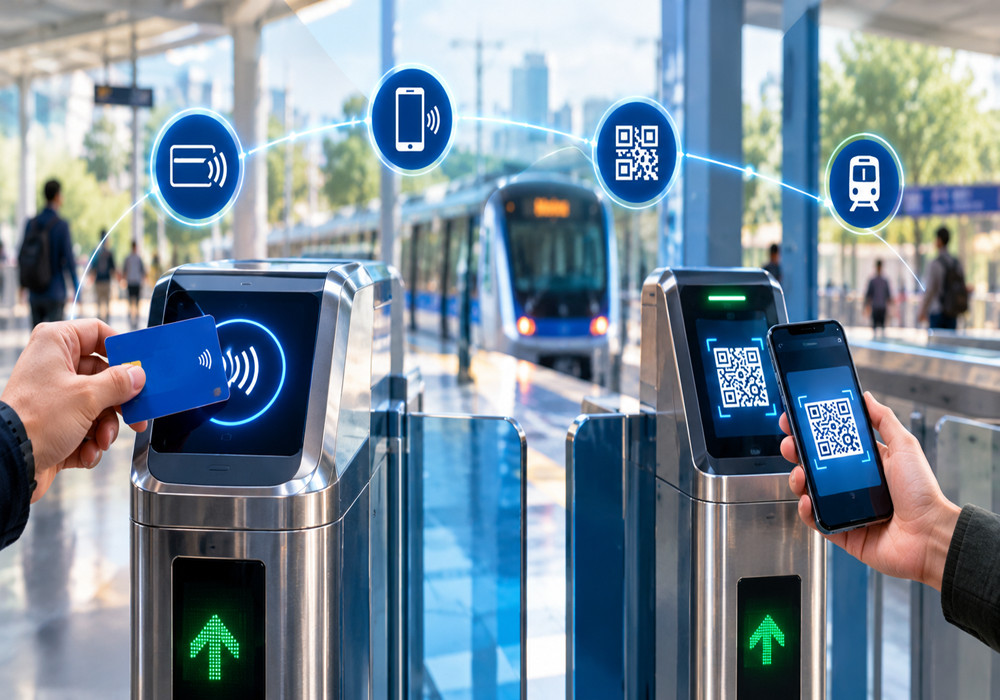


Public transportation is increasingly moving towards digital payment and ticketing infrastructure. From metro stations and city buses to toll roads and parking facilities, operators are adopting technology that makes passenger payments faster, more convenient and easier to manage.
An automatic fare collection (AFC) system enables passengers to pay for transportation using contactless bank cards, mobile wallets, QR codes, smart cards and other digital credentials. It connects passenger-facing devices such as fare validators and ticketing terminals with payment processing platforms and central management systems.
But what happens behind a simple tap or QR scan? How does the system validate a passenger, calculate the correct fare, process payments and maintain transaction records?
This guide explains how an automatic fare collection system works, including its transaction lifecycle, payment processing, backend communication, integration requirements and the role of EMV technology.
What Is an Automatic Fare Collection System?
An automatic fare collection system is an integrated payment and ticketing solution that automates fare collection across public transportation networks and other mobility services.
Instead of relying entirely on manual ticket sales or cash payments, an AFC system uses electronic credentials and connected devices to validate passengers and manage fare transactions.
Depending on the implementation, passengers may use:
- Contactless debit and credit cards
- NFC-enabled smartphones and mobile wallets
- QR codes and digital tickets
- Closed-loop transit smart cards
- Account-based travel credentials
- National or regional transit payment cards
The system communicates with validators, payment platforms and central back-office applications to manage passenger access, fare calculation, transaction records and settlement.
How Does an Automatic Fare Collection System Work?
The automatic fare collection process involves several connected stages. Although the exact workflow depends on the transport network and payment architecture, the general transaction lifecycle follows these steps.
-
Passenger Presents a Payment Credential
The process begins when a passenger presents a payment credential at a fare validator, ticketing terminal or access gate.
The device may support different payment methods, including:
- Contactless bank cards
- NFC mobile wallets
- QR-based tickets
- Transit smart cards
- Other supported digital credentials
The validator captures the credential information required by the configured payment or ticketing application.
-
Validator Reads and Processes the Credential
After the passenger presents a credential, the validator reads the relevant information and determines whether it can process the payment or travel request.
For contactless bank cards, the terminal uses the appropriate payment application and contactless processing logic. For QR tickets and closed-loop cards, it follows the corresponding validation rules.
The device then prepares the transaction or validation request for the next stage.
-
Passenger and Transaction Validation
The system checks whether the presented credential is valid for the requested journey or transaction.
Depending on the AFC architecture, validation may involve:
- Checking card or ticket validity
- Verifying available balance or account status
- Applying configured fare rules
- Checking entry and exit records
- Evaluating payment risk and acceptance rules
- Confirming whether the credential is permitted for travel
In open-loop systems, the payment terminal may perform certain checks locally while additional processing takes place through the payment infrastructure.
-
Fare or Payment Decision
Once the required information is available, the system determines whether the passenger can proceed.
For a closed-loop system, the decision may depend on stored value, card status or the transit operator’s rules.
For an open-loop contactless system, the terminal follows the configured EMV payment flow and the transit payment architecture. Depending on the implementation, the system may use online authorization, offline processing or deferred payment models.
If the validation is successful, the gate opens or the validator provides an acceptance indication. If it fails, the passenger may receive a rejection message or be asked to use another payment method.
-
Transaction and Journey Event Recording
The validator or connected application records the relevant transaction or journey event.
Depending on the system design, this information may include:
- Credential reference or token
- Device and terminal identification
- Transaction timestamp
- Entry or exit location
- Transaction status
- Fare-related information
- Payment application details
Sensitive payment information must be handled according to the applicable security requirements. Tokenization and secure transaction processing can help reduce exposure of cardholder data.
-
Fare Calculation and Journey Matching
In networks that use distance-based or entry-exit fare models, the backend may match passenger journey events to calculate the final fare.
For example, a passenger may tap a contactless card when entering a metro station and tap again when exiting. The AFC backend uses the recorded journey information and configured fare rules to determine the applicable charge.
Fare calculation may consider:
- Entry and exit stations
- Travel distance or zones
- Time-based fare rules
- Daily or weekly fare caps
- Transfers between transport services
- Concession or passenger categories, where supported
Not every AFC deployment uses entry-exit matching. Some systems apply fixed fares at the point of validation.
-
Payment Processing and Settlement
The final payment workflow depends on whether the system uses an open-loop or closed-loop payment model.
In open-loop systems, transaction data may be submitted to the payment processor or acquiring infrastructure according to the configured authorization and clearing model.
In closed-loop systems, the fare may be deducted from the passenger’s stored-value account or transit balance.
The backend maintains transaction records to support reconciliation, reporting, dispute handling and settlement between relevant stakeholders.
How Does Contactless Card Payment Work in an AFC System?
Contactless bank card payments are increasingly used in public transportation because passengers can travel using cards they already carry.
When a passenger taps a contactless card or mobile wallet on a compatible validator, the terminal communicates with the payment credential using NFC technology.
For EMV contactless payments, the terminal and card or mobile wallet follow the applicable EMV transaction flow. The payment application processes the required data and generates transaction information according to the supported scheme and terminal configuration.
The transaction may then follow an online, offline or transit-specific processing model, depending on the operator’s payment architecture and acceptance requirements.
For this reason, transit payment integration requires more than simply installing an NFC reader. The terminal must support the required payment application, contactless kernel, security controls and EMV certification process.
Open-Loop vs. Closed-Loop Automatic Fare Collection
Automatic fare collection systems generally support open-loop, closed-loop or hybrid payment models.
Open-Loop AFC System
An open-loop system allows passengers to use eligible payment instruments such as contactless debit cards, credit cards and supported mobile wallets.
The system processes payments through the relevant payment network and acquiring infrastructure.
Key characteristics:
- Supports eligible bank cards and mobile wallets.
- Reduces the need for passengers to purchase dedicated transit cards.
- Requires compatible contactless payment terminals.
- Depends on payment scheme rules and the selected transit architecture.
Closed-Loop AFC System
A closed-loop system uses a dedicated transit card, account or stored-value credential issued or managed by the transport operator.
Passengers load value or receive travel entitlement on the supported credential and use it at validators.
Key characteristics:
- Uses operator-managed payment credentials.
- Supports transit-specific fare and account rules.
- Can provide greater control over the passenger payment environment.
- Requires a dedicated card or account ecosystem.
Hybrid AFC System
A hybrid system supports multiple payment methods within the same transportation network.
For example, passengers may use contactless bank cards, mobile wallets, QR tickets and dedicated transit cards across compatible validators.
The appropriate model depends on passenger needs, infrastructure, payment partnerships and operational requirements.
How Do AFC Validators Communicate with the Backend?
Validators are the point of interaction between passengers and the automatic fare collection system. They communicate with backend applications to exchange transaction, configuration and operational information.
A typical architecture includes the following layers:
- Validator or payment terminal
Reads the passenger’s payment credential, performs the required local processing and records transaction events.
- AFC application and backend
Manages passenger validation, fare rules, journey records, account information and transaction processing according to the selected architecture.
- Payment processing infrastructure
Connects the payment environment with the relevant processor, acquirer or payment network when required.
- Central management platform
Provides operational monitoring, reporting, device configuration, application updates and transaction visibility.
Reliable communication between these layers is essential for maintaining consistent service across multiple stations, vehicles and transport locations.
Common Transaction Failures in Automatic Fare Collection
Even well-designed AFC systems can experience transaction failures. Identifying the cause helps operators improve passenger experience and system reliability.
| Common issue | Possible reason | Recommended consideration |
| Card not detected | NFC or reader issue | Check antenna performance and reader configuration |
| Payment declined | Issuer or payment restrictions | Follow the configured decline and retry process |
| Invalid QR ticket | Expired or incorrect ticket | Validate ticket status and expiry rules |
| Network interruption | Connectivity failure | Define offline processing and recovery rules |
| Duplicate transaction | Repeated presentation or processing | Implement transaction controls and duplicate detection |
| Incorrect fare | Incomplete journey or rule mismatch | Review journey records and fare calculation logic |
The system should also provide clear passenger feedback and maintain sufficient transaction logs for troubleshooting.
How Does Offline Processing Support AFC Operations?
Public transportation networks operate across stations, tunnels, vehicles and remote locations where network connectivity may be inconsistent.
An automatic fare collection system may therefore need to support defined offline or limited-connectivity operations.
Depending on the architecture, offline capabilities may include:
- Local credential validation
- Secure transaction storage
- Cached fare rules and configuration
- Controlled offline payment acceptance
- Transaction synchronization after connectivity is restored
- Duplicate detection and recovery mechanisms
Offline acceptance rules must be designed carefully. Payment scheme requirements, risk controls, device capabilities and transport operator policies determine which transactions can be accepted without a live backend connection.
Role of EMV Kernel in Contactless Transit Payments
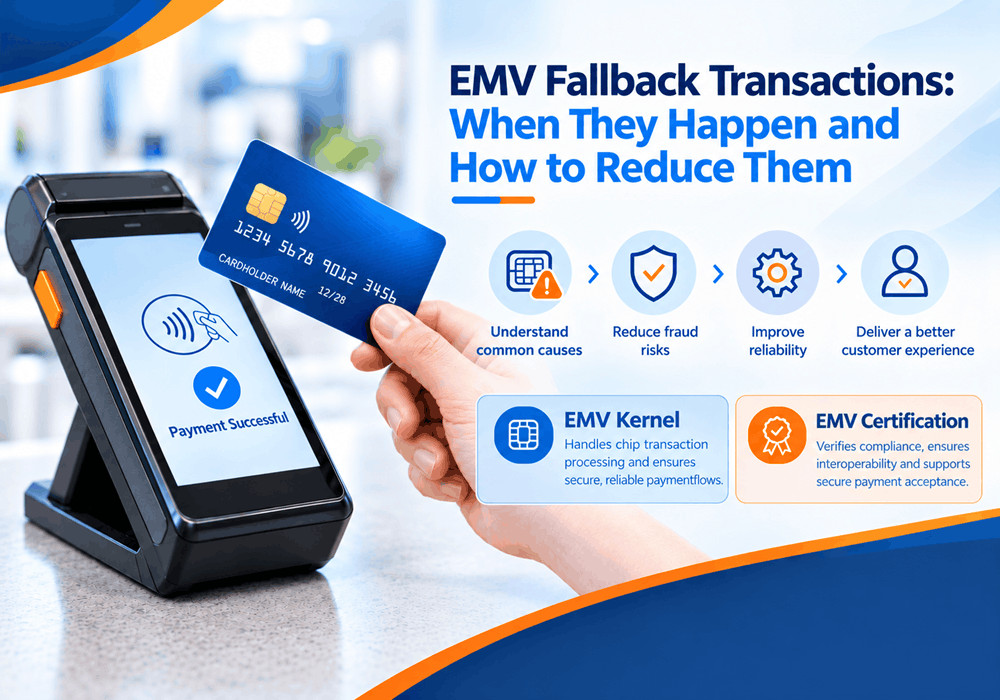
An EMV Kernel is a software component within a payment terminal that supports the processing of EMV contactless transactions.
In an AFC environment that accepts contactless bank cards, the kernel helps the terminal communicate with the card or mobile payment credential and process the required payment application data.
The selected kernel must be compatible with the terminal hardware, supported payment schemes and the intended transaction flow.
For payment terminal manufacturers, fintech companies and transit solution providers, kernel selection and integration are important considerations when building contactless fare collection infrastructure.
EazyPay Tech provides EMV Kernel development and integration services to support payment terminal solutions and contactless payment implementations.
Why Is EMV Certification Important for AFC Devices?
When an AFC terminal accepts EMV contactless bank cards, the payment application and terminal implementation must meet the applicable payment scheme and certification requirements.
Depending on the product and project scope, the certification process may involve:
- EMV Level 1 for applicable communication and interface requirements
- EMV Level 2 for payment kernel functionality
- EMV Level 3 for terminal and acquirer or host integration testing
- Payment scheme-specific testing and approval
The exact requirements depend on the terminal, payment application, supported schemes and deployment model.
It is important to understand that EMV certification covers defined payment technology requirements. It does not automatically certify the complete AFC network, fare management platform or transport operation.
EazyPay Tech supports EMV certification services for payment terminal manufacturers, fintech companies and payment solution providers.
How Can SoftPOS Support Transit Payment Solutions?
SoftPOS, also known as Tap on Phone, enables compatible NFC-enabled Android devices to accept contactless payments through a software-based payment acceptance solution.
In suitable transit environments, SoftPOS may support selected mobility payment use cases, such as:
- Mobile ticket inspection and payment
- On-board payment acceptance
- Portable payment collection
- Flexible payment points
- Transport services with mobile staff
The deployment must meet applicable payment security, device compatibility and payment acceptance requirements. SoftPOS is not a direct replacement for every high-volume fixed fare validator, but it can complement an AFC ecosystem where mobile acceptance is appropriate.
Explore EazyPay Tech’s SoftPOS and Tap on Phone solutions for mobile contactless payment acceptance.
Why Is Terminal Management (TMS) Important in AFC Networks?
Large transportation networks may operate hundreds or thousands of validators and payment terminals across stations, buses and other locations.
Managing these devices individually can become difficult as the network grows.
A Terminal Management System (TMS) helps operators and solution providers centrally manage connected payment devices.
Common TMS capabilities include:
- Remote application and parameter updates
- Firmware and configuration management
- Device monitoring and diagnostics
- Terminal status and connectivity tracking
- Transaction and operational reporting
- Device lifecycle management
For AFC deployments, effective terminal management helps maintain consistent device configurations and simplifies ongoing operational support.
Learn more about EazyPay Tech’s Terminal Management System.
Key Considerations Before Implementing an Automatic Fare Collection System
Selecting an AFC solution requires evaluating both passenger-facing technology and backend payment infrastructure.
Before implementation, transport operators and system integrators should consider:
- Payment methods: Determine whether the system will support contactless cards, mobile wallets, QR codes, smart cards or a hybrid model.
- Fare calculation: Define fixed fares, distance-based fares, zone-based pricing, transfers and fare capping.
- Terminal compatibility: Confirm validator hardware, NFC capabilities, operating systems and payment application requirements.
- EMV compliance: Identify the applicable EMV, payment scheme and certification requirements.
- Backend integration: Plan connectivity with payment processors, acquiring systems, ticketing platforms and transport applications.
- Security: Apply suitable controls for payment data, device access, encryption and key management.
- Connectivity: Define online and offline transaction handling, synchronization and recovery.
- Device management: Establish remote monitoring, configuration and software update processes.
- Testing: Validate payment flows, fare rules, device performance and end-to-end integration before deployment.
- Scalability: Ensure the solution can support additional routes, stations, validators and payment methods as the network expands.
Future Trends in Automatic Fare Collection
The automatic fare collection landscape continues to evolve as transportation operators adopt more flexible and connected payment technologies.
Some important developments include:
- Account-Based Ticketing (ABT): Fare calculation and passenger account management increasingly move towards centralized backend platforms.
- Open-Loop Contactless Payments: More transport networks are enabling eligible bank cards and mobile wallets for passenger payments.
- Mobile Ticketing: QR codes, digital tickets and mobile credentials provide additional ways to access transport services.
- Multimodal Payments: Integrated systems aim to support journeys across buses, metro, rail, parking and other mobility services.
- Cloud-Based Management: Centralized platforms help operators monitor devices, manage configurations and access operational information.
- Advanced Analytics: Transaction and journey data can help operators understand passenger usage, identify operational issues and improve service planning.
These developments are making AFC infrastructure more connected, flexible and adaptable to changing passenger expectations.
Frequently Asked Questions
- What is automatic fare collection?
Automatic fare collection is a technology-based process that enables transportation operators to collect fares electronically using contactless cards, mobile wallets, QR codes, smart cards and other digital payment credentials.
- How does an automatic fare collection system work?
An automatic fare collection system reads a passenger’s payment credential, validates the transaction or travel entitlement, records the relevant journey event, calculates the applicable fare and processes payment according to its configured architecture.
- What is the difference between automatic and automated fare collection?
Both terms are commonly used to describe electronic fare collection in public transportation. Their usage may vary across operators and markets, but both generally refer to systems that reduce manual fare collection through digital payment and ticketing technology.
- Can an AFC system accept contactless bank cards?
Yes. An AFC system can accept eligible contactless debit and credit cards when its validators, payment applications and backend infrastructure support the required EMV contactless and payment scheme requirements.
- What is the role of an EMV Kernel in an AFC terminal?
An EMV Kernel supports the processing of EMV contactless payment transactions. It enables compatible payment terminals to communicate with supported contactless cards and mobile payment credentials.
- Is EMV certification required for AFC devices?
When an AFC terminal accepts EMV payment cards, applicable EMV and payment scheme requirements must be considered. The exact certification and approval requirements depend on the terminal, payment application and deployment architecture.
- Can an AFC system work without an internet connection?
Some AFC systems support limited offline operation through local validation, cached configuration and transaction storage. However, offline acceptance depends on the payment model, security requirements and operator policies.
- Can SoftPOS be used in public transportation?
SoftPOS can support selected transit payment use cases, such as mobile payment acceptance and portable ticketing operations, where the device and deployment meet applicable payment security and acceptance requirements.
- Why is a TMS important for an AFC deployment?
A Terminal Management System helps operators remotely monitor and manage validators and payment terminals, distribute software updates, configure devices and track operational status across a transportation network.
- Can EazyPay Tech support automatic fare collection integration?
Yes. EazyPay Tech supports payment technology integration for transit and mobility solutions, including EMV Kernel development, EMV certification support, SoftPOS, payment terminal integration and Terminal Management System capabilities.
An effective automatic fare collection system involves much more than reading a contactless card or scanning a QR code. It requires coordinated payment terminals, validation applications, fare management, backend communication, payment processing and device management.
As public transportation networks expand their digital payment capabilities, reliable integration and payment compliance become increasingly important.
EazyPay Tech supports payment technology requirements for transit and mobility projects through EMV Kernel development, EMV certification, SoftPOS and terminal management capabilities.
Planning an automatic fare collection or contactless transit payment solution?
Contact EazyPay Tech to discuss your payment terminal, EMV integration and transit payment technology requirements.