
Public transportation is evolving as cities look for faster, more convenient, and more efficient ways to manage passenger journeys. From metro networks and city buses to toll roads and parking facilities, transport operators are increasingly adopting digital technologies to simplify payments, reduce manual processes, and improve the passenger experience.
Automated fare collection (AFC) is a technology-driven approach to collecting, validating, and managing fares without relying entirely on manual ticket sales or cash handling. An automated fare collection system combines payment acceptance devices, ticketing or credential technologies, transaction processing software and central management platforms to support fare payments across transport networks.
Depending on the implementation, passengers may pay using contactless bank cards, mobile wallets, smart cards, QR codes, mobile applications, or other supported payment credentials. The system validates the payment or travel entitlement and records the transaction for fare calculation, reporting, reconciliation, and settlement.
For public transport authorities, transit operators, banks, fintech companies, original equipment manufacturers (OEMs), and system integrators, AFC offers an opportunity to build more connected and flexible transport payment ecosystems.
This guide explains what automated fare collection is, how an AFC system works, its key components and benefits, where it is used, and what organizations should consider when implementing one.
What Is Automated Fare Collection (AFC)?
Automated fare collection is the use of electronic devices and software to collect, validate, process, and manage fares for transportation and related mobility services.
An automated fare collection system (AFC system) connects passenger facing devices, such as ticket vending machines, validators, fare gates and payment terminals, with the software and infrastructure responsible for processing transactions and managing fare rules.
A typical AFC system may support:
- Electronic ticket purchasing and validation.
- Contactless payments using supported cards and mobile wallets.
- QR-code tickets and digital travel credentials.
- Smart-card-based fare collection.
- Fare calculation, including distance-based or zone-based pricing.
- Transaction monitoring, reporting, reconciliation and settlement.
- Integration with transport management and payment processing systems.
The exact capabilities depend on the transport network, payment methods, fare policies, and technical architecture.
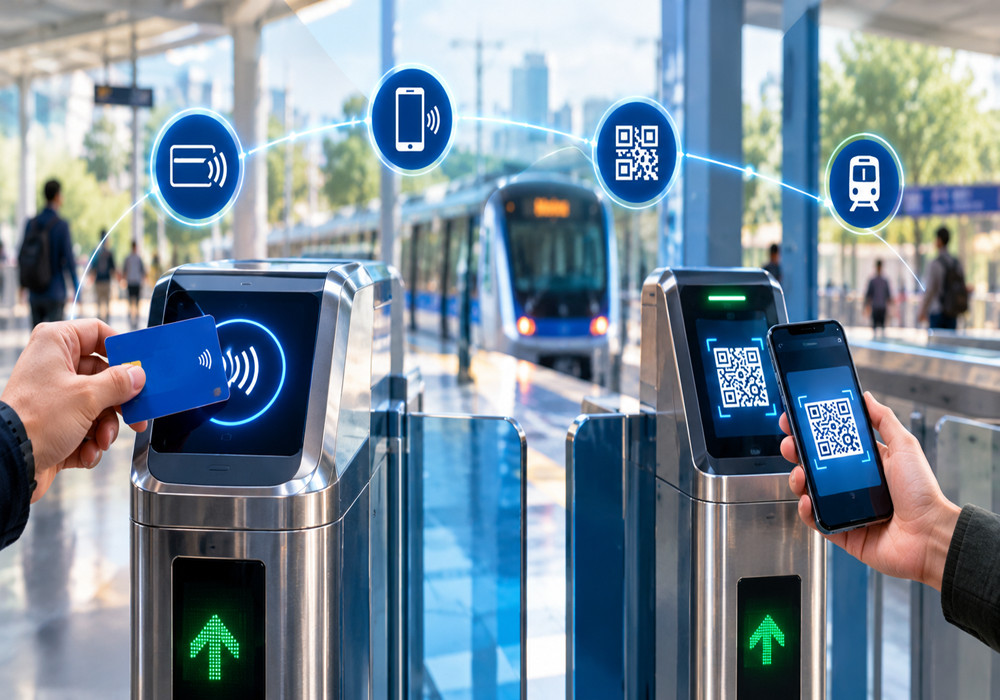
For example, a passenger entering a metro station may tap a contactless bank card at a fare gate. The AFC system reads the credential, performs the required validation, and allows entry when the transaction or travel entitlement is approved. Depending on the system design, the final fare may be calculated at entry, at exit, or through a later account-based processing workflow.
What Is the Difference Between AFC and an Automated Ticketing System?
An automated ticketing system primarily focuses on issuing, selling, or validating tickets. An AFC system can cover a broader set of functions, including payment acceptance, fare calculation, passenger validation, transaction processing, and financial reconciliation.
| Feature | Automated Ticketing System | Automated Fare Collection System |
| Primary purpose | Ticket issuance and validation | End-to-end fare collection and management |
| Ticket management | Core function | May be included |
| Payment processing | May be limited or integrated | Often a core integration |
| Fare calculation | Depends on implementation | Can support complex fare rules |
| Transaction reporting | Basic or advanced | Can include financial and operational reporting |
| Multi-modal integration | Depends on design | Can support integrated transport networks |
These terms sometimes overlap. The distinction depends on the architecture and functionality of the deployed system.
How Does an Automated Fare Collection System Work?
An AFC system connects the passenger, the fare collection device, the payment or ticketing infrastructure, and the central back office.
Although the process differs between closed-loop ticketing and open-loop bank-card payments, most systems follow a similar sequence.
Step 1: The Passenger Presents a Payment Credential
The passenger presents a supported payment method or travel credential at a validator, fare gate, bus terminal, ticket machine, or other acceptance device.
Common options include:
- Contactless debit and credit cards.
- NFC-enabled smartphones and mobile wallets.
- Transport smart cards.
- QR codes and mobile tickets.
- Other operator-approved electronic credentials.
The available methods depend on the AFC deployment and the payment schemes it supports.
Step 2: The AFC Device Reads the Credential
A validator or payment terminal captures the relevant credential data using the appropriate technology, such as NFC, a contactless card reader, a QR scanner, or a smart-card interface.
The device communicates with the AFC application and applies the initial validation rules. For bank-card transactions, payment processing may also involve an EMV payment application and the required acceptance infrastructure.
Step 3: The System Validates the Journey or Payment
The system determines whether the presented credential can be accepted for the requested journey or transaction.
Depending on the design, this may involve checking:
- Ticket validity and expiry.
- Available balance or travel entitlement.
- Fare rules and travel zones.
- Card or credential status.
- Payment authorization requirements.
- Offline acceptance rules, where supported.
In account-based systems, the device may record the journey and the fare may be calculated or finalized by the central system later. In other implementations, fare validation and payment processing may happen differently.
Step 4: The Passenger Receives Confirmation
Once the applicable validation or acceptance rules are satisfied, the system provides feedback. A fare gate may open, a bus validator may display an approval message, or a device may produce an audible or visual confirmation.
If validation fails, the system may reject the credential and display an appropriate message.
Step 5: The Transaction or Journey Record Is Sent for Processing
The AFC device records the relevant event and sends it to the central platform or payment infrastructure according to the system’s connectivity and processing model.
A transaction record may include the credential reference, device identifier, timestamp, fare information, and other operational data needed for processing. Sensitive payment data must be handled in accordance with the applicable security requirements.
Step 6: The Back Office Calculates Fares and Manages Records
The central AFC platform applies the configured fare rules, maintains journey records, and supports reporting and reconciliation.
For account-based ticketing, the system may combine multiple journey events to determine the total fare. For example, a passenger’s entry and exit records may be used to calculate a distance-based metro fare.
Step 7: Payment Reconciliation and Settlement Take Place
Where bank-card or other external payment processing is involved, transaction records may be submitted for clearing, reconciliation, and settlement through the relevant payment infrastructure.
The exact process depends on the payment model, acquiring arrangements, transport operator, and supported payment schemes.
In simple terms: An AFC system reads a ticket or payment credential, validates the passenger’s travel or payment request, records the event, applies fare rules, and supports the processing and reporting required to collect the fare.
Key Components of an Automated Fare Collection System
A complete AFC solution typically includes passenger-facing devices, payment or ticketing software, communication infrastructure, and central management systems.
- Fare Gates and Passenger Validators
Fare gates and validators are the devices passengers interact with when entering a metro station, boarding a bus, or accessing another controlled transport facility.
They may support contactless cards, smart cards, QR codes, mobile tickets, or other credentials. The required hardware depends on the deployment environment and the acceptance methods.
- Payment Terminals and Acceptance Devices
Payment terminals allow passengers to make electronic payments at supported points in the journey.
Depending on the use case, these devices may include unattended terminals, attended payment terminals, Android POS devices, mobile acceptance devices, or purpose-built transit validators.
Organizations planning bank-card acceptance should evaluate device capabilities, payment application requirements, supported schemes, security controls, and relevant certification needs.
EazyPay Tech provides payment terminal and payment acceptance solutions for organizations developing and integrating payment technology. The appropriate solution depends on the specific AFC device, payment method, and deployment requirements.
- Ticketing and Fare Management Software
The fare management layer defines how fares are calculated and applied. It may support:
- Flat fares.
- Distance-based fares.
- Zone-based fares.
- Daily or monthly passes.
- Transfers and journey combinations.
- Concessions and eligible discounts.
- Fare caps, where supported.
This software must reflect the operator’s policies and account for how journeys are recorded and validated.
- Payment Processing and Transaction Management
When an AFC system accepts bank cards or mobile wallets, it must integrate with the appropriate payment acceptance and processing infrastructure.
This may involve payment applications, payment gateways or processors, acquiring banks, payment networks, and transaction management services.
The integration must account for transaction authorization, reversal handling, duplicate prevention, reconciliation, and other operational requirements.
- Central Back Office
The back office is the central software environment used to manage fare rules, devices, transaction records, operational reporting, and other system functions.
Depending on the architecture, it may also handle passenger accounts, journey histories, exception processing, and integration with transport operations platforms.
- Connectivity and Device Management
AFC devices need secure and reliable communication with central systems, payment services, or other infrastructure.
Connectivity may use cellular networks, Wi-Fi, Ethernet, or a combination of technologies. Some deployments support offline operation for defined functions.
A terminal management system (TMS) can help manage supported payment devices remotely, including application updates, configuration, monitoring, and diagnostics. Where applicable, a TMS can complement the AFC back office rather than replace fare management or payment processing.
Learn more about Terminal Management System solutions for remote payment-device management.
- Reporting, Reconciliation, and Settlement
Reporting tools help operators understand fare revenue, transaction volumes, device availability, failed validations, and other operational indicators.
Reconciliation compares records from relevant systems to identify discrepancies and support accurate financial reporting. Settlement processes depend on the payment methods, contractual arrangements, and processing infrastructure involved.
Types of Automated Fare Collection Systems
AFC systems can be designed around different payment credentials and fare collection models. Some networks use one model, while others combine several.
Closed-Loop Smart Card Systems
Closed-loop systems use transport-specific cards or credentials issued for use within a particular network or participating group of services.
Passengers may load value or travel products onto a card and present it at a validator. The system checks the card or its associated records according to the deployed architecture.
These systems can offer control over fare products and passenger policies but require the operator to manage the relevant card or credential ecosystem.
Open-Loop Contactless Payment Systems
Open-loop AFC systems accept supported payment cards and mobile wallets instead of requiring passengers to obtain a dedicated transport card.
Passengers can use eligible contactless credentials at compatible validators or gates. Depending on the implementation, transactions may be processed immediately or through a delayed or account-based workflow.
Open-loop acceptance can reduce the need for separate transport-specific payment credentials, but it introduces payment scheme, acquiring, security, certification, and fare-processing considerations.
QR-Code-Based Fare Collection
QR-based systems use a printed or digital QR code to identify a ticket or travel entitlement.
A passenger may buy a ticket through an application, website, kiosk, or another sales channel and present the code to a scanner.
QR-based fare collection can be useful where mobile ticketing, low-cost ticket distribution, or integration with existing ticketing infrastructure is a priority.
Account-Based Ticketing
In account-based ticketing, the passenger’s travel entitlement and journey records are managed primarily in a central system rather than relying entirely on information stored on a physical card.
The passenger may use a bank card, mobile wallet, transport card, or another linked credential to identify journeys. The central platform applies the relevant fare rules and may calculate the final fare after the journey.
Account-based systems can support features such as fare capping and multi-journey calculations when designed and configured to do so.
Hybrid AFC Systems
Hybrid systems combine multiple technologies, such as transport smart cards, QR tickets, and contactless bank-card acceptance.
A hybrid model can help operators support different passenger groups and transition gradually from legacy ticketing to newer payment methods. It also requires consistent fare rules, reliable integration, and clear reconciliation processes across the supported channels.
Applications of Automated Fare Collection
Automated fare collection is used wherever organizations need to validate access, collect fares, or process transport-related payments.
-
Metro and Rail Networks
Metro and rail systems use AFC technology to manage passenger entry, exit, and fare calculation.
Common applications include:
- Contactless fare gates.
- Smart-card and QR-ticket validation.
- Bank-card and mobile-wallet acceptance.
- Distance- and zone-based fare calculation.
- Journey matching and fare adjustment.
- Revenue reporting and operational monitoring.
Example: A metro operator introduces contactless bank-card acceptance alongside its existing smart cards. Passengers can use supported payment credentials at compatible gates, while the operator maintains the fare policies and transaction processes needed to manage journeys.
-
Bus Networks
Bus operators can use AFC validators to collect fares and record passenger boarding events.
Depending on the implementation, the system may support contactless bank cards, transport smart cards, QR tickets, mobile tickets, and other electronic payment methods.
Onboard acceptance devices must account for vehicle movement, connectivity limitations, power availability, device durability, and fast passenger boarding.
For operators considering mobile-based acceptance, SoftPOS technology may be relevant where the intended payment use case, device, software architecture, and applicable security requirements support it. SoftPOS is not a universal replacement for dedicated transit validators, and its suitability should be assessed for each deployment.
-
Toll Roads and Expressways
Automated payment technologies help toll operators manage vehicle access and collect tolls through electronic methods.
Depending on the system, toll collection may use vehicle tags, license-plate recognition, dedicated transponders, account-based billing, contactless payment facilities, or other supported technologies.
A tolling platform can integrate with payment infrastructure, vehicle identification systems, account management software, and transaction reconciliation tools.
The appropriate technology depends on whether the toll facility uses stop-and-pay lanes, electronic toll collection, free-flow tolling, or a combination.
-
Parking Facilities
Parking operators can use automated systems to manage entry, exit, and parking payments.
Possible implementations include ticket-based parking, QR-based access, contactless payment terminals, license-plate recognition, and account-linked parking services.
For example, a parking facility may record a vehicle’s entry time, calculate the applicable fee at exit, and accept an electronic payment at a compatible terminal. The parking platform then reconciles the payment and access records.
-
Integrated and Multi-Modal Transport
Integrated AFC systems connect multiple modes of transportation, such as buses, metro networks, commuter rail, ferries, and selected mobility services.
A unified system can allow passengers to use a supported credential across participating services while applying the relevant transfer rules and fare policies.
Achieving this requires coordination among transport operators, payment providers, technology vendors, and authorities responsible for fare policy and settlement.
What Is Contactless Fare Collection?
Contactless fare collection allows passengers to present a compatible card, mobile device, or other supported credential to a reader without physically inserting the credential into the device.
Depending on the implementation, contactless technology can include NFC-enabled payment cards and mobile wallets, as well as contactless transport smart cards.
In bank-card-based AFC systems, contactless payments may use EMV technology to support payment transactions. Transport smart cards, however, may use different technical standards and processing models.
How Contactless Fare Collection Works
- The passenger taps a supported credential at a compatible validator or gate.
- The reader captures the required credential information.
- The device or connected system performs the applicable validation and payment processing steps.
- The device provides feedback to the passenger.
- The system records the journey or transaction for fare calculation, processing, and reconciliation.
The precise sequence depends on whether the system uses transport-specific credentials, open-loop payment cards, account-based ticketing, offline processing, or a combination.
Benefits of Contactless Fare Collection
- Faster interactions at compatible gates and validators.
- Less dependence on cash and paper tickets.
- Greater convenience for passengers using supported credentials.
- Potential integration with mobile wallets and bank-card payment infrastructure.
- More digital transaction data for reporting and reconciliation.
Contactless acceptance still requires careful design. Transit operators must consider transaction speed, reader performance, offline behavior, payment authorization, fare rules, and the handling of rejected or incomplete transactions.
The Role of EMV Technology in AFC Payment Integration
EMV technology provides specifications for chip-based payment transactions, including contactless payments. When an AFC system accepts eligible bank cards or mobile-wallet credentials, EMV-related requirements may apply to the payment acceptance device and its software.
The integration needs to consider the payment application, supported payment schemes, terminal configuration, transaction data, acquiring requirements, and the applicable approval or certification process.
EMV Kernel
An EMV kernel implements the payment scheme’s required processing logic for supported EMV transactions. In contactless payment acceptance, the relevant kernel must be compatible with the intended device, payment application, scheme requirements, and integration design.
For AFC projects, the kernel and payment application must be selected and integrated with the appropriate fare collection and transaction-processing architecture.
Explore EMV Kernel development and integration to understand the payment software requirements relevant to your implementation.
EMV Certification
EMV certification and other required approvals help establish that the relevant device, software, and payment implementation meet the applicable requirements.
The exact approvals depend on the payment scheme, device type, kernel, terminal application, acquirer, and deployment model. An AFC project should identify these requirements early because they can influence device selection, integration scope, testing, and launch schedules.
Learn more about EMV Certification services when planning payment acceptance for an AFC deployment.
Important: EMV certification alone does not certify an entire AFC system. Fare calculation, transport integration, operational security, and other system-level requirements may require separate testing, approvals, or assessments.
NCMC and Interoperable Transit Payments
Interoperability is an important consideration for transport networks that want to support passenger travel across multiple services or operators.
In India, the National Common Mobility Card (NCMC) is associated with interoperable mobility payments and transport use cases. Its practical implementation depends on the supported specifications, participating systems, payment arrangements, and deployment requirements.
Transport authorities and system integrators planning NCMC-enabled services need to consider card and acceptance compatibility, fare rules, transaction processing, back-office integration, reconciliation, and the required testing or approvals.
Outside India, comparable interoperability objectives may be addressed through other national mobility initiatives, transport credentials, open-loop bank-card acceptance, or regional payment frameworks.
For broader transit deployments, EazyPay Tech’s payment integration capabilities can be evaluated for the specific card, validator, payment application, and back-office requirements involved.
Benefits of an Automated Fare Collection System
A well-designed AFC system can deliver operational, financial, and passenger-experience benefits. The actual outcomes depend on implementation quality, existing infrastructure, passenger behavior, and the operator’s business model.
- Improved Passenger Convenience
Electronic tickets and supported contactless payment methods can reduce the need to purchase a paper ticket for every journey.
Passengers may be able to use an existing payment card, mobile wallet, transport smart card, or digital ticket, depending on the network.
- Faster Boarding and Passenger Throughput
Quick validation at suitable gates and onboard devices can help reduce transaction time and passenger queues.
The improvement depends on reader performance, payment processing design, device placement, passenger familiarity, and the handling of failed transactions.
- Reduced Manual Processes
Automated fare collection can reduce reliance on manual ticket sales, cash counting, and paper-based reporting.
Staff may then focus more on passenger assistance, service operations, and exception handling.
- Better Transaction Visibility
Digital records can help operators monitor fare collection activity, identify discrepancies, and produce more consistent reports.
Accurate reporting depends on reliable device logs, data quality, reconciliation procedures, and integration across the relevant systems.
- Flexible Fare Policies
Software-based fare management can support different fare structures, including flat, zone-based, distance-based, concessionary, and time-based models.
Operators can configure supported policies centrally, subject to the capabilities and change-management processes of the deployed system.
- Multiple Payment Options
AFC systems can combine transport-specific credentials with supported bank cards, mobile wallets, QR tickets, or other electronic payment methods.
This flexibility can help operators serve different passenger needs without requiring every passenger to use the same credential.
- Scalable Transport Operations
Modular system design and centralized management can support the addition of new devices, routes, stations, or payment methods.
Scalability still depends on infrastructure capacity, vendor compatibility, security controls, and the ability to integrate new components without disrupting existing services.
Challenges in Implementing an AFC System
Implementing AFC is not simply a matter of installing validators or payment terminals. A successful deployment requires coordination among transport operations, payment processing, software systems, hardware suppliers, and regulatory stakeholders.
- Integration With Existing Infrastructure: Legacy ticketing systems, transport databases, payment gateways, and operational platforms may use different interfaces and data formats.
- Recommended approach: Document existing interfaces, define ownership of fare and payment data, agree on integration responsibilities, and test end-to-end scenarios before deployment.
- Payment Certification and Scheme Requirements: Open-loop payment acceptance can involve multiple technical specifications, approvals, and stakeholder requirements.
- Recommended approach: Identify the applicable payment schemes, terminal requirements, kernel dependencies, acquiring expectations, and certification scope during the planning stage.
- Network Connectivity and Offline Operation: Buses, underground stations, tunnels, and remote transport facilities may experience intermittent connectivity.
- Recommended approach: Define which functions must work offline, how transactions are stored securely, when data is synchronized, and how delayed, declined, duplicate, or incomplete transactions are handled. Offline acceptance should only be enabled where the payment model, risk controls, device capabilities, and applicable requirements support it.
- High Transaction Volumes: Busy transport systems may process large numbers of validations and payment events within short periods.
- Recommended approach: Test throughput, peak loads, response times, retry behavior, back-office capacity, and recovery procedures under realistic conditions.
- Fare Policy Complexity
- Different routes, zones, concessions, transfers, caps, and journey combinations can make fare calculation complicated.
- Recommended approach: Translate fare policies into clear rules and build test cases for ordinary journeys, transfers, incomplete journeys, refunds, and exceptions.
- Multi-Vendor Compatibility
- An AFC ecosystem may include devices, payment applications, processors, software platforms, and back-office systems supplied by different vendors.
- Recommended approach: Define interface specifications, data ownership, testing responsibilities, version management, and support arrangements before procurement and integration.
- Passenger Adoption and Accessibility
- Some passengers may be unfamiliar with digital ticketing or may not have access to supported payment cards or smartphones.
- Recommended approach: Provide clear instructions, accessible interfaces, suitable alternative payment options, and assistance during the transition.
- Security and Compliance in Automated Fare Collection: AFC systems process travel records and, in some deployments, payment information. Security must therefore be addressed across devices, applications, communication channels, central systems, and operational processes.
- Payment Data Protection: Systems accepting bank cards must apply the relevant payment security requirements and protect sensitive data throughout the transaction lifecycle. The design should minimize the collection and retention of sensitive information and use approved payment components and secure integration practices.
- Secure Payment Applications and Devices Payment acceptance devices should be configured, tested, and maintained according to their applicable security and payment scheme requirements. Depending on the deployment, this may involve approved payment applications, secure software updates, device protection, cryptographic controls, and management of cryptographic keys.
- Network and API Security: AFC devices and central platforms exchange data through network connections and APIs. Security controls may include encrypted communications, strong authentication, authorization checks, certificate management, monitoring, and appropriate protection against unauthorized access.
- Access Control and Audit Logs: Administrative systems should use role-based access controls and record important configuration changes, privileged actions, and operational events. Regular access reviews and monitoring help reduce the risk of misuse or unauthorized changes.
- Privacy and Passenger Data: Journey histories and linked payment credentials may reveal sensitive information about passenger movements. Organizations should assess applicable privacy and data-protection obligations, limit data collection to legitimate purposes, define retention policies, and restrict access to passenger records.
- Testing, Monitoring, and Incident Response: Security should be assessed throughout the system lifecycle rather than only before launch. A robust approach includes security testing, vulnerability management, device monitoring, incident-response procedures, backup and recovery planning, and periodic reviews of relevant compliance obligations. The applicable standards and legal requirements depend on the system architecture, payment model, jurisdiction, and data being processed.
How to Choose the Right AFC Solution
The right automated fare collection system depends on the transport environment, passenger needs, payment methods, operational requirements, and long-term expansion plans.
Before selecting a solution, transport authorities and system integrators should evaluate the following areas.
Define the Transport Use Case
Identify whether the system is intended for metro gates, buses, tolls, parking, rail, or an integrated transport network.
Each environment has different requirements for device placement, transaction speed, connectivity, environmental durability, and passenger throughput.
Select the Appropriate Payment Model
Decide whether the system should support closed-loop smart cards, open-loop bank-card payments, QR tickets, account-based ticketing, or a hybrid approach.
The decision should reflect passenger preferences, payment availability, operating costs, fare policies, and the capabilities of existing infrastructure.
Assess Device and Software Compatibility
Check the compatibility of validators, payment terminals, ticketing applications, EMV components where applicable, and central management platforms.
Ensure the chosen solution supports the required payment methods and can be integrated with the existing back office and transport systems.
Establish Security and Certification Requirements
Identify the applicable payment, device, data-protection, and operational security requirements.
Include certification planning, testing, documentation, and maintenance in the project schedule.
Plan for Scalability and Lifecycle Management
Consider how the system will support additional routes, stations, devices, payment methods, and software updates.
Remote device management, diagnostics, secure updates, and lifecycle tracking can help operators maintain distributed device fleets.
Evaluate Support and Total Cost of Ownership
Compare not only the initial procurement cost but also integration, licensing, connectivity, maintenance, certification, upgrades, support, and replacement costs.
A clear lifecycle plan helps organizations understand the long-term operational implications of their chosen architecture.
Future Trends in Automated Fare Collection
AFC technology continues to evolve as transport operators look for more flexible payment experiences, stronger system integration, and better operational visibility.
- Wider Adoption of Open-Loop Payments
More transport deployments are considering payment models that allow eligible passengers to use supported bank cards and mobile wallets directly at validators.
Adoption depends on the local payment ecosystem, acquiring arrangements, device compatibility, and the business case for each network.
- Account-Based Ticketing and Fare Capping
Account-based ticketing can shift more fare calculation and journey management into central software.
When supported, fare capping can limit the total amount a passenger pays over a defined period, according to the operator’s fare rules.
These capabilities require accurate journey matching, reliable transaction processing, and well-defined policies for incomplete or disputed journeys.
- Mobile-Based Payment Acceptance
NFC-enabled mobile devices and SoftPOS technologies may provide additional payment acceptance options in suitable use cases.
The appropriate approach depends on device capability, payment application design, required security approvals, passenger throughput, and the intended operating environment.
- Cloud-Based Device and System Management
Cloud-based platforms can help organizations monitor distributed devices, manage supported configurations, deploy approved updates, and review operational information centrally.
A cloud approach must be designed with appropriate security, availability, connectivity, and data-management controls.
- More Integrated Mobility Services
Transport networks may increasingly connect ticketing and payment with additional mobility services, including participating rail, bus, parking, and other transport providers.
The technical challenge is to establish consistent credentials, journey records, fare rules, and settlement arrangements across different organizations.
- Data-Driven Operations
Aggregated operational data can help operators identify equipment issues, monitor transaction failures, understand passenger flows, and improve service planning.
Analytics should be based on appropriate data quality, access controls, and privacy safeguards.
- Stronger Focus on Cybersecurity and Lifecycle Management
As AFC systems become more connected, secure device configuration, software maintenance, monitoring, and incident response remain important throughout the system lifecycle.
Organizations should consider security and maintainability during architecture and procurement decisions, rather than treating them as final-stage requirements.
How EazyPay Tech Can Support AFC Payment Integration
Building an automated fare collection system requires more than selecting a validator or payment terminal. The payment layer must work with the fare collection application, device hardware, transaction-processing infrastructure, and operational systems.
EazyPay Tech works in payment technology and software, including payment application development, EMV kernel development and certification support, payment terminal solutions, and SoftPOS-related technology.
Depending on the project’s scope, relevant capabilities may include:
- Payment application and terminal integration: Aligning payment acceptance software with the intended device and transaction workflow.
- EMV Kernel development and integration: Supporting relevant EMV processing requirements for compatible payment acceptance devices.
- EMV Certification support: Helping address applicable testing and certification requirements for the relevant payment implementation.
- SoftPOS technology: Evaluating mobile-based payment acceptance for appropriate transport and mobility use cases.
- Payment device management: Considering terminal management capabilities for configuration, monitoring, and software lifecycle operations.
- Transport payment interoperability: Assessing the integration requirements for supported transport credentials and payment frameworks, including NCMC where applicable.
The precise scope depends on the target market, device architecture, supported payment schemes, transport operator requirements, and applicable approvals.
For transport authorities, banks, fintech companies, OEMs, and system integrators, early coordination between the payment and fare collection teams can help clarify integration dependencies and reduce avoidable rework.
Looking to integrate payment technology into your AFC system? Contact EazyPay Tech to discuss your requirements.
Visit EazyPay Tech to discuss your payment technology and integration needs.
Frequently Asked Questions About Automated Fare Collection
- What is automated fare collection?
Automated fare collection is a technology-based method of collecting, validating, and managing transport fares using electronic devices and software. It can support smart cards, QR tickets, contactless bank cards, mobile wallets, and other configured payment or travel credentials.
- How does an automated fare collection system work?
An AFC system reads a passenger’s payment credential or ticket, validates the applicable payment or travel entitlement, records the transaction or journey, and applies the relevant fare rules. Depending on the design, payment authorization and final fare calculation may take place at different stages.
- What are the main components of an AFC system?
The main components typically include fare gates and validators, payment or ticketing devices, fare management software, transaction-processing infrastructure, connectivity, a central back office, and reporting and reconciliation tools. The exact components depend on the system architecture.
- What is the difference between AFC and a ticketing system?
A ticketing system focuses primarily on ticket issuance and validation. An AFC system can cover a wider set of functions, including payment acceptance, fare calculation, transaction processing, journey management, reporting, and reconciliation.
- Where is automated fare collection used?
Automated fare collection is used in metro and rail networks, buses, toll facilities, parking facilities, and integrated mobility systems. The technologies and workflows vary according to the environment and the payment or ticketing model.
- Can an AFC system accept contactless bank cards?
Yes. An AFC system can support eligible contactless bank cards and mobile wallets when compatible devices, payment applications, processing arrangements, and required approvals are in place. Acceptance depends on the implementation and the payment schemes supported.
- What is the role of EMV in automated fare collection?
EMV specifications support chip-based payment transactions, including relevant contactless bank-card payments. In an AFC deployment that accepts these payment methods, the payment acceptance device and software must meet the applicable technical, integration, and certification requirements.
- Can SoftPOS be used in an AFC system?
SoftPOS may be suitable for selected payment acceptance use cases when the device, payment application, security requirements, and operating environment support it. It should be evaluated against dedicated validators or payment terminals, especially where rapid passenger throughput or specialized transit functionality is required.
- What are the main challenges of implementing an AFC system?
Common challenges include integrating legacy systems, supporting different payment methods, meeting payment and security requirements, managing intermittent connectivity, handling complex fare policies, ensuring interoperability, and reconciling transactions across multiple systems.
- How does an AFC system improve passenger convenience?
An AFC system can reduce dependence on cash and paper tickets, support electronic ticketing and compatible contactless payment methods, and streamline fare validation. The passenger experience depends on the supported credentials, device performance, network design, and availability of alternative payment options.
- What is account-based ticketing in AFC?
Account-based ticketing stores and manages journey and fare information primarily in a central system. Passengers use an associated credential to identify journeys, while the system applies the configured fare rules and calculates charges according to the implementation.
- How can EazyPay Tech help with AFC payment integration?
EazyPay Tech’s relevant payment technology capabilities include payment software, EMV kernel development and integration, certification support, payment terminal solutions, and SoftPOS-related technology. The appropriate scope depends on the project’s payment methods, hardware, target markets, and technical requirements.
Automated fare collection is an important part of modern transport infrastructure. By combining electronic ticketing, payment acceptance, fare management, and transaction processing, an AFC system can help operators improve passenger convenience and manage fare collection across different transport environments.
However, successful implementation depends on more than the choice of payment technology. Organizations must align device capabilities, fare policies, payment processing, system integration, security, certification, and long-term maintenance.
Whether you are developing a new AFC platform, modernizing an existing fare collection system, or introducing contactless bank-card acceptance, a clearly defined payment integration strategy is essential.
Looking to integrate payment technology into your AFC system? Contact EazyPay Tech to discuss your requirements.
Explore EazyPay Tech to learn more about payment software, EMV technology, payment terminal solutions, and related integration capabilities.