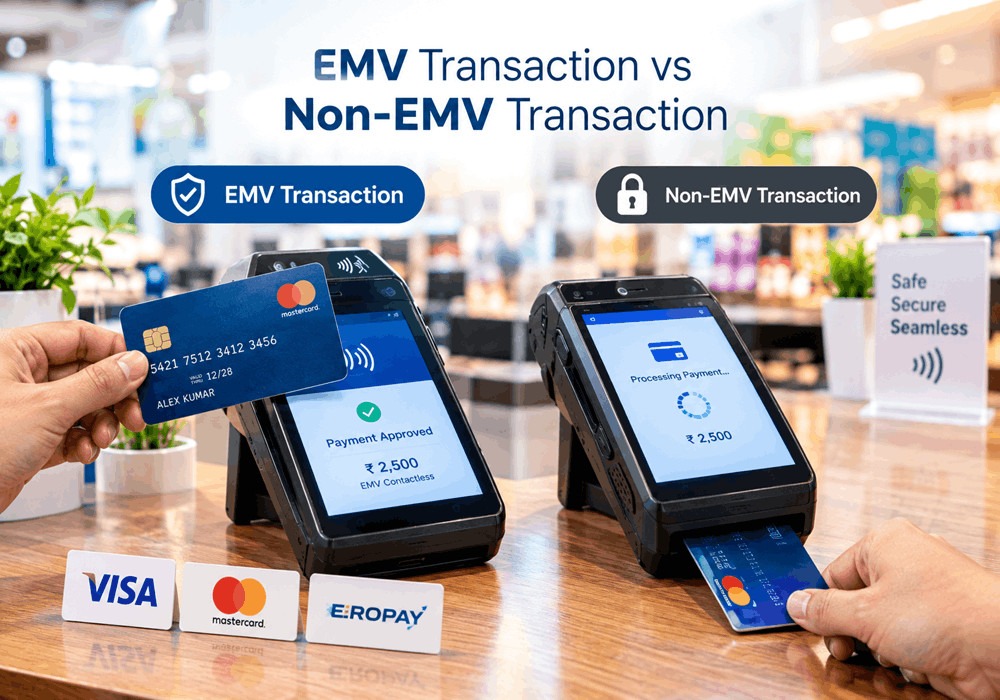

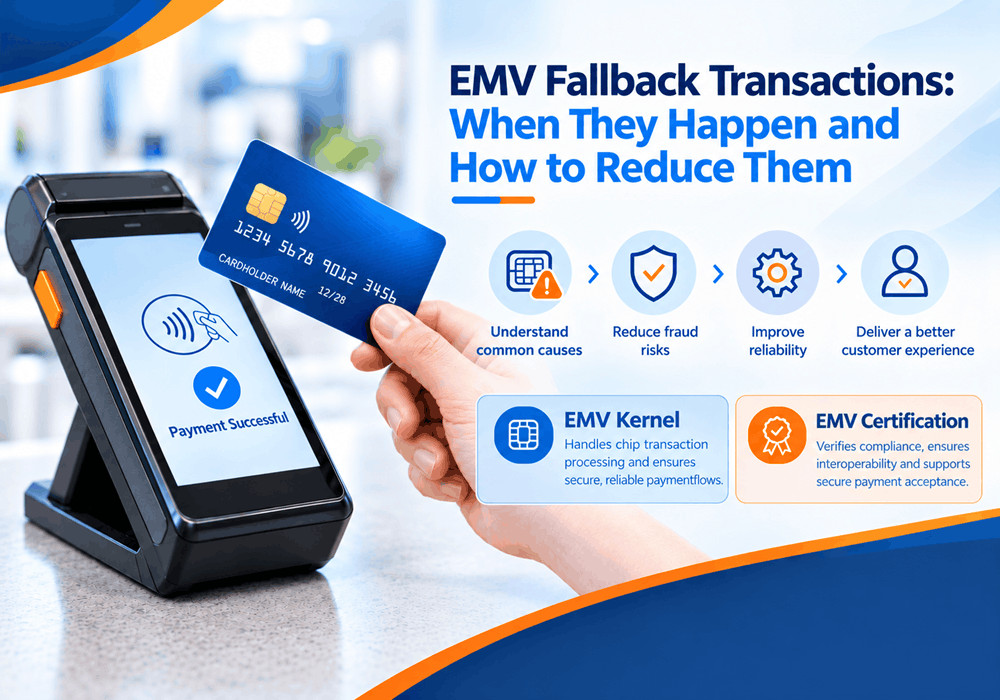
EMV chip payments have become a standard security mechanism for card-present transactions. By using chip technology to generate transaction-specific cryptographic data, EMV helps protect card payments against counterfeit fraud and improves payment security across supported payment environments.
However, not every chip transaction completes successfully. When a chip card cannot be processed through the normal chip-reading process, a payment terminal may prompt the customer to try again, use another supported payment method, or where permitted fall back to magnetic-stripe processing. This situation is known as an EMV fallback transaction.
Frequent EMV fallback transactions can create checkout delays, increase operational costs, affect customer experience, and introduce additional fraud risks. For banks, acquirers, payment processors, and terminal manufacturers, understanding why fallback occurs is essential to improving transaction reliability.
What Is an EMV Fallback Transaction?
An EMV fallback transaction occurs when a payment terminal cannot complete a transaction using the chip-reading process and switches to another supported card-reading method, typically magnetic stripe processing, if the terminal, card, payment network and applicable rules permit it.
For example, a customer inserts a chip-enabled debit or credit card into a POS terminal. If the terminal repeatedly fails to read the chip, it may display a message asking the customer to swipe the card instead. If the transaction proceeds through an allowed magnetic-stripe path, it may be recorded as an EMV fallback transaction.
Fallback is not the same as an ordinary declined transaction. A decline means the transaction was not approved, while fallback describes a change in the card-reading method after chip processing could not be completed. A fallback transaction may still be approved or declined by the issuer.
Importantly, fallback should not be treated as a universal or unrestricted alternative to chip processing. Its availability and handling depend on the payment network’s rules, terminal configuration, card capabilities, local regulations, and the specific failure conditions.
How Does an EMV Fallback Transaction Work?
A typical fallback scenario follows these steps:
- Card insertion: The customer inserts an EMV chip card into a compatible payment terminal.
- Chip-reading attempt: The terminal establishes communication with the card and begins the required EMV processing.
- Processing failure: The chip cannot be read reliably, or the transaction cannot continue through the expected chip interface.
- Fallback evaluation: The terminal determines whether another card-reading method is permitted under its configuration and applicable payment rules.
- Customer prompt: If allowed, the terminal may ask the customer to retry, reinsert the card, or swipe it.
- Alternative processing: If magnetic-stripe fallback is supported and permitted, the terminal attempts to process the transaction through that path.
- Authorization and recording: The transaction is submitted for authorization as applicable, and the terminal or payment system records the relevant transaction details and fallback indicators.
Not every failed chip read results in fallback. A terminal may require another insertion attempt, reject the transaction, or direct the customer to another payment method. Some payment environments restrict or prohibit fallback under particular conditions.
When Do EMV Fallback Transactions Happen?
EMV fallback generally occurs when chip processing cannot be completed and an alternative processing method is available and permitted. The most common scenarios include the following.
-
Damaged or Worn EMV Chips
Physical damage is one of the most recognizable causes of chip-reading failure. Scratches, worn contact surfaces, contamination, or damage to the chip module can interfere with communication between the card and terminal.
If repeated insertion attempts fail, the terminal may offer a permitted fallback option.
How to reduce it: Encourage customers to use another supported payment method when their card is visibly damaged. Merchants should also monitor repeated chip failures involving the same card or terminal and avoid encouraging unnecessary swipes.
-
Dirty or Damaged POS Card Readers
A card may be in good condition while the terminal’s chip reader is faulty. Dust, debris, worn contacts, physical damage, or deteriorating hardware can prevent reliable communication with the chip.
Terminals operating in high-volume retail, transport, hospitality, and fuel environments may be particularly exposed to wear and environmental contamination.
How to reduce it: Establish routine inspection and cleaning procedures in accordance with the terminal manufacturer’s instructions. Replace damaged reader components and track repeated failures by terminal ID to identify devices requiring maintenance.
-
Incorrect Terminal Configuration
EMV processing depends on correctly configured terminal parameters, supported application capabilities, and appropriate transaction handling. Incorrect configuration can lead to application-selection problems, processing errors, or unexpected failures.
Examples include incorrect EMV parameters, incomplete application configuration, inconsistent terminal profiles, and unsupported transaction settings.
How to reduce it: Validate terminal configuration before deployment and whenever software or parameters are updated. Maintain controlled configuration management and use a Terminal Management System (TMS), where available, to monitor devices and distribute approved settings.
-
EMV Kernel Software Issues
The EMV kernel manages the terminal-side processing required to communicate with the chip card and execute the relevant EMV transaction flow. Software defects, incorrect parameter handling, integration problems, or incompatibilities between the kernel and terminal environment may cause chip transactions to fail.
A kernel issue can affect many devices, making it important to distinguish software-related failures from individual card or hardware problems.
How to reduce it: Use an appropriately validated EMV kernel, test its integration with the terminal hardware and payment application, and investigate error patterns following software releases. Review transaction logs and reproduce failures under controlled test conditions before deploying corrective changes.
-
Contact Problems During Card Insertion
Chip processing may fail when the card is not inserted correctly, is removed too early, or cannot maintain a stable electrical connection with the reader. Customer handling and terminal design can both contribute to these problems.
How to reduce it: Provide clear on-screen instructions, allow sufficient time for transaction processing, and ensure the terminal design supports intuitive card insertion. Where repeated failures occur, inspect the reader and review the terminal’s interaction flow.
-
Unsupported or Incompatible Card Applications
A terminal and card must have compatible applications and processing capabilities for the intended transaction. Problems with application selection, application configuration, or interoperability can prevent a chip transaction from proceeding as expected.
These issues are not necessarily physical chip failures, even if the customer sees a general error message.
How to reduce it: Verify application support, EMV parameters, and integration requirements for the relevant card schemes and markets. Conduct interoperability testing with representative cards and transaction scenarios.
-
Terminal Software or Firmware Updates
A software release can unintentionally introduce regressions affecting chip communication, application selection, transaction sequencing, or error handling. Incorrectly deployed configuration changes may also produce similar symptoms.
If fallback rates increase soon after a release, the timing can provide an important diagnostic clue.
How to reduce it: Test releases in a controlled environment, use staged deployments, compare fallback rates before and after updates, and maintain a rollback plan. Monitor performance across terminal models and software versions to identify affected device groups quickly.
-
Poor Network or Host Integration
A network or host communication problem does not automatically qualify as EMV fallback. However, errors in the payment application, transaction-state handling, or terminal integration can sometimes be misclassified as chip-processing failures or trigger inappropriate recovery behaviour.
It is therefore important to identify whether the original failure occurred at the card interface, within the EMV application, or during communication with the payment host.
How to reduce it: Correlate terminal logs with payment application and host logs. Use clear error classification and ensure that communication failures do not incorrectly trigger magnetic-stripe fallback.
EMV Fallback vs. EMV Chip Failure vs. Transaction Decline
These terms are related but describe different situations.
| Term | Meaning |
| EMV chip failure | The terminal cannot successfully complete a required step in chip communication or processing. |
| EMV fallback | An eligible transaction switches from chip processing to another permitted card-reading method, typically magnetic stripe. |
| Transaction decline | The issuer or another relevant decision point does not approve the transaction. |
| Contactless failure | A contactless transaction cannot complete through the contactless interface; the next action depends on the terminal and applicable rules. |
| Host communication failure | The terminal cannot communicate successfully with the payment host or authorization system. |
A chip failure may lead to a fallback prompt, but the two are not identical. Similarly, a declined transaction does not necessarily involve fallback.
Accurate classification helps payment teams identify the underlying cause instead of treating every unsuccessful transaction as the same problem.
Why Is It Important to Reduce EMV Fallback Transactions?
Although fallback can provide a way to complete certain transactions when chip processing fails, excessive fallback activity can indicate technical, operational, or security problems.
- Increased Fraud Exposure
Magnetic-stripe transactions generally do not provide the same dynamic cryptographic protections as EMV chip transactions. Fraudsters may attempt to exploit weak fallback controls or use counterfeit magnetic-stripe cards in environments where fallback is accepted.
- Payment Network Compliance Risks
Payment networks establish rules for identifying, processing, and reporting fallback transactions. Incorrect transaction indicators, unsupported fallback practices, or failure to follow applicable requirements may expose acquirers and merchants to compliance issues or financial liability.
- Poor Customer Experience
Repeated card insertion attempts and swipe prompts can increase checkout time and frustrate customers. At high-volume locations, such as supermarkets, restaurants, transport facilities, and fuel stations, these delays can affect service efficiency.
- Higher Operational Costs
Frequent fallback transactions may indicate the need for terminal maintenance, software corrections, application updates, or hardware replacement. Without proper monitoring, payment providers may spend more time resolving recurring incidents.
- Reduced Payment Reliability
A sudden increase in fallback transactions across multiple terminals may signal a broader problem, such as a defective software deployment, incorrect terminal configuration, or a hardware batch issue.
Reducing fallback is therefore not simply about improving transaction success rates. It also helps strengthen payment security, operational efficiency, and the reliability of card acceptance systems.
How to Reduce EMV Fallback Transactions
A structured approach combining monitoring, testing, maintenance, and compliance controls can help payment providers reduce unnecessary fallback activity.
- Monitor Fallback Rates Across Terminals
Establish regular reporting on fallback transactions at the merchant, terminal, location, software-version, and payment-scheme levels.
Useful metrics include:
- Total fallback transactions.
- Fallback transactions as a percentage of eligible chip-card transactions.
- Chip-read failure rates.
- Repeated failures by terminal or merchant.
- Fallback trends before and after software updates.
- Differences between terminal models, locations, and card applications.
There is no single fallback-rate threshold that is appropriate for every payment environment. Establish baselines and investigate unusual increases based on the applicable payment-network requirements and operational context.
Visa’s guidance on managing fallback transactions emphasizes reviewing fallback reports and investigating patterns that may indicate device or configuration problems.
- Configure Appropriate Chip-Retry Behaviour
A single unsuccessful chip read does not always mean the card is defective. The customer may have inserted the card incorrectly, or the reader may have experienced a temporary communication problem.
Where supported and permitted by the applicable payment-network rules, terminal configurations can allow a limited number of chip-read attempts before offering an alternative payment method.
The retry policy should be tested against relevant scheme requirements and terminal capabilities. Excessive retries can inconvenience customers, while insufficient retries can produce unnecessary fallback transactions.
- Maintain POS Hardware and Chip Readers
Regular preventive maintenance can reduce failures caused by worn or contaminated card readers.
Recommended practices include:
- Inspect readers for visible damage and wear.
- Clean equipment according to manufacturer instructions.
- Track recurring failures by terminal identifier.
- Replace faulty reader components promptly.
- Review hardware performance in high-volume environments.
- Verify reader functionality after maintenance or replacement.
When many transactions fail at one particular terminal, investigate the reader before assuming that customers’ cards are responsible.
- Validate EMV Kernel Functionality
The EMV kernel is responsible for important parts of chip transaction processing. Its correct implementation and integration with the terminal’s payment application are essential for reliable EMV acceptance.
An appropriately validated EMV Kernel helps ensure that supported chip transactions follow the required processing logic. Developers should test application selection, card communication, transaction outcomes, error handling, and relevant edge cases to identify defects that could lead to unnecessary fallback.
Kernel updates should be assessed carefully because changes to transaction logic or configuration can affect deployed terminals. Regression testing and controlled releases help reduce the likelihood of introducing new chip-processing failures.
- Complete Relevant EMV Certification and Integration Testing
EMV Certification helps establish that payment components or terminal solutions meet the applicable technical and payment-system requirements. The exact approvals and testing depend on the product, payment scheme, terminal interface, and deployment market.
For example, Level 1 testing addresses the card-reader interface, Level 2 testing evaluates the EMV kernel, and Level 3 testing validates terminal integration with the payment acceptance infrastructure under the relevant payment-system programme.
Certification does not guarantee that fallback will never occur. However, appropriate testing and validation can help uncover interoperability issues, configuration problems, and defects before deployment.
- Verify Application Identifiers and Terminal Parameters
Application selection problems can occur when a terminal does not support the required card application or has incorrect application configuration.
Payment teams should verify that:
- Required application identifiers (AIDs) are supported.
- Terminal and card capabilities are compatible.
- Scheme-specific parameters are configured correctly.
- Terminal entry capabilities accurately reflect the device’s actual functionality.
- Acquirer and host integrations correctly handle the supported transaction paths.
For large terminal fleets, maintain version-controlled configuration profiles and validate changes before distributing them to production devices.
- Use a Terminal Management System (TMS)
A Terminal Management System can help payment providers manage distributed POS terminals and identify recurring technical issues.
Depending on its capabilities, a TMS can support remote application and parameter updates, device monitoring, diagnostics, software-version tracking, and deployment management.
For example, if fallback rates increase following an update, teams can compare affected devices by software version and deployment group. They can then investigate the issue, deploy a correction, or roll back a problematic release where supported.
A TMS does not automatically eliminate fallback transactions. Its value lies in improving visibility, reducing response times, and supporting consistent terminal management.
- Improve Merchant and Cashier Training
Human factors can contribute to unnecessary fallback. Customers may remove cards too early, insert them incorrectly, or follow an incorrect checkout procedure.
Training should explain how to:
- Guide customers through chip insertion.
- Follow terminal prompts.
- Avoid unnecessary magnetic-stripe transactions.
- Identify visible signs of card damage or tampering.
- Escalate repeated chip failures.
- Follow the merchant’s approved procedures for permitted fallback transactions.
Staff should never bypass chip processing simply because a swipe appears faster or more convenient.
- Investigate Software Releases and Configuration Changes
A sudden increase in fallback following a deployment should trigger a focused investigation.
Compare affected and unaffected devices, review software and parameter changes, examine error codes, and reproduce the problem in a test environment.
Where a common defect is identified, corrective updates should be validated before deployment. Maintaining release records and rollback procedures makes it easier to identify the source of failures and limit their impact.
- Enforce Fallback Controls and Transaction Identification
Fallback should only be permitted when supported by the terminal, card, payment network, and applicable rules. Payment applications should correctly identify fallback transactions in the authorization data when required.
Monitoring should also identify suspicious patterns, including repeated fallback attempts, unusually high fallback volumes at a single merchant, or activity inconsistent with the terminal’s normal performance.
Acquirers and processors should review these patterns through their fraud-monitoring and operational-risk processes. Fallback should never be used as a workaround for an unrelated authorization or host communication problem.
How to Investigate High EMV Fallback Rates
When fallback activity exceeds its expected level, a systematic troubleshooting process helps isolate the underlying cause.
| Observed pattern | Possible cause | Recommended investigation |
| Nearly all transactions fall back at one terminal | Reader failure or incorrect configuration | Inspect hardware and verify terminal capabilities |
| Fallback increases across terminals after an update | Software regression or parameter error | Compare versions and review recent deployments |
| Failures occur with one card scheme | Missing application support or incorrect AID configuration | Verify scheme-specific application support |
| Failures are intermittent at a busy location | Reader wear, card handling, or environmental factors | Inspect hardware and review transaction logs |
| Chip processing fails across several terminal models | Shared application, integration, or configuration issue | Compare EMV logs and payment application behaviour |
| Fallback appears alongside host communication errors | Transaction-state or integration problem | Correlate terminal, application, and host logs |
These patterns are diagnostic clues, not definitive conclusions. Teams should confirm the cause using transaction records, terminal logs, hardware testing, and the relevant payment-network requirements.
Best Practices for Payment Providers and Terminal Manufacturers
For banks, acquirers, processors, fintech companies, and POS manufacturers, reducing fallback requires a coordinated approach across the payment lifecycle.
During development
- Implement EMV transaction flows according to applicable specifications.
- Test chip-read failures, retries, application selection, and error recovery.
- Validate kernel and payment-application integration.
- Confirm that fallback controls follow the relevant scheme rules.
Before deployment
- Complete the required EMV approvals and scheme-specific testing.
- Verify terminal configuration and application support.
- Test representative cards and transaction scenarios.
- Establish baseline fallback metrics and monitoring alerts.
After deployment
- Track fallback rates by device, merchant, scheme, and software version.
- Investigate unusual changes promptly.
- Maintain terminal hardware and software.
- Review compliance requirements and update systems when necessary.
This lifecycle approach helps distinguish isolated card problems from systemic failures and supports continuous improvement in payment acceptance.
EMV fallback transactions can provide a permitted alternative when chip processing fails, but consistently high fallback rates may indicate hardware defects, software problems, configuration errors, or gaps in operational controls.
The most effective way to reduce fallback is to combine accurate transaction monitoring with reliable terminal hardware, properly implemented EMV kernels, appropriate certification and testing, controlled software deployments, and clear merchant procedures.
For payment providers and terminal manufacturers, treating fallback reduction as an ongoing engineering and operational priority can improve payment reliability, support fraud prevention, and deliver a better customer experience.
Need Support with EMV Kernel Development or Certification?
EazyPay Tech supports payment technology providers with EMV Kernel development and integration, EMV Certification, payment application development, and related payment solutions. Our team works with businesses seeking to develop, validate, and deploy reliable payment acceptance systems.
Contact EazyPay Tech to discuss your requirements for EMV Kernel development, EMV Level 1, Level 2 or Level 3 testing and certification support, and other payment technology solutions.
Website: https://eazypaytech.com/
Email: info@eazypaytech.com