
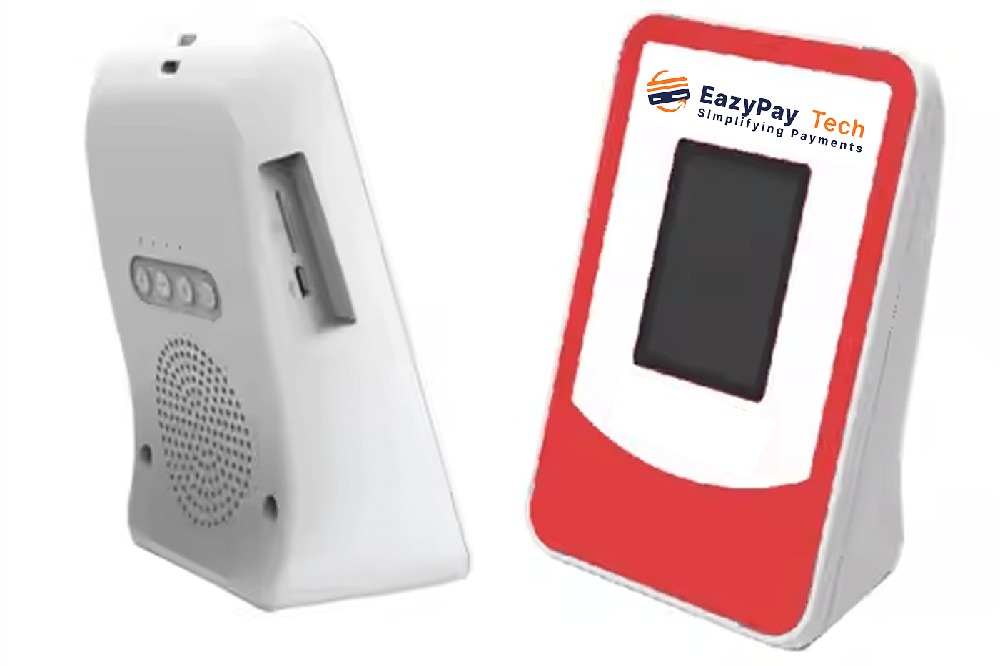
The Hardware Layer is the tangible foundation of a payment soundbox — the part you can touch, open, and see. It contains every physical component that gives the device its ability to process, connect, and announce payment transactions. Each hardware element is meticulously engineered to ensure the device is responsive, energy-efficient, and reliable in demanding retail environments where downtime is not an option.
Microcontroller / System-on-Chip (SoC)
At the heart of the payment soundbox lies the microcontroller or SoC, acting as the command center that executes every instruction and controls every interaction between components.
Key Functions :
- Transaction Processing Engine: Interprets incoming payment data packets, validates them, and initiates the corresponding audio announcement sequence without delays.
- Peripheral Coordination: Acts as the “traffic controller,” synchronizing the GSM/4G module for data reception, the amplifier for sound output, and the storage unit for retrieving the correct audio file.
- Real-Time Event Handling: Responds instantly to incoming triggers — ensuring that the time from payment receipt to audio announcement is typically less than a second.
- Low-Power Management: Dynamically adjusts the device’s operating mode, such as entering sleep states during inactivity and waking instantly on event detection, preserving battery life.
- Secure Data Handling: Maintains encrypted firmware and ensures all stored transaction audio prompts are protected from unauthorized access or tampering.
GSM/4G Module
The GSM/4G module is the lifeline of the soundbox. It ensures the device is always connected to payment servers, even in remote or Wi-Fi-deprived environments.
Key Functions
- Persistent Connectivity: Maintains a secure, continuous connection to the payment processing network so payment notifications arrive without interruptions.
- Multi-Band Support: Operates across multiple frequency bands to ensure compatibility with regional telecom infrastructure, enabling global deployments.
- Fallback & Recovery: If 4G coverage is unstable, the module automatically switches to 3G or 2G to maintain uninterrupted service.
- Secure Data Transport: Uses encryption protocols (e.g., TLS) to protect all payment-related communication from interception or tampering.
- Network Health Monitoring: Constantly evaluates signal strength and packet loss to adapt transmission methods for optimal reliability and minimal latency.
Speaker
The speaker system, backed by a tuned amplifier, transforms raw transaction data into clear, audible payment confirmations that can cut through even the noisiest shop floors.
Key Functions
- Multi-Language Playback: Delivers voice confirmations in the merchant’s preferred language, stored locally in high-quality audio formats to avoid distortion.
- Dynamic Volume Adaptation: Amplifier circuitry can adjust sound levels based on ambient noise — ensuring the message is always audible without being harsh.
- High Clarity Output: The amplifier ensures no distortion even at high volumes, preserving speech intelligibility.
- Event-Tied Announcements: Synchronizes audio playback precisely with the completion of transaction verification, avoiding any mismatch between the payment and the announcement.
- Durability & Longevity: Built to withstand continuous use in challenging environments, from hot outdoor stalls to air-conditioned stores.
Battery / Power Supply
The battery and power system ensure that the soundbox is always ready to work, even in areas with unreliable electricity.
Key Functions
- High-Density Rechargeable Cells: Uses Lithium-ion or Lithium-polymer batteries optimized for lightweight portability and high energy storage.
- Smart Charging Management: Integrated charging ICs regulate input power to prevent overheating, overcharging, or deep discharge, which extends battery life.
- Dual Power Options: Supports both battery operation for portability and direct plug-in for stationary, high-traffic retail environments.
- Long Uptime: A well-optimized power circuit ensures 24–72 hours of continuous operation on a single charge, depending on configuration and usage.
- Emergency Mode: Even when battery levels are critically low, the system can reserve enough power for a final few announcements to avoid missed payments.
Hardware Layer Workflow in a Payment Soundbox
- Payment Notification Arrival: GSM/4G module receives an encrypted payment alert from the bank or payment gateway.
- Processing & Validation: Microcontroller authenticates the message, checks transaction details, and identifies the appropriate audio file.
- Audio File Retrieval: The correct voice prompt (e.g., “Payment of ₹500 received”) is fetched from onboard storage.
- Amplification & Output: Amplifier drives the speaker to deliver the message in a clear, merchant-selected language.
- Power Optimization: After the announcement, components return to low-power mode until the next event.
Use Cases for Different Merchant Environments
The hardware design of a payment soundbox is not a one-size-fits-all solution. The way merchants operate — from small roadside vendors to high-volume retail chains — determines how the microcontroller, connectivity modules, speaker system, and power supply are configured and optimized. Below are real-world merchant scenarios illustrating how the Hardware Layer adapts to different needs.
Roadside & Mobile Vendors – Portability and Battery Efficiency First
Example: Tea stalls, street food carts, flower vendors, mobile repair kiosks.
Hardware Priorities:
- Long Battery Life: Lithium-polymer cells with 48–72 hours uptime to handle full-day operations without access to charging points.
- Compact SoC with Low-Power Modes: Minimizes energy consumption while ensuring instant wake-up when a payment notification arrives.
- Loud & Clear Audio Output: Amplifier tuned for high-volume playback to overcome outdoor noise from traffic or crowds.
- Rugged Build: Hardware designed to withstand dust, humidity, and occasional accidental drops.
Why it matters:
In these environments, merchants often can’t plug in the device throughout the day, so the battery and speaker performance directly influence usability and reliability.
Small Shops & Boutiques – Reliable Connectivity in Mixed Networks
Example: Grocery stores, stationery shops, small garment boutiques.
Hardware Priorities:
- GSM/4G Module with Strong Antenna: Ensures uninterrupted payment notifications even when Wi-Fi is unstable or unavailable.
- Flexible Power Source: Option to run on battery during peak hours and switch to AC power during low-traffic periods.
- Moderate Volume with Crisp Clarity: Speaker optimized for indoor environments, avoiding unnecessarily loud announcements.
- Multi-Language Audio Files: Enables merchants to serve diverse customer bases with localized payment confirmations.
Why it matters
Indoor shops need a balance between volume, connectivity, and a steady power source, with hardware tuned for medium-duty daily use.
High-Volume Retail Chains – Speed, Redundancy, and Integration
Example: Supermarkets, electronics showrooms, department stores.
Hardware Priorities:
- High-Performance SoC: Capable of processing frequent incoming transactions without lag, even during peak customer flow.
- Dual Connectivity Options: GSM/4G backup for Wi-Fi to ensure zero downtime during payment processing.
- Amplifier with Zone-Based Volume Control: Customizable audio output to suit different sections of a large store.
- Continuous Power Mode: Permanently connected to a power supply, with battery as an emergency backup.
Why it matters
In a high-transaction environment, even a few seconds’ delay in payment confirmation can disrupt the checkout process and affect customer experience.
Food Courts & Malls – Shared Spaces with High Ambient Noise
Example: Multi-merchant food stalls, mall kiosks, beverage counters.
Hardware Priorities:
- Extra-High Output Amplifier: Ensures announcements are audible despite background music and crowd chatter.
- Noise-Optimized Speaker Design: Reduces distortion and maintains clarity even at maximum volume.
- Fast Wake-Up from Sleep Mode: Handles multiple back-to-back transactions during rush hours.
- Compact, Space-Efficient Build: Fits easily into tight counter spaces alongside other POS devices.
Why it matters:
In crowded, noisy environments, clear and loud payment announcements are critical for avoiding payment disputes and keeping service lines moving.
Rural and Semi-Urban Merchants – Connectivity Resilience
Example: General stores, agricultural supply shops, mobile recharge vendors.
Hardware Priorities:
- Multi-Band GSM/4G with Strong Signal Reception: Handles weak network conditions and switches bands seamlessly.
- Efficient Power Use: Ensures the device can run for multiple days on a single charge where electricity is intermittent.
- Weather-Resistant Hardware: Protects internal components from dust, heat, and moisture.
- Offline Alert Buffer: Stores transaction notifications locally and plays them once connectivity is restored (if supported by the payment network).
Why it matters:
In areas with patchy networks and unreliable power supply, the soundbox’s hardware must prioritize connectivity resilience and power efficiency above all else.
Premium Service Merchants – Branding and Customization
Example: Salons, spas, premium cafes.
Hardware Priorities:
- High-Fidelity Speaker Output: Clear, pleasant-sounding announcements that match the brand’s ambiance.
- Customizable Voice Prompts: Allows brand-specific payment messages instead of generic announcements.
- Compact and Aesthetic Design: Hardware casing designed to complement premium interiors.
- Silent Standby Operation: No background noise or interference when idle.
Why it matters
For businesses focused on customer experience, the payment soundbox must integrate seamlessly into the brand’s environment, both visually and audibly.