In today’s fast-evolving digital payment ecosystem, ensuring the security and reliability of payment transactions has become more critical than ever before. For merchants, banks, and payment solution providers, the challenge is not only to provide convenience to customers but also to guarantee that every transaction is processed securely, seamlessly, and in compliance with global payment standards. One of the most recognized standards in this context is EMV, which stands for Europay, Mastercard, and Visa.
When discussing EMV compliance, you will often hear references to Level 1 (L1), Level 2 (L2), and Level 3 (L3) certifications. These terms, while technical in appearance, simply represent three layers of evaluation and validation that ensure a payment device can handle secure transactions effectively. Each level serves a unique purpose, from verifying hardware functionality to validating software kernels and conducting end-to-end transaction testing with banks and payment networks.
For non-technical stakeholders such as business owners, product managers, or executives, understanding these EMV levels is essential. Decisions regarding device procurement, deployment timelines, and merchant acceptance depend heavily on the certification status of the terminals. Without full EMV compliance, a payment device may fail to gain approval from major card schemes such as Visa, Mastercard, RuPay, and American Express, which can lead to delays in deployment, increased costs, and loss of consumer trust.
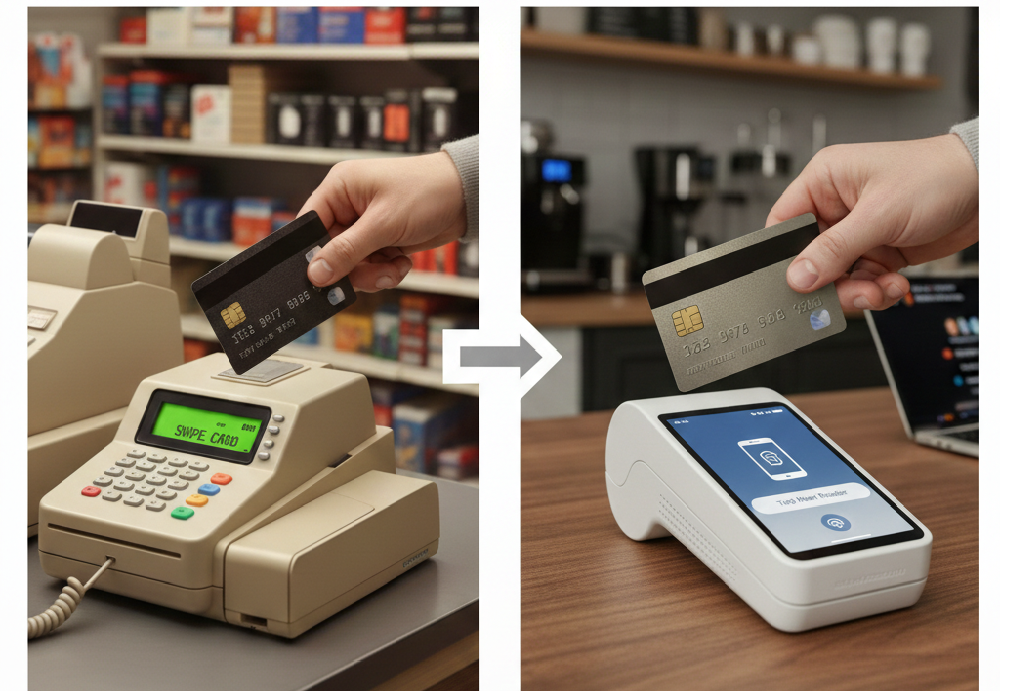
EMV is a globally recognized standard for secure card payments that emerged from a collaboration between Europay, Mastercard, and Visa in the 1990s. The main objective of EMV was to replace magnetic stripe cards, which are highly vulnerable to fraud, with chip-based cards that store encrypted data securely within a microprocessor chip. The adoption of EMV technology has been pivotal in reducing fraud, enhancing payment security, and enabling seamless transactions across multiple countries and card networks.
Unlike magnetic stripe cards that store unencrypted data easily copied by fraudsters, EMV cards rely on sophisticated cryptographic algorithms that generate unique transaction codes for every payment, making it virtually impossible to clone or manipulate the card. EMV also supports contactless payments via Near Field Communication (NFC) technology, allowing consumers to tap their cards or mobile devices to complete a transaction securely and quickly.
Understanding EMV Levels: L1, L2, L3
EMV certification is divided into three levels, each focusing on a different aspect of a payment device’s ability to process secure transactions effectively. These levels are designed to validate hardware reliability, software integrity, and end-to-end transactional accuracy.
EMV Level 1 (L1) – Hardware Layer
EMV Level 1 certification primarily focuses on the physical and electrical functionality of the payment device. This stage ensures that the device can communicate properly with EMV cards, both contact and contactless, under a variety of operating conditions. During L1 testing, evaluators check whether the card is correctly powered, detected, and read by the terminal.
For contact cards, this involves testing electrical signaling and chip communication to guarantee that the card and terminal exchange data reliably. For contactless cards or NFC-enabled devices, the evaluation confirms that radio-frequency communication is stable, the card can be detected accurately, and the chip receives proper power to initiate secure transactions. Additional tests verify that the device can handle multiple types of card insertion, removal, and tap interactions without errors or interruptions.
Example: A POS terminal undergoing L1 certification must accurately recognize and power a Visa contactless card, establish communication with the chip, and respond immediately with no errors. If the hardware fails this test, the terminal cannot reliably process any transactions, making L1 certification the foundation of EMV compliance.
EMV Level 2 (L2) – Kernel Software Layer
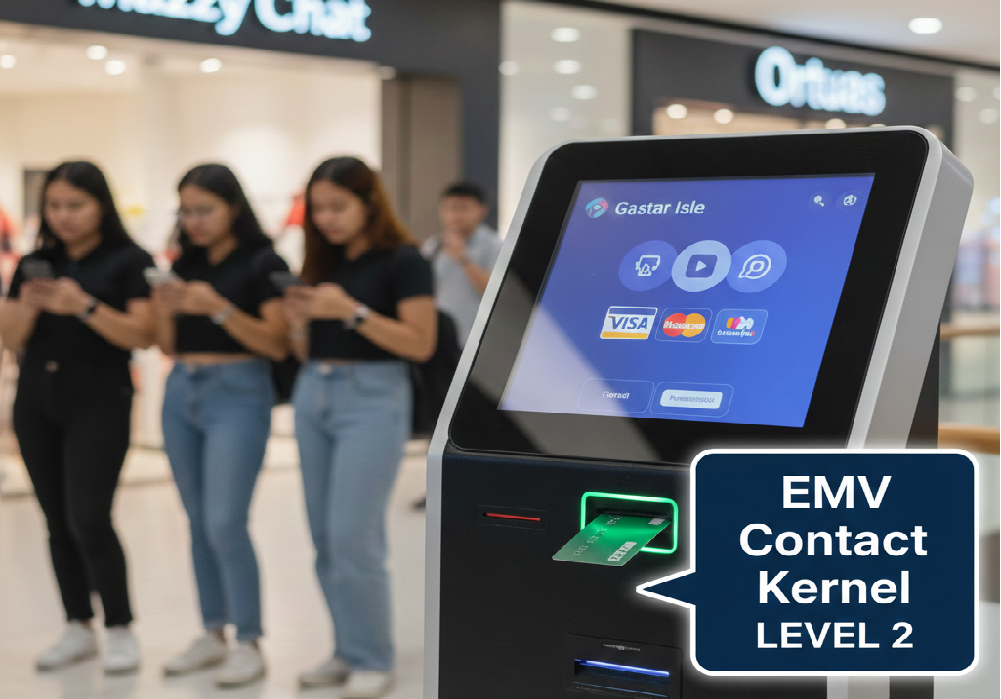
EMV Level 2 certification evaluates the software layer of the payment device, commonly referred to as the EMV Kernel. This layer acts as the “brain” of the terminal, interpreting card data, executing transaction rules, and interacting with multiple card schemes. L2 ensures that the terminal can process chip and contactless transactions securely and correctly according to EMV specifications.
The EMV Kernel performs several critical functions: reading the card, authenticating the cardholder via PIN or signature, applying transaction rules, supporting multiple schemes, and ensuring the integrity of the transaction flow. L2 testing confirms that these functions operate reliably across a variety of scenarios, including different card types, transaction amounts, and network conditions.
Example: When a Mastercard chip card is inserted, the L2 kernel must validate the card, authenticate the cardholder, and determine whether the transaction should be approved or declined. In devices such as payment Soundboxes or SoftPOS applications, L2 certification is crucial to ensure that embedded software handles real-world transaction scenarios securely and consistently.
EMV Level 3 (L3) – End-to-End Transaction Layer
EMV Level 3 certification is the final stage and ensures that the entire transaction lifecycle works seamlessly. This includes communication between the payment device, the acquiring bank, the card network, and the issuing bank. L3 testing validates that transactions are approved or declined correctly and that all error scenarios are handled accurately.
The scope of L3 includes end-to-end transaction processing, including approvals, declines, insufficient funds, PIN errors, network failures, and other exceptions. Devices are tested in real-world conditions to confirm interoperability across Visa, Mastercard, RuPay, and other major schemes.
Example: When a RuPay card is tapped on a terminal, L3 certification ensures that the transaction is processed in real time, the authorization response is received correctly from the issuing bank, and the terminal produces the appropriate receipt or error message. L3 certification builds confidence among merchants, consumers, and financial institutions, ensuring reliable and secure payment experiences.
Why EMV Levels Matter to Stakeholders
Understanding the importance of EMV certification is critical for stakeholders who may not be technically inclined but are responsible for business decisions. L1 certification guarantees that the hardware functions correctly, preventing transaction failures caused by faulty card readers or poor contactless interfaces. L2 certification ensures that the software kernel correctly interprets card data, enforces transaction rules, and supports multi-scheme payments, which reduces errors and enhances customer satisfaction. L3 certification confirms that the end-to-end transaction process works reliably, ensuring smooth authorization and error handling.
For stakeholders, EMV compliance has tangible business benefits: certified devices can be deployed globally without compatibility concerns, mitigate fraud risks, ensure uninterrupted transaction processing, and accelerate return on investment by reducing downtime or deployment delays. In essence, investing in fully certified EMV devices safeguards merchants, builds customer trust, and ensures compliance with international payment standards.
Real-World Use Cases
Retail POS Terminals: EMV-certified POS terminals allow merchants to accept both chip and contactless card payments with complete confidence. This enables a seamless checkout experience for customers and significantly reduces the risk of fraud or declined transactions.
ATMs: Level 1 certification ensures that ATMs detect and read EMV chip cards reliably. Level 2 validates transaction logic, such as withdrawals, balance inquiries, and fund transfers. Level 3 ensures that the full end-to-end transaction, including communication with issuing banks, functions correctly.
SoftPOS and Payment Soundboxes: These mobile and handheld devices integrate EMV L2 kernels, allowing secure transactions through smartphones or dedicated soundbox devices. L3 certification ensures that the transaction authorizations occur in real time, providing merchants and customers with immediate confirmation.
Public Transport and Ticketing (NCMC): Terminals used for transportation, such as ticketing machines, undergo L1 testing for accurate card detection, L2 kernel validation for fare calculation and transaction logic, and L3 testing for end-to-end integration with banks and transport operators. This ensures passengers can tap cards seamlessly without delays or errors.
How EMV Certification is Performed
L1 Testing: Evaluators test the terminal’s electrical and contactless interfaces to ensure cards are detected and powered properly. This includes verifying the chip connection, NFC communication, and physical reliability of the reader.
L2 Testing: The EMV kernel is rigorously evaluated using multiple card schemes and transaction types. Tests include card authentication, PIN verification, transaction processing, and compliance with EMV specifications.
L3 Testing: Real-world end-to-end transactions are performed with acquiring banks to validate approvals, declines, and error handling. L3 testing ensures interoperability with Visa, Mastercard, RuPay, and other networks, confirming that the terminal can handle transactions under actual operating conditions.
Challenges: Terminal manufacturers often face challenges such as network variations, differences in card types, and software updates during certification. To address this, pre-certification testing, lab simulations, and iterative kernel adjustments are performed.
Common Issues and Troubleshooting
- L1 Hardware Failures: Terminals may fail to detect cards due to improper chip reader calibration or NFC antenna issues.
- L2 Kernel Issues: Misconfigurations in the kernel can cause transaction errors, such as incorrect cardholder verification or EMV rule application failures.
- L3 Transaction Errors: Network delays, inconsistent authorization messages, or misinterpretation of response codes can cause transaction failures.
Tips: Regular firmware updates, testing across multiple card schemes, and pre-certification validation help mitigate common issues.
Future Trends in EMV
- Wearable Devices: Smartwatches, rings, and other wearable devices are increasingly supporting EMV contactless transactions.
- SoftPOS Adoption: Smartphones are emerging as terminals for secure payments, particularly in developing markets.
- CBDCs and Digital Currencies: Central bank digital currencies will integrate EMV compliance to ensure secure, standardized transactions.
- AI Fraud Detection: Machine learning and AI are being incorporated into EMV terminals to detect fraudulent patterns in real time.
EMV L1, L2, and L3 certification ensures that payment devices are secure, reliable, and globally accepted. L1 verifies hardware reliability, L2 validates software kernel operations, and L3 confirms end-to-end transaction integrity. For non-technical stakeholders, understanding these levels is crucial for making informed decisions about device deployment, merchant trust, and regulatory compliance.