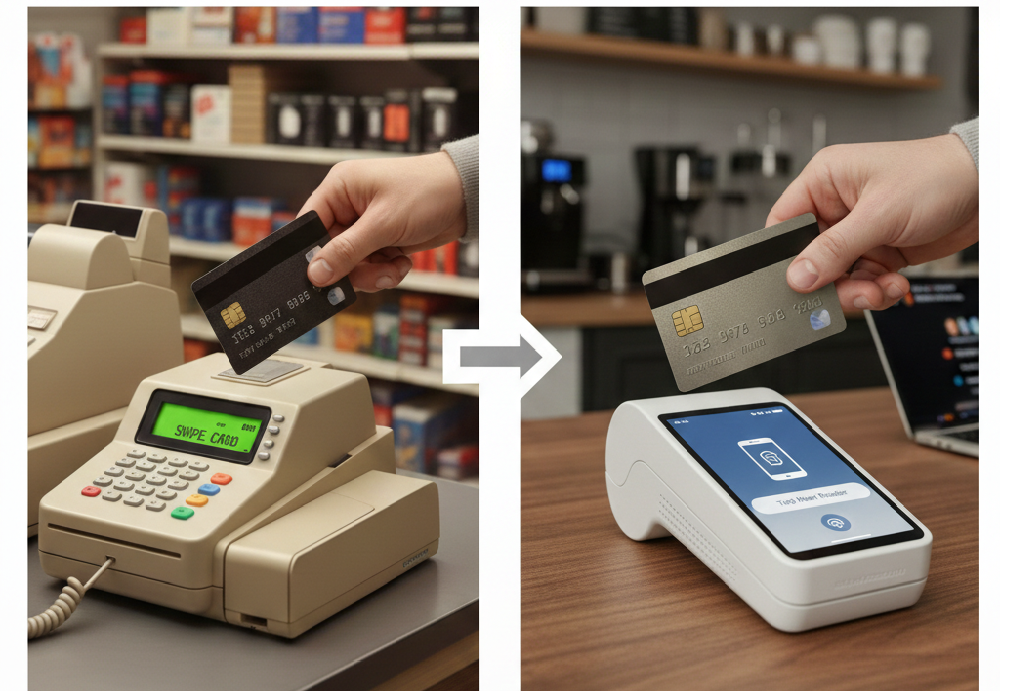
The global payment industry has undergone one of the most significant technological transformations in modern financial history. What began as a simple magnetic stripe card system in the mid-20th century has evolved into a highly secure, cryptography-driven ecosystem powered by EMV chip technology, contactless payments, mobile wallets, and software-based acceptance models. This evolution was not driven by innovation alone, but by necessity specifically, the growing threat of payment fraud, increasing transaction volumes, and the demand for secure, interoperable, and globally standardized payment systems.
The migration from magstripe cards to EMV chip cards represents a fundamental shift in how payment security is designed and enforced. Rather than relying solely on backend authorization systems, EMV introduced intelligence and cryptographic security directly into the card and terminal, fundamentally changing the trust model of card payments. Understanding how and why this migration occurred is critical for banks, fintech’s, payment service providers, terminal manufacturers, and merchants operating in today’s digital payment ecosystem.
The Magstripe Era: The Foundation of Global Card Payments
Origins of Magnetic Stripe Technology
Magnetic stripe technology was introduced in the late 1960s and became the backbone of card payments for several decades. The simplicity of magstripe cards allowed banks to issue payment cards at scale and merchants to accept electronic payments using relatively inexpensive terminals. Data such as the card number, expiration date, and service codes were encoded on a magnetic strip and read by swiping the card through a terminal.
At the time, this technology represented a major advancement over cash-based transactions, enabling faster checkout, electronic authorization, and centralized transaction processing. Magstripe cards enabled the global expansion of credit and debit card networks and laid the groundwork for modern digital payments.
How Magstripe Transactions Work
In a magstripe transaction, the cardholder swipes the card through a reader, which captures static card data stored on the magnetic strip. This data is transmitted through the acquiring bank and payment network to the issuing bank for authorization. If the card data matches issuer records and passes basic risk checks, the transaction is approved.
The critical limitation of this model lies in the static nature of the data. Every transaction uses the same card information, meaning that if the data is copied or intercepted, it can be reused indefinitely without detection at the card level.
Security Limitations of Magstripe Cards
While magstripe technology enabled global card adoption, it was never designed to combat sophisticated fraud. The absence of encryption, dynamic authentication, or card-level intelligence made magstripe cards highly vulnerable to skimming, cloning, and counterfeit fraud.
Fraudsters could easily capture card data using compromised terminals, skimming devices, or data breaches and create duplicate cards that worked exactly like the original. As transaction volumes increased and fraud techniques became more advanced, the weaknesses of magstripe technology became impossible to ignore.
The Rise of Card Fraud and the Need for Change
Growing Fraud Costs and Operational Risk
By the 1990s and early 2000s, counterfeit card fraud had become a major financial burden for banks and payment networks. Fraud losses were escalating rapidly, especially in regions with high card usage and limited cardholder verification mechanisms. Backend fraud detection systems were no longer sufficient to prevent losses caused by cloned cards.
Merchants, banks, and networks needed a solution that could prevent fraud at the point of transaction, rather than detecting it after the fact. This shift in thinking marked the beginning of a new era in payment security.
Limitations of Backend-Only Security Models
Traditional magstripe security relied heavily on backend authorization systems, velocity checks, and manual fraud monitoring. While these methods could detect suspicious patterns, they could not reliably distinguish between legitimate and counterfeit cards during a transaction.
The industry recognized that true fraud prevention required secure authentication at the card and terminal level, not just at the issuer backend. This realization set the stage for the development of EMV technology.
The Birth of EMV: A Global Security Standard
What Is EMV?
EMV stands for Europay, Mastercard, and Visa—the three organizations that collaborated in the mid-1990s to create a global standard for secure card payments. The goal of EMV was to define a common framework for chip-based card transactions that could be adopted worldwide, reducing fraud while maintaining interoperability across markets.
Over time, EMV standards were adopted and governed by EMVCo, with participation from major global payment networks including Visa, Mastercard, American Express, Discover, JCB, and UnionPay.
Core Objectives of EMV
EMV was designed to achieve several critical objectives:
- Prevent counterfeit card fraud by eliminating static card data
- Introduce cryptographic security at the card level
- Enable both online and offline authentication
- Standardize secure payment acceptance globally
- Support future innovations such as contactless and mobile payments
These objectives fundamentally changed how payment security was implemented across the ecosystem.
EMV Chip Technology: How It Works
The EMV Microprocessor
Unlike magstripe cards, EMV cards contain a secure microprocessor chip capable of performing cryptographic operations. This chip acts as a secure computing environment that validates transactions, authenticates itself to the terminal, and generates unique transaction data for every payment.
The chip securely stores cryptographic keys and sensitive card data in tamper-resistant memory, making it extremely difficult to extract or replicate.
Dynamic Data Authentication
One of the most important innovations introduced by EMV is dynamic data authentication. Instead of transmitting static card information, the EMV chip generates a unique cryptographic value for each transaction. This value cannot be reused, even if intercepted.
As a result, cloned cards created using stolen data are automatically rejected, because they cannot generate valid cryptographic responses.
EMV Transaction Flow
During an EMV transaction, the terminal and card engage in a secure dialogue. The terminal reads application data, selects the appropriate EMV application, and requests cryptographic authentication from the card. The card validates the transaction parameters and generates a cryptogram, which is sent to the issuer for authorization.
This process ensures that both the card and the terminal are genuine and that the transaction has not been tampered with.
EMV Authentication Methods
EMV supports multiple cardholder verification and authentication methods, allowing flexibility across markets and use cases.
Offline data authentication methods allow terminals to verify card authenticity without contacting the issuer, while online authentication methods involve real-time issuer validation. Cardholder verification methods such as PIN entry further enhance security by ensuring that the person using the card is authorized.
This layered security approach significantly reduces fraud compared to magstripe transactions.
Global EMV Migration and the Liability Shift
Early Adoption in High-Fraud Markets
Europe was one of the earliest adopters of EMV technology, driven by high levels of counterfeit fraud. Countries such as the UK, France, and Germany rolled out chip-and-PIN systems in the early 2000s, resulting in dramatic reductions in card-present fraud.
Other regions followed gradually, with adoption timelines influenced by fraud levels, regulatory pressure, and infrastructure readiness.
The EMV Liability Shift
A major turning point in global EMV adoption was the introduction of the EMV liability shift by card networks. Under this policy, liability for counterfeit fraud shifts to the party that has not adopted EMV technology.
If a merchant uses a magstripe-only terminal while the card issuer has issued an EMV card, the merchant becomes liable for fraud losses. This financial incentive accelerated terminal upgrades and chip card issuance worldwide.
Impact on Merchants and Banks
The liability shift forced merchants to invest in EMV-compliant terminals and encouraged banks to reissue cards with chips. While the transition required upfront investment, the long-term reduction in fraud losses justified the cost for most stakeholders.
Evolution of Payment Terminals and Infrastructure
EMV Certification Requirements
EMV migration required significant changes to payment terminals and backend systems. Terminals had to comply with multiple levels of EMV certification, including hardware compliance, kernel implementation, and end-to-end transaction testing.
This complexity created demand for specialized expertise in EMV kernel development, certification testing, and scheme compliance.
Role of EMV Kernels
The kernel is the EMV software component that implements EMV transaction logic within a payment terminal or device. It manages application selection, risk management, cryptographic processing, and communication with the issuer.
High-quality kernel implementation is critical for transaction security, performance, and certification success.
From Chip & PIN to Contactless EMV
The Natural Next Step
Once EMV chips became standard, the industry began integrating Near Field Communication (NFC) technology to enable contactless payments. Contactless EMV uses the same cryptographic principles as contact EMV, but with faster transaction times and improved convenience.
Benefits of Contactless Payments
Contactless EMV transactions reduce checkout time, minimize physical contact, and support low-value transactions without PIN entry. These benefits drove rapid adoption in retail, transit, and quick-service environments.
EMV in the Mobile and SoftPOS Era
Mobile Wallets and Tokenization
EMV technology extended beyond plastic cards into mobile wallets such as Apple Pay and Google Pay. These solutions use EMV-based tokenization and secure elements to protect card data while enabling seamless mobile payments.
SoftPOS and Tap-on-Phone
The latest evolution of EMV is software-based payment acceptance, where smartphones themselves act as payment terminals. SoftPOS and Tap-on-Phone solutions rely on EMV contactless specifications, trusted execution environments, and PCI MPoC standards to ensure security.
This evolution demonstrates how EMV continues to adapt to new form factors and use cases.
Why Magstripe Still Exists (and Why It’s Disappearing)
Despite its limitations, magstripe technology still exists in some regions for backward compatibility. However, many countries are disabling magstripe functionality entirely due to fraud risks.
As global EMV adoption increases and digital payments expand, magstripe usage continues to decline and is expected to be phased out entirely in the coming years.
EMV as a Turning Point in Payment Security
The migration from magstripe to EMV chip technology was inevitable. Static data could no longer support a rapidly growing, globally connected payment ecosystem. EMV introduced dynamic authentication, cryptographic security, and standardized global trust, fundamentally redefining how payments are secured.
As the payment industry continues to evolve toward contactless, mobile, and software-defined acceptance, EMV remains at the core of innovation. Understanding this evolution is essential for any organization involved in payment technology today.